| 🤓 Admin Zone 🛠️ hidden to non-admins | |
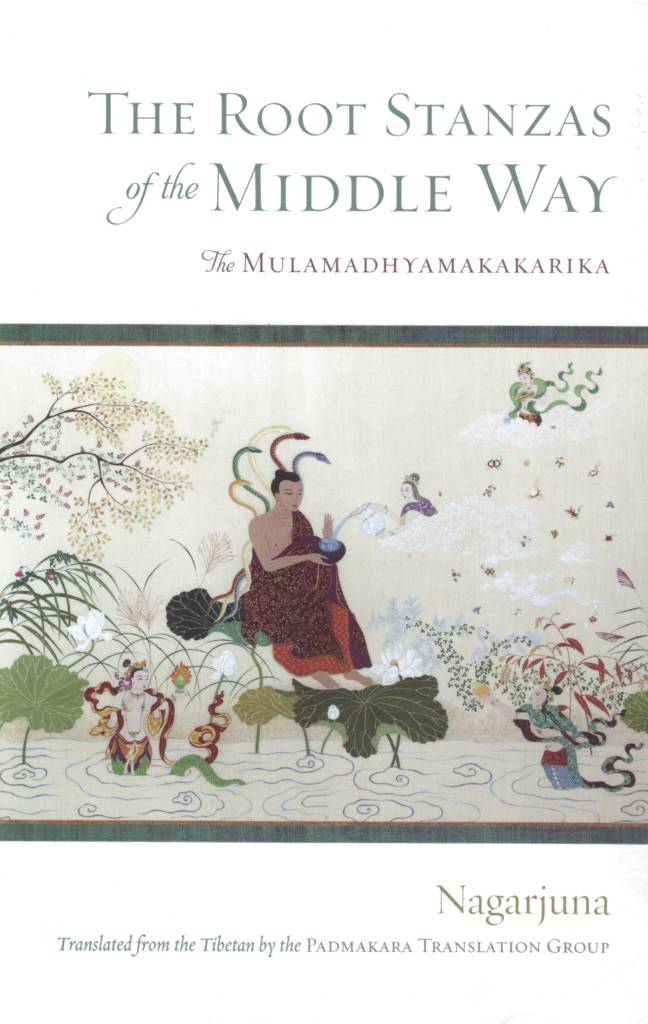
The Root Stanzas of the Middle Way: The Mulamadhyamakakarika
Book
Please note that many items in our library are simply pages that represent a detailed library catalog entry and citation of someone else's work, presentation, or performance. Read our General Disclaimer for more information. You can find more information about this item on the publisher website.

Description
This volume presents a new English translation of the founding text of the Madhyamaka (Middle Way) school of Mahayana Buddhism, Nagarjuna’s Root Stanzas of the Middle Way, and includes the Tibetan version of the text. The Root Stanzas holds an honored place in all branches of Tibetan Buddhism, as well as in the Buddhist traditions found in China, Japan, and Korea, because of the way it develops the seminal view of emptiness (shunyata), which is crucial to understanding Mahayana Buddhism and central to its practice. It is prized for its pithy and pointed arguments that show that things lack intrinsic being and thus are “empty” (shunya). They abide in the Middle Way, free from the extremes of permanence and annihilation.
Citation
Blankleder, Helena, and Wulstan Fletcher (Padmakara Translation Group), trans. The Root Stanzas of the Middle Way: The Mulamadhyamakakarika. By Nāgārjuna. Boulder, CO: Shambhala Publications, 2016.
Publisher Link
Table of contents
- Translators' Prefacexv
- The Root Stanzas of the Middle Way1
- Homage2
- 1. An Examination of Conditions3
- 2. An Examination of Motion7
- 3. An Examination of the Sense Powers13
- 4. An Examination of the Aggregates15
- 5. An Examination of the Elements17
- 6. An Examination of Desire and the Desirous19
- 7. An Examination of Arising, Abiding, and Decay21
- 8. An Examination of Agent and Action27
- 9. An Examination of the Foregoing Entity31
- 10. An Examination of Fire and Fuel35
- 11. An Examination of Earlier and Later Limits39
- 12. An Examination of Self-Production and Other-Production41
- 13. An Examination of Compounded Things43
- 14. An Examination of Contact45
- 15. An Examination of Intrinsic Being47
- 16. An Examination of Bondage and Release from Bondage51
- 17. An Examination of Action53
- 18. An Examination of the Self and Phenomena59
- 19. An Examination of Time63
- 20. An Examination of the Confluence of Causes and Conditions65
- 21. An Examination of Arising and Destruction71
- 22. An Examination of the Tathagata75
- 23. An Examination of Mistakes79
- 24. An Examination of the Truths of the Aryas85
- 25. An Examination of Nirvana93
- 26. An Examination of the Twelve Links of Existence99
- 27. An Examination of Views103
- Concluding Homage109
- Colophon111
- The Tibetan Text113
- Notes171
- Bibliography175
Interconnections
1 Full translation of

Mūlamadhyamakakārikā. (T. Dbu ma rtsa bai tshig le'u byas pa; C. Zhong lun; J. Chüron; K. Chung non 中論). In Sanskrit, "Root Verses on the Middle Way"; the magnum opus of the second-century Indian master Nāgārjuna ; also known as the Prajñānāmamūlamadhyamakakārikā and the Madhyamakaśāstra. (The Chinese analogue of this text is the Zhong lun, which renders the title as Madhyamakaśāstra. This Chinese version was edited and translated by Kumārajīva . Kumārajīva's edition, however, includes not only Nāgārjuna's verses but also Piṅgala's commentary to the verses.) The most widely cited and commented upon of Nāgārjuna's works in India, the Mūlamadhyamakakārikā, was the subject of detailed commentaries by such figures as Buddhapālita, Bhāvaviveka, and Candrakīrti (with Candrakīrti's critique of Bhāvaviveka's criticism of a passage in Buddhapālita's commentary providing the locus classicus for the later Tibetan division of Madhyamaka into *Svātantrika and *Prāsaṅgika). In East Asia, it was one of the three basic texts of the "Three Treatises" school (C. San lun zong), and was central to Tiantai philosophy. Although lost in the original Sanskrit as an independent work, the entire work is preserved within the Sanskrit text of Candrakīrti's commentary, the Prasannapadā (serving as one reason for the influence of Candrakīrti's commentary in the European reception of the Mūlamadhyamakakārikā). The work is composed of 448 verses in twenty-seven chapters. The topics of the chapters (as provided by Candrakīrti) are the analysis of: (1) conditions (pratyaya), (2) motion, (3) the eye and the other sense faculties (indriya), (4) aggregates (skandha), (5) elements (dhātu), (6) passion and the passionate, (7) the conditioned (in the sense of production, abiding, disintegration), (8) action and agent, (9) prior existence, (10) fire and fuel, (11) the past and future limits of saṃsāra, (12) suffering, (13) the conditioned (saṃskāra), (14) contact (saṃsarga), (15) intrinsic nature (svabhāva), (16) bondage and liberation, (17) action and effect, (18) self, (19) time, (20) assemblage (sāmagrī), (21) arising and dissolving, (22) the tathāgata, (23) error, (24) the four noble truths, (25) nirvāṇa, (26), the twelve links of dependent origination (pratītyasamutpāda), and (27) views. (Source: "Mūlamadhyamakakārikā." In The Princeton Dictionary of Buddhism, 553. Princeton University Press, 2014. http://www.jstor.org/stable/j.ctt46n41q.27.)