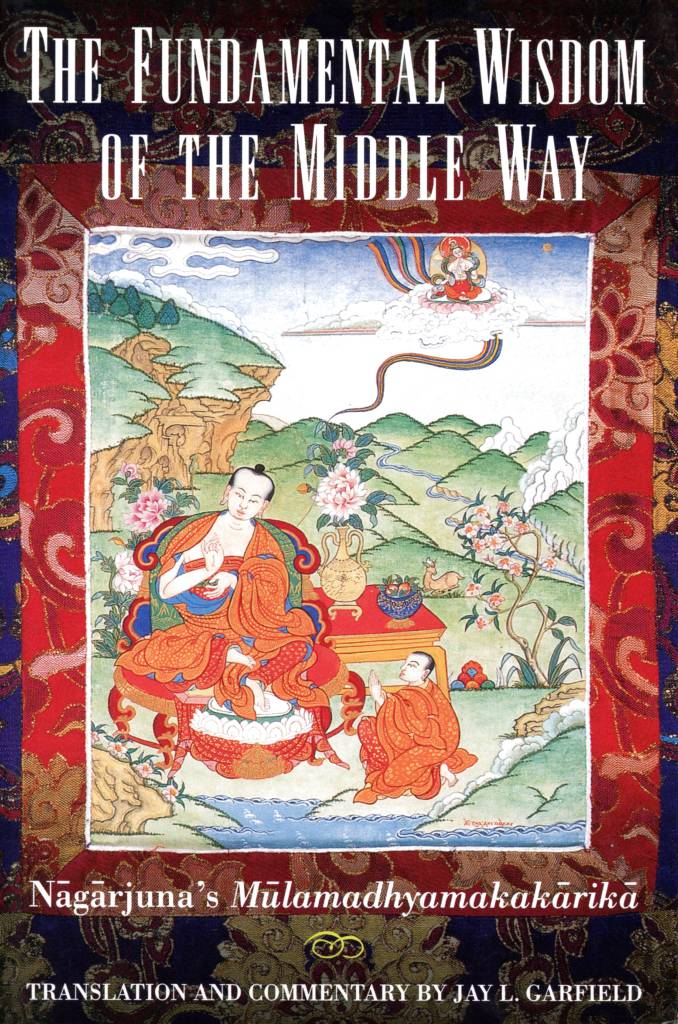
The Fundamental Wisdom of the Middle Way

From Bodhicitta
LibraryBooksThe Fundamental Wisdom of the Middle Way
< Books
Books/The Fundamental Wisdom of the Middle Way

The Fundamental Wisdom of the Middle Way
Book


Please note that many items in our library are simply pages that represent a detailed library catalog entry and citation of someone else's work, presentation, or performance. Read our General Disclaimer for more information.
The Fundamental Wisdom of the Middle Way-front.jpg

Description

The Buddhist saint Nāgārjuna, who lived in South India in approximately the second century CE, is undoubtedly the most important, influential, and widely studied Mahāyāna Buddhist philosopher. His many works include texts addressed to lay audiences, letters of advice to kings, and a set of penetrating metaphysical and epistemological treatises. His greatest philosophical work, the Mūlamadhyamikakārikā--read and studied by philosophers in all major Buddhist schools of Tibet, China, Japan, and Korea--is one of the most influential works in the history of Indian philosophy. Now, in The Fundamental Wisdom of the Middle Way, Jay L. Garfield provides a clear and eminently readable translation of Nāgārjuna's seminal work, offering those with little or no prior knowledge of Buddhist philosophy a view into the profound logic of the Mūlamadhyamikakārikā.

Garfield presents a superb translation of the Tibetan text of Mūlamadhyamikakārikā in its entirety, and a commentary reflecting the Tibetan tradition through which Nāgārjuna's philosophical influence has largely been transmitted. Illuminating the systematic character of Nāgārjuna's reasoning, Garfield shows how Nāgārjuna develops his doctrine that all phenomena are empty of inherent existence, that is, than nothing exists substantially or independently. Despite lacking any essence, he argues, phenomena nonetheless exist conventionally, and that indeed conventional existence and ultimate emptiness are in fact the same thing. This represents the radical understanding of the Buddhist doctrine of the two truths, or two levels of reality. He offers a verse-by-verse commentary that explains Nāgārjuna's positions and arguments in the language of Western metaphysics and epistemology, and connects Nāgārjuna's concerns to those of Western philosophers such as Sextus, Hume, and Wittgenstein. An accessible translation of the foundational text for all Mahāyāna Buddhism, The Fundamental Wisdom of the Middle Way offers insight to all those interested in the nature of reality. (Source: Oxford University Press)

Citation
Garfield, Jay L. trans. The Fundamental Wisdom of the Middle Way: Nāgārjuna's Mūlamadhyamakakārikā. New York: Oxford University Press, 1995.
Texts Translated


Translation of

 
Prajñānāmamūlamadhyamakakārikā
Mūlamadhyamakakārikā. (T. Dbu ma rtsa bai tshig le'u byas pa; C. Zhong lun; J. Chüron; K. Chung non 中論). In Sanskrit, "Root Verses on the Middle Way"; the magnum opus of the second-century Indian master Nāgārjuna ; also known as the Prajñānāmamūlamadhyamakakārikā and the Madhyamakaśāstra. (The Chinese analogue of this text is the Zhong lun, which renders the title as Madhyamakaśāstra. This Chinese version was edited and translated by Kumārajīva . Kumārajīva's edition, however, includes not only Nāgārjuna's verses but also Piṅgala's commentary to the verses.) The most widely cited and commented upon of Nāgārjuna's works in India, the Mūlamadhyamakakārikā, was the subject of detailed commentaries by such figures as Buddhapālita, Bhāvaviveka, and Candrakīrti (with Candrakīrti's critique of Bhāvaviveka's criticism of a passage in Buddhapālita's commentary providing the locus classicus for the later Tibetan division of Madhyamaka into *Svātantrika and *Prāsaṅgika). In East Asia, it was one of the three basic texts of the "Three Treatises" school (C. San lun zong), and was central to Tiantai philosophy. Although lost in the original Sanskrit as an independent work, the entire work is preserved within the Sanskrit text of Candrakīrti's commentary, the Prasannapadā (serving as one reason for the influence of Candrakīrti's commentary in the European reception of the Mūlamadhyamakakārikā). The work is composed of 448 verses in twenty-seven chapters. The topics of the chapters (as provided by Candrakīrti) are the analysis of: (1) conditions (pratyaya), (2) motion, (3) the eye and the other sense faculties (indriya), (4) aggregates (skandha), (5) elements (dhātu), (6) passion and the passionate, (7) the conditioned (in the sense of production, abiding, disintegration), (8) action and agent, (9) prior existence, (10) fire and fuel, (11) the past and future limits of saṃsāra, (12) suffering, (13) the conditioned (saṃskāra), (14) contact (saṃsarga), (15) intrinsic nature (svabhāva), (16) bondage and liberation, (17) action and effect, (18) self, (19) time, (20) assemblage (sāmagrī), (21) arising and dissolving, (22) the tathāgata, (23) error, (24) the four noble truths, (25) nirvāṇa, (26), the twelve links of dependent origination (pratītyasamutpāda), and (27) views. (Source: "Mūlamadhyamakakārikā." In The Princeton Dictionary of Buddhism, 553. Princeton University Press, 2014. http://www.jstor.org/stable/j.ctt46n41q.27.)
Text

Scholarship on

 
Prajñānāmamūlamadhyamakakārikā
Mūlamadhyamakakārikā. (T. Dbu ma rtsa bai tshig le'u byas pa; C. Zhong lun; J. Chüron; K. Chung non 中論). In Sanskrit, "Root Verses on the Middle Way"; the magnum opus of the second-century Indian master Nāgārjuna ; also known as the Prajñānāmamūlamadhyamakakārikā and the Madhyamakaśāstra. (The Chinese analogue of this text is the Zhong lun, which renders the title as Madhyamakaśāstra. This Chinese version was edited and translated by Kumārajīva . Kumārajīva's edition, however, includes not only Nāgārjuna's verses but also Piṅgala's commentary to the verses.) The most widely cited and commented upon of Nāgārjuna's works in India, the Mūlamadhyamakakārikā, was the subject of detailed commentaries by such figures as Buddhapālita, Bhāvaviveka, and Candrakīrti (with Candrakīrti's critique of Bhāvaviveka's criticism of a passage in Buddhapālita's commentary providing the locus classicus for the later Tibetan division of Madhyamaka into *Svātantrika and *Prāsaṅgika). In East Asia, it was one of the three basic texts of the "Three Treatises" school (C. San lun zong), and was central to Tiantai philosophy. Although lost in the original Sanskrit as an independent work, the entire work is preserved within the Sanskrit text of Candrakīrti's commentary, the Prasannapadā (serving as one reason for the influence of Candrakīrti's commentary in the European reception of the Mūlamadhyamakakārikā). The work is composed of 448 verses in twenty-seven chapters. The topics of the chapters (as provided by Candrakīrti) are the analysis of: (1) conditions (pratyaya), (2) motion, (3) the eye and the other sense faculties (indriya), (4) aggregates (skandha), (5) elements (dhātu), (6) passion and the passionate, (7) the conditioned (in the sense of production, abiding, disintegration), (8) action and agent, (9) prior existence, (10) fire and fuel, (11) the past and future limits of saṃsāra, (12) suffering, (13) the conditioned (saṃskāra), (14) contact (saṃsarga), (15) intrinsic nature (svabhāva), (16) bondage and liberation, (17) action and effect, (18) self, (19) time, (20) assemblage (sāmagrī), (21) arising and dissolving, (22) the tathāgata, (23) error, (24) the four noble truths, (25) nirvāṇa, (26), the twelve links of dependent origination (pratītyasamutpāda), and (27) views. (Source: "Mūlamadhyamakakārikā." In The Princeton Dictionary of Buddhism, 553. Princeton University Press, 2014. http://www.jstor.org/stable/j.ctt46n41q.27.)
Text

  • Preface, vii
  • Acknowledgments, xi
  • Part One
    The Text of Mūlamadhyamakakārikā
    • Dedicatory Verses, 2
    • I Examination of Conditions, 3
    • II Examination of Motion, 6
    • III Examination of the Senses, 10
    • IV Examination of the Aggregates, 12
    • V Examination of Elements, 14
    • VI Examination of Desire and the Desirous, 16
    • VII Examination of the Conditioned, 18
    • VIII Examination of the Agent and Action, 23
    • IX Examination of the Prior Entity, 26
    • X Examination of Fire and Fuel, 28
    • XI Examination of the Initial and Final Limits, 31
    • XII Examination of Suffering, 33
    • XIII Examination of Compounded Phenomena, 35
    • XIV Examination of Connection, 37
    • XV Examination of Essence, 39
    • XVI Examination of Bondage, 41
    • XVII Examination of Actions and Their Fruits, 43
    • XVIII Examination of Self and Entities, 48
    • XIX Examination of Time, 50
    • XX Examination of Combination, 52
    • XXI Examination of Becoming and Destruction, 56
    • XXII Examination of the Tathāgata, 60
    • XXIII Examination of Errors, 63
    • XXIV Examination of the Four Noble Truths, 67
    • XXV Examination of Nirvaāṇa, 73
    • XXVI Examination of The Twelve Links, 77
    • XXVII Examination of Views, 79
  • Part Two
    The Text and Commentary
    • Introduction to the Commentary, 87
    • Dedicatory Verses, 100
    • Examination of Conditions, 103
    • II Examination of Motion, 124
    • III Examination of the Senses, 136
    • IV Examination of the Aggregates, 142
    • V Examination of Elements, 149
    • VI Examination of Desire and the Desirous, 153
    • VII Examination of the Conditioned, 159
    • VIII Examination of the Agent and Action, 178
    • IX Examination of the Prior Entity, 183
    • X Examination of Fire and Fuel, 189
    • XI Examination of the Initial and Final Limits, 196
    • XII Examination of Suffering, 202
    • XIII Examination of Compounded Phenomena, 207
    • XIV Examination of Connection, 216
    • XV Examination of Essence, 220
    • XVI Examination of Bondage, 225
    • XVII Examination of Actions and Their Fruits, 231
    • XVIII Examination of Self and Entities, 245
    • XIX Examination of Time, 254
    • XX Examination of Combination, 258
    • XXI Examination of Becoming and Destruction, 267
    • XXII Examination of the Tathāgata, 275
    • XXIII Examination of Errors, 284
    • XXIV Examination of the Four Noble Truths, 293
    • XXV Examination of Nirvāṇa, 322
    • XXVI Examination of The Twelve Links, 335
    • XXVII Examination of Views, 342
  • References, 361
  • Index, 367