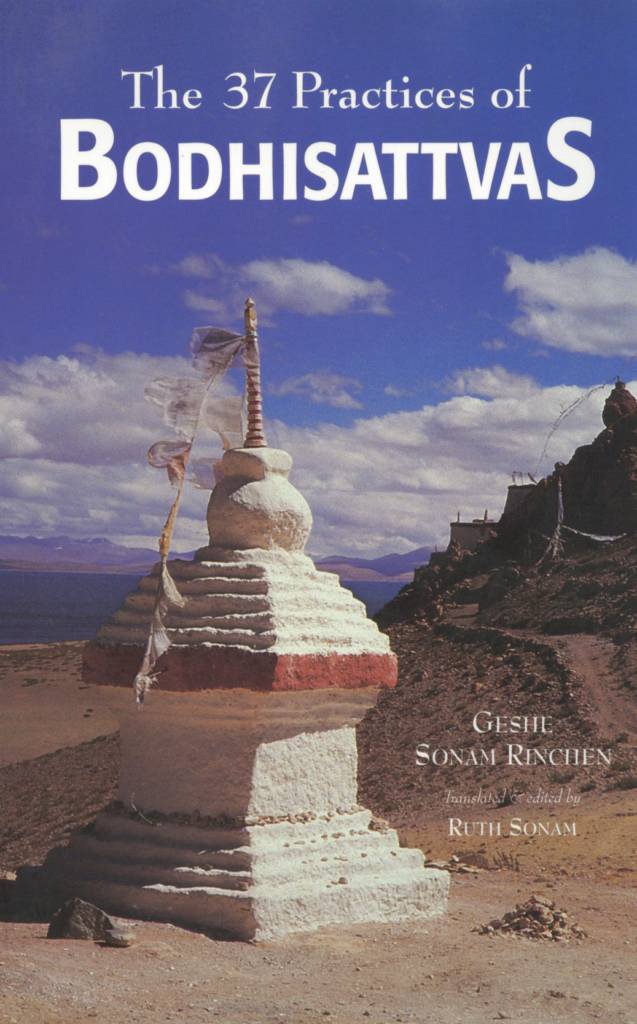
The 37 Practices of Bodhisattvas (Rinchen)
From Bodhicitta
< BooksBooks/The 37 Practices of Bodhisattvas (1997, Snow Lion)
| 🤓 Admin Zone 🛠️ hidden to non-admins | |
The 37 Practices of Bodhisattvas (Rinchen)
Book
Please note that many items in our library are simply pages that represent a detailed library catalog entry and citation of someone else's work, presentation, or performance. Read our General Disclaimer for more information.
-front.jpg)
Description
Recognizing their true potential and letting go of everything which could hinder them on their spiritual journey, Bodhisattvas entrust themselves to the path taught by the Buddha. Resisting disturbing emotions, they learn to respond to difficult situations in a constructive way. Fully understanding the nature of reality and the illusion-like nature of pleasure and pain, they overcome clinging attachment and aversion. In these ways Bodhisattvas come to cherish living beings as the source of all happiness and are ultimately able to work solely for the good of all.
Gyelsay Togmay Sangpo wrote The Thirty-seven Practices of Bodhisattvas in the fourteenth century. His succinct and simple verses of advice summarize the quintessence of the Mahayana path to perfection. Geshe Sonam Rinchen's oral teachings elucidate these practices for the modern reader and show how we can transform our actions, feelings and ways of thinking to become Bodhisattvas ourselves. (Source: Back Cover)
Citation
Rinchen, Sonam. The 37 Practices of Bodhisattvas. Translated and edited by Ruth Sonam. Ithaca, NY: Snow Lion Publications, 1997.
Table of contents
- Introduction7
- Prologue13
- 1 The Good Ship17
- 2 Leaving Home21
- 3 Letting Go25
- 4 Trusting31
- 5 Commitment37
- 6 Wish-fulfilling Jewels41
- 7 Transforming Trouble45
- 8 Dreams and Rainbows57
- 9 Training and Serving63
- 10 Beware71
- Conclusion77
- Dedication83
- Notes85
- Tibetan Names and Their Transliteration97
- Tibetan Commentaries99
- Tibetan Text101
Interconnections
1 Full translation of

Gyalse Tokme Zangpo's (1295–1369) highly influential work on Mind Training (blo sbyong) that outlines the training of a bodhisattva in a series of thirty-seven verses is still very popular today with Buddhist practitioners around the world. The colophon states: "This was composed at the Jewel Cave of Ngulchu by the monk Tokme [Zangpo], expounder of scripture and reasoning, for the benefit of myself and others." Since he gathered together all the paths of the bodhisattvas and composed them in the form of thirty-seven verses, the title is clearly fitting.
1 Teaching based on
Gyalse Tokme Zangpo's (1295–1369) highly influential work on Mind Training (blo sbyong) that outlines the training of a bodhisattva in a series of thirty-seven verses is still very popular today with Buddhist practitioners around the world. The colophon states: "This was composed at the Jewel Cave of Ngulchu by the monk Tokme [Zangpo], expounder of scripture and reasoning, for the benefit of myself and others." Since he gathered together all the paths of the bodhisattvas and composed them in the form of thirty-seven verses, the title is clearly fitting.