Questioning the Buddha

From Bodhicitta
< BooksBooks/Questioning the Buddha

🤓 Admin Zone 🛠️ hidden to non-admins
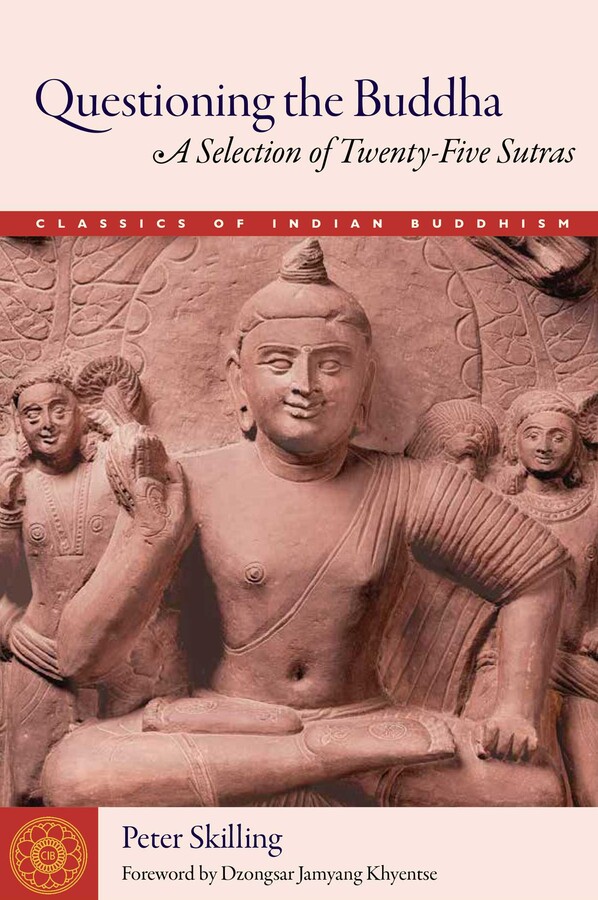
Questioning the Buddha: A Selection of Twenty-Five Sutras
Book


Please note that many items in our library are simply pages that represent a detailed library catalog entry and citation of someone else's work, presentation, or performance. Read our General Disclaimer for more information.
Questioning the Buddha-front.jpg

Description

In the forty-five years the Buddha spent traversing northern India, he shared his wisdom with everyone from beggar women to kings. Hundreds of his discourses, or sutras, were preserved by his followers, first orally and later in written form. Around thirteen hundred years after the Buddha’s enlightenment, the sutras were translated into the Tibetan language, where they have been preserved ever since. To date, only a fraction of these have been made available in English. Questioning the Buddha brings the reader directly into the literary treasure of the Tibetan canon with thoroughly annotated translations of twenty-five different sutras. Often these texts, many translated here in full for the first time, begin with an encounter in which someone poses a question to the Buddha.

Peter Skilling, an authority on early Buddhist epigraphy, archaeology, and textual traditions, has been immersed in the Buddhist scriptures of diverse traditions for nearly half a century. In this volume, he draws on his deep and extensive research to render these ancient teachings in a fresh and precise language. His introduction is a fascinating history of the Buddhist sutras, including the transition from oral to written form, the rise of Mahayana literature, the transmission to Tibet, the development of canons, and a look at some of the pioneers of sutra study in the West.

Sutras included in this volume are: Four Dharmas Not to Be Taken for Granted; The Benefits of Giving; The Exposition of Four Dharmas; The Merit of the Three Refuges; Four Dharmas Never to Be Abandoned; Advice for Bodhisatva Dharmaketu; Advice for Bodhisatva Jayamati; Sūtra Comparing Bodhicitta to Gold; Bodhisatva Maitreya’s Question about the Gift of the Dharma; Four Summaries of the Dharma Spoken to the Nāga King Sāgara; The Stanza of Dependent Arising; The Heart Formula of Dependent Arising; Prediction of the Boy Brahmaśrī’s Future Buddhahood; Kṣemavatī’s Prediction to Future Buddhahood; The City Beggar Woman; An Old Woman’s Questions about Birth and Death; The Questions of Śrīmatī the Brahman Woman; The Questions of the Laywoman Gaṅgottarā; Brahmā Sahāṃpati’s Question; Advice to King Prasenajit; Passage to the Next Life; Instructions for King Bimbisāra; Instructions for King Udayana; Buddhas as Rare as a Grain of Golden Sand; and Predictions on the Eve of the Great Final Nirvāṇa. (Source: Wisdom Experience)

Citation
Skilling, Peter, trans. Questioning the Buddha: A Selection of Twenty-Five Sutras. Classics of Indian Buddhism. Somerville, MA: Wisdom Publications, 2021.
Table of contents
  • Foreword by Dzongsar Jamyang Khyentsexi
  • Prefacexv
Introduction
  • 1. Prologue3
  • 2. Canon Formation11
  • 3. Vaitulya/Mahayana Dharmaparyas47
  • 4. In Praise of the Buddha67
  • 5. The Structure of This Book97
  • 6. Style and Content: The Tribulations of Translation143
  • 7. Reading the Dharmaparayayas153
The Translations
  • I. DOGMA, DHARMA, AND RITUAL
    • 1. Four Dharmas Not to Be Taken for Granted163
      • Caturdharmaka-sutra
    • 2. The Benefits of Giving171
      • Dananusamsanirdesa
    • 3. The Exposition of Four Dharmas181
      • Caturdharmanirdesa
    • 4. The Merit of the Three Refuges189
      • Trisaranagamana
    • 5. Four Dharmas Never to Be Abandoned199
      • Caturdharmaka-sutra
    • 6. Advice for Bodhisatva Dharmaketu207
      • Dharmaketu-sutra
    • 7. Advice for Bodhisatva Jayamati213
      • Jayamati-sutra
    • 8. Sūtra Comparing Bodhicitta to Gold221
      • Suvarna-sutra
    • 9. Bodhisatva Maitreya’s Question about the Gift of the Dharma227
      • Maitreya-pariprccha
    • 10. Four Summaries of the Dharma Spoken to the Nāga King Sāgara235
      • Sagaranagaraja-pariprccha
    • 11. The Stanza of Dependent Arising247
      • Pratityasamutpada-sutra
    • 12. The Heart Formula of Dependent Arising269
      • Pratityasamutpadahrdaya
  • II. MARVELOUS CHILDREN, WOMEN, AND GODS
    • 13. Prediction of the Boy Brahmaśrī’s Future Buddhahood277
      • Brahmasri-vyakarana
    • 14. Kṣemavatī’s Prediction to Future Buddhahood285
      • Ksemavati-vyakarana
    • 15. The City Beggar Woman297
      • Nagaravalambika-sutra
    • 16. An Old Woman’s Questions about Birth and Death315
      • Mahallika-pariprccha
    • 17. The Questions of Śrīmatī the Brahman Woman331
      • Srimatibrahmani-pariprccha
    • 18. The Questions of the Laywoman Gaṅgottarā341
      • Gangottara-pariprccha
    • 19. Brahmā Sahāṃpati’s Question353
      • Brahma-pariprccha
  • III. CONVERSATIONS WITH KINGS
    • 20. Advice to King Prasenajit373
      • Rajavavadaka-sutra
    • 21. Passage to the Next Life393
      • Bhavasamkranti
    • 22. Instructions for King Bimbisāra409
      • Rajadesa-sutra
    • 23. Instructions for King Udayana429
      • Rajadesa-sutra
  • IV. THE RANGE OF THE BUDDHAS
    • 24. Buddhas as Rare as a Grain of Golden Sand439
      • Suvarnabalukopama-sutra
    • 25. Predictions on the Eve of the Great Final Nirvāṇa451
      • Mahaparinirvanasutra
  • Appendixes
    • 1. Vacillations of Dating469
    • 2. Conventions481
    • 3. Tibetan Titles495
    • 4. Tibetan Concordances499
    • 5. Chinese Parallels505
  • Abbreviations509
  • Notes511
  • Bibliography585
  • Index642
  • About the Author655
Interconnections
8 Full translation of
Sutra portrait.jpg
Classical WorksAbout this item
In this short sūtra the Buddha explains that throughout one's life there are four beliefs one should not hold: (1) that there is pleasure to be found among women, (2) or at the royal court; (3) that happiness can be ensured by depending on health and attractiveness, (4) or on wealth and material possessions. (Source: 84000)
Jinamitra translator.jpg
Classical WorksAbout this item
Sutra of Advice to the King (Skt. Rājāvavādakasūtra; Tib. འཕགས་པ་རྒྱལ་པོ་ལ་དམས་པ་ཞེས་བྱ་བ་ཐེག་པ་ཆེན་པོའི་མདོ།, Wyl. 'phags pa rgyal po la gdams pa zhes bya ba theg pa chen po'i mdo) — The main topic of this sutra is impermanence. (Source: Rigpawiki)
Jinamitra translator.jpg
Classical WorksAbout this item
Heralded by a miraculous flood, the celestial bodhisattva Sāgaramati arrives in Rājagṛha to engage in a Dharma discussion with Buddha Śākyamuni. He discusses an absorption called "The Pristine and Immaculate Seal" and many other subjects relevant to bodhisattvas who are in the process of developing the mind of awakening and practicing the bodhisattva path. The sūtra strongly advises that bodhisattvas not shy away from the afflictive emotions of beings—no matter how unpleasant they may be—and that insight into these emotions is critical for a bodhisattva's compassionate activity. The sūtra deals with the preeminence of wisdom and non-grasping on the path. In the end, as a teaching on how to deal with māras, the sūtra illuminates the many pitfalls possible on the path of the Great Vehicle. (Source: 84000)
Jinamitra translator.jpg
Classical WorksAbout this item
The Questions of the Nāga King Sāgara begins with a miracle that portends the coming of the Nāga King Sāgara to Vulture Peak Mountain in Rājagṛha. The nāga king engages in a lengthy dialogue with the Buddha on various topics pertaining to the distinction between relative and ultimate reality, all of which emphasize the primacy of insight into emptiness. The Buddha thereafter journeys to King Sāgara's palace in the ocean and reveals details of the king’s past lives in order to introduce the inexhaustible casket dhāraṇī. In the nāga king's palace in the ocean, he gives teachings on various topics and acts as peacemaker, addressing the ongoing conflicts between the gods and asuras and between the nāgas and garuḍas. Upon returning to Vulture Peak, the Buddha engages in dialogue with King Ajātaśatru and provides Nāga King Sāgara's prophecy. (Source: 84000)
Jinamitra translator.jpg
Classical WorksAbout this item
The Questions of the Nāga King Sāgara presents a discourse given by the Buddha Śākyamuni on the importance of considering the effects caused by actions. At the start of his teaching, the Buddha remarks how the variety of forms that exist, and in fact all phenomena, come about as the result of virtuous and nonvirtuous actions. By understanding this law of cause and effect and by taking great care to engage in virtue, one will avoid rebirth in the lower realms and enter the path to perfect awakening. In the rest of his discourse he explains in great detail the advantages of engaging in each of the ten virtues and the problems associated with not engaging in them. (Source: 84000)
PNT Nanam Yeshe de.jpg
Classical WorksAbout this item
In this very short sūtra, the Buddha explains to a nāga king and an assembly of monks that reciting the four aphorisms of the Dharma is equivalent to recitation of all of the 84,000 articles of the Dharma. He urges them to make diligent efforts to engage in understanding the four aphorisms (also called the four seals), which are the defining philosophical tenets of the Buddhist doctrine: (1) all compounded phenomena are impermanent; (2) all contaminated phenomena are suffering; (3) all phenomena are without self; (4) nirvāṇa is peace. (Source: 84000)
PNT Nanam Yeshe de.jpg
Classical WorksAbout this item
While the Buddha is residing in the Realm of the Thirty-Three Gods with a retinue of deities, great hearers, and bodhisattvas, Avalokiteśvara asks the Buddha how beings can gain merit from building a stūpa. The Buddha responds by stating the Buddhist creed on dependent arising:
All phenomena that arise from causes,
The Tathāgata has taught their cause,
And that which is their cessation,
Thus has proclaimed the Great Renunciant.

The Buddha then explains that this dependent arising is the dharmakāya, and that whoever sees dependent arising sees the Buddha. He concludes the sūtra by saying that one should place these verses inside stūpas to attain the merit of Brahmā. (Source: 84000: Translating the Words of the Buddha)