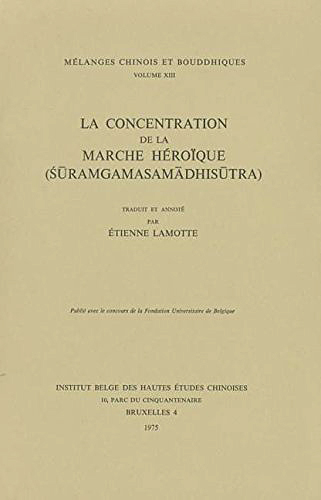
La concentration de la marche héroïque (Śūraṃgamasamādhisūtra) (Lamotte 1965)
From Bodhicitta
< Books
Books/La concentration de la marche héroïque (Śūraṃgamasamādhisūtra) (Lamotte 1965)| 🤓 Admin Zone 🛠️ hidden to non-admins | |
La concentration de la marche héroïque: (Śūraṃgamasamādhisūtra)
Book
Please note that many items in our library are simply pages that represent a detailed library catalog entry and citation of someone else's work, presentation, or performance. Read our General Disclaimer for more information.

Description
This book is a French translation of the Śūraṅgamasamādhisūtra from Kumārajīva's Chinese edition by Étienne Lamotte.
Citation
Lamotte, Étienne, trans. La concentration de la marche héroïque: (Śūraṃgamasamādhisūtra). Mélanges Chinois et Bouddhiques 13. Brussels: Institut Belge des Hautes Études Chinoises, 1965.
Interconnections
1 Full translations

The first full English translation of Kumārajīva's Chinese translation of the Śūraṅgamasamādhisūtra. Here Sara Boin-Webb translates Étienne Lamotte's French edition.
1 Full translation of

Śūraṃgamasamādhisūtra [or Śūraṅgamasamādhisūtra]. (T. Dpa' bar 'gro ba'i ting nge 'dzin gyi mdo; C. Shoulengyan sanmei jing; J. Shuryōgon zanmaikyō; K. Sunǔngǒm sammae kyǒng). In Sanskrit, "Sūtra on the Heroic-March Concentration," an early Mahāyāna sūtra that explains how the mind becomes free and unimpeded like the "march" (gama) of a "hero" (śūra), who "walks alone, fearlessly, like a lion." (This translated sūtra should be distinguished from the *Śūraṃgamasūtra, a Chinese apocryphal scripture of similar name, which dates from the early eighth century.) The Śūraṃgamasamādhi as taught in this sūtra not only enables bodhisattvas quickly to attain complete, perfect enlightenment (anuttarasamyaksaṃbodhi), but also ensures that even śrāvakas, pratyekabuddhas, and arhats are put on the right path leading to buddhahood. In addition, the Śūraṃgamasamādhi also permits enlightened beings to manifest themselves in any variety of forms in order to teach sentient beings. The sūtra also includes descriptions of the world systems of many other buddhas (buddhakṣetra), including Abhirati, the buddha-land of Akṣobhya. Although some fragments of the Sanskrit recension of the Śūraṃgamasamādhisūtra have survived, the full sūtra is extant only in an early-fifth-century translation attributed to the eminent Kuchean translator Kumārajīva, in two rolls, and in an early-ninth-century Tibetan translation. (Source: "Śūraṃgamasamādhisūtra." In The Princeton Dictionary of Buddhism, 873. Princeton University Press, 2014. http://www.jstor.org/stable/j.ctt46n41q.27)