Śūraṃgamasamādhisūtra: The Concentration of Heroic Progress
From Bodhicitta
< Books
Books/Śūraṃgamasamādhisūtra: The Concentration of Heroic Progress| 🤓 Admin Zone 🛠️ hidden to non-admins | |
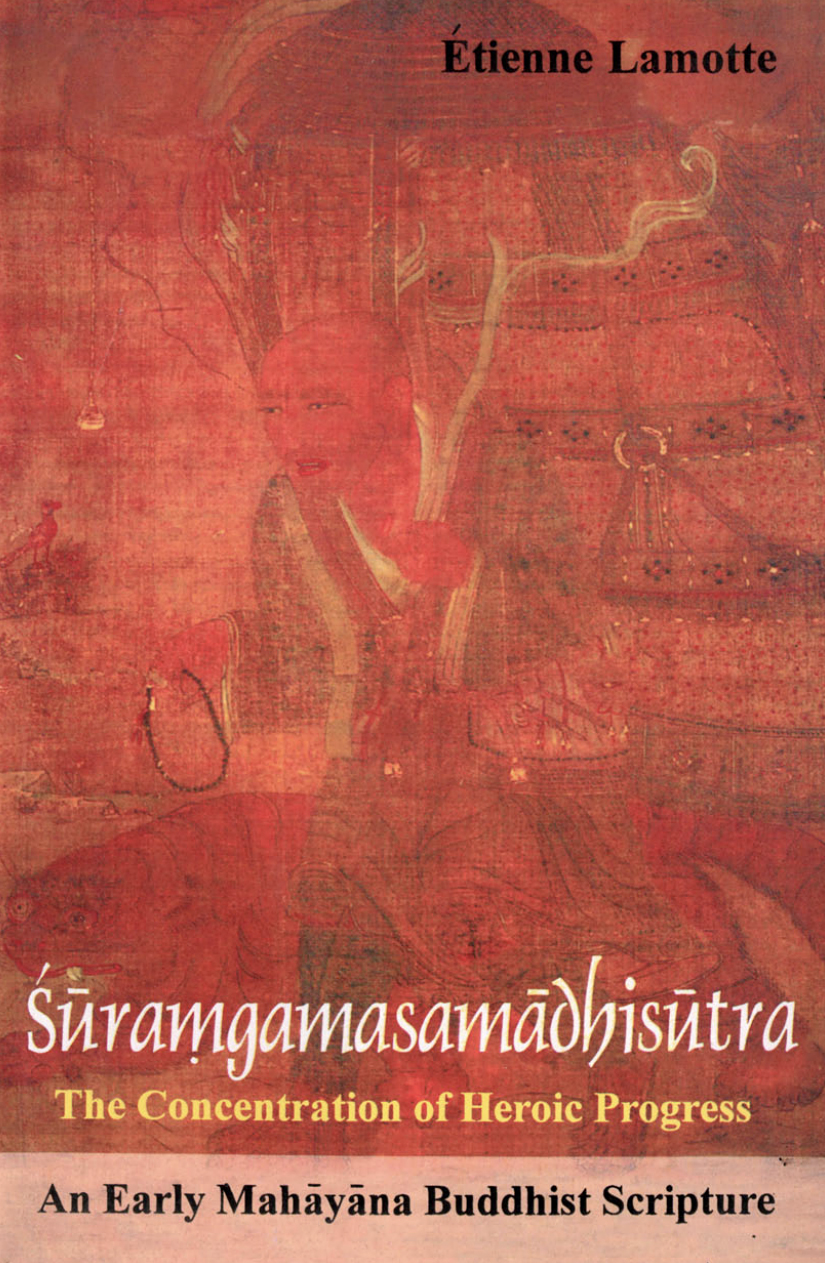
Śūraṃgamasamādhisūtra: The Concentration of Heroic Progress; An Early Mahāyāna Buddhist Scripture
Book
Please note that many items in our library are simply pages that represent a detailed library catalog entry and citation of someone else's work, presentation, or performance. Read our General Disclaimer for more information.

Description
First full English translation of Kumārajīva's Chinese translation from the Sanskrit original. This work is an English translation of Lamotte's French translation published in 1965.
Citation
Lamotte, Étienne, and Sara Boin-Webb, trans. Śūraṃgamasamādhisūtra: The Concentration of Heroic Progress; An Early Mahāyāna Buddhist Scripture. London: Curzon Press in association with the Buddhist Society, 1998.
Table of contents
- Introduction from the Technical Editorviii
- Preface to the original French editionx
- Foreword to the English editionxi
- Note from the English Translatorxvii
- Acknowledgementsxviii
- Abbreviations and Bibliographyxix
- Chapter One: THE ŚŪRAṂGAMASAMĀDHISŪTRA1
- Chapter Two: THE CHINESE AND TIBETAN VERSIONS56
- I. Translation by Chih Ch'an59
- II & III. Ssu-chuan translations65
- IV. Translation by Chih Ch'ien66
- V. Translation by Po Yen72
- VI. Translation by Dharmarakṣa74
- Commentary by Po Yuan80
- VII. Translation by Chu Shu-Ian81
- VIII. Combined edition by Chih Min-tu85
- Commentary by Hsieh Fu90
- IX. Translation by Chih Shih-lun90
- X. Translation by Kumārajīva94
- Commentary by Shih Hung-ch'ung97
- XI. Additional Note98
- XII. Tibetan translation99
- Concordance of the translations of the Śūraṃgamasamādhisūtra104
- Introduction107
- The Most Excellent Concentration109
- The Heroic Progress113
- The Offering of a Throne114
- The Multiplication of the Buddhas116
- Unreality and Identity of the Tathāgatas117
- The Hundred Aspects of the Heroic Progress119
- The Heroic Progress and Good Dharmas127
- The Heroic Progress and the Perfections128
- 1. Dānapāramitā128
- 2. Śīlapāramitā128
- 3. Kṣāntipāramitā129
- 4. Viryapāramitā130
- 5. Dhyānapāramitā131
- 6. Prajñāpāramitā133
- Liberating Action of the Heroic Progress135
- Instantaneous and Simultaneous Practice of the Perfections137
- Gradual Training in the Heroic Progress138
- Secrets and Mysteries of Meruśikharadhara150
- Gopaka's Devotion and Change of Sex154
- Multiple Appearance of a Bodhisattva in the Heroic Progress159
- Various Transformations of the Assembly161
- Necessity of Acquiring the Heroic Progress162
- Philosophical Discussion164
- 1. The Practice of the Heroic Progress164
- 2. The End Result of the Heroic Progress164
- 3. The Nirvana of the Buddhas165
- 4. The Absence of a Base166
- 5. The Bodhisattva's Eloquence167
- Revelations Concerning the Devaputra *Matyabhimukha168
- Mara Tied with the Five Bonds172
- The Twelve Bonds of False Views173
- The Virtue of the Name174
- Bondage and Deliverance174
- Conversion of the Daughters of the Gods175
- Self-interested Conversion of Mara176
- Conversion of the Lustful Devakanyās177
- Further Guile of Māra178
- Prediction to Māra179
- The Four Kinds of Prediction179
- 1. Anutpāditabodhicittavyākaraṇa182
- 2. Utpāditabodhicittavyākaraṇa184
- 3. Rahovyākaraṇa187
- 4. Anutpattikadharmakṣāntilabdhasaṃmukhavyākaraṇa188
- Bodhisattvas Having Received the Prediction189
- Prediction Conferred on the Daughters of the Gods191
- Fallacious Departure of Mara192
- Respective Value of Offerings to the Buddha193
- Exploits of Māragocarānupalipta in the Heroic Progress196
- Exploits of the Buddha in the Heroic Progress197
- Extension of the Heroic Progress to Other World Systems198
- Faith in the Heroic Progress200
- The Field of Merit204
- The Truly Learned208
- Prediction to Vimalacandragarbha211
- Provisional Nature of Pratyekabodhi212
- Mañjuśrī's Fictitious Nirvāṇa214
- Exploits of the Bodhisattvas in the Heroic Progress216
- Superiority of the Offender over the Holy One222
- Two Hundred Discouraged Bodhisattvas Obtain the Ten Powers223
- Why and How to Practise the Heroic Progress225
- Maitreya in the Heroic Progress227
- Mañjuśrī Identical to the Buddha Nāgavaṃśāgra229
- Appearance of the Buddhas of the Ten Regions232
- Protection Assured to the Heroic Progress233
- Identity of the Buddhas Śākyamuni and Vairocana235
- The Wonderful Effects of the Heroic Progress238
- 1. Longevity and Security238
- 2. Twenty Inconceivable Virtues239
- 3. Reaching Enlightenment239
- 4. Confident Faith240
- Final Conversions241
- Synopsis of formulas and stock phrases243
- Index245
Interconnections
2 Full translation of

Śūraṃgamasamādhisūtra [or Śūraṅgamasamādhisūtra]. (T. Dpa' bar 'gro ba'i ting nge 'dzin gyi mdo; C. Shoulengyan sanmei jing; J. Shuryōgon zanmaikyō; K. Sunǔngǒm sammae kyǒng). In Sanskrit, "Sūtra on the Heroic-March Concentration," an early Mahāyāna sūtra that explains how the mind becomes free and unimpeded like the "march" (gama) of a "hero" (śūra), who "walks alone, fearlessly, like a lion." (This translated sūtra should be distinguished from the *Śūraṃgamasūtra, a Chinese apocryphal scripture of similar name, which dates from the early eighth century.) The Śūraṃgamasamādhi as taught in this sūtra not only enables bodhisattvas quickly to attain complete, perfect enlightenment (anuttarasamyaksaṃbodhi), but also ensures that even śrāvakas, pratyekabuddhas, and arhats are put on the right path leading to buddhahood. In addition, the Śūraṃgamasamādhi also permits enlightened beings to manifest themselves in any variety of forms in order to teach sentient beings. The sūtra also includes descriptions of the world systems of many other buddhas (buddhakṣetra), including Abhirati, the buddha-land of Akṣobhya. Although some fragments of the Sanskrit recension of the Śūraṃgamasamādhisūtra have survived, the full sūtra is extant only in an early-fifth-century translation attributed to the eminent Kuchean translator Kumārajīva, in two rolls, and in an early-ninth-century Tibetan translation. (Source: "Śūraṃgamasamādhisūtra." In The Princeton Dictionary of Buddhism, 873. Princeton University Press, 2014. http://www.jstor.org/stable/j.ctt46n41q.27)

This book is a French translation of the Śūraṅgamasamādhisūtra from Kumārajīva's Chinese edition by Étienne Lamotte.
1 Other editions

An English translation of Kumārajīva's Chinese translation from the Sanskrit original. This work is an English translation of Lamotte's French translation published in 1965.