| 🤓 Admin Zone 🛠️ hidden to non-admins | |

Description
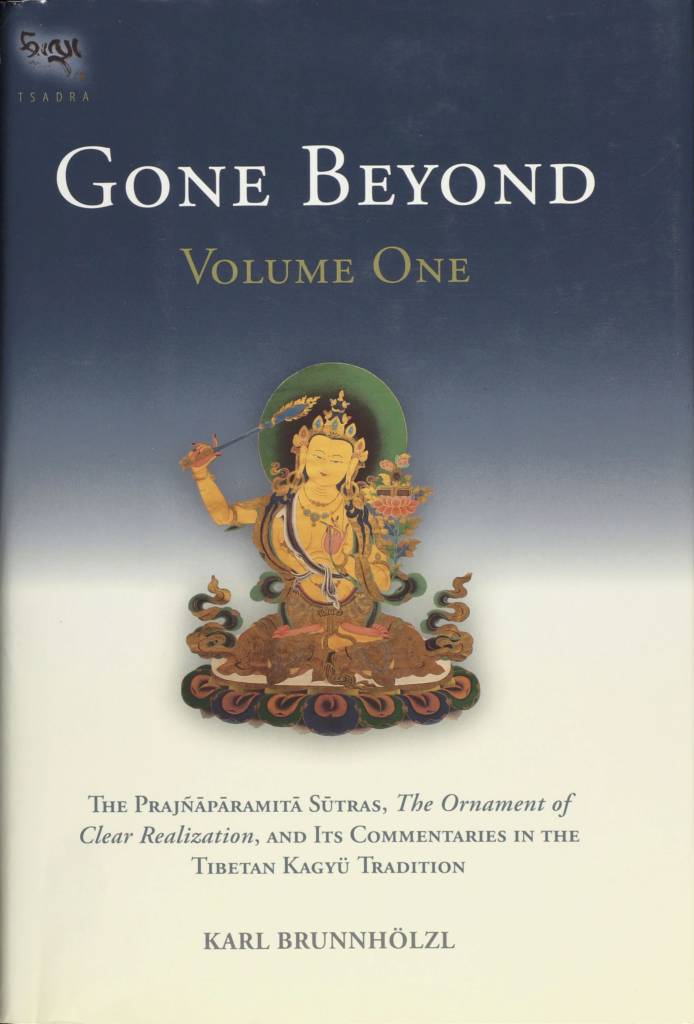
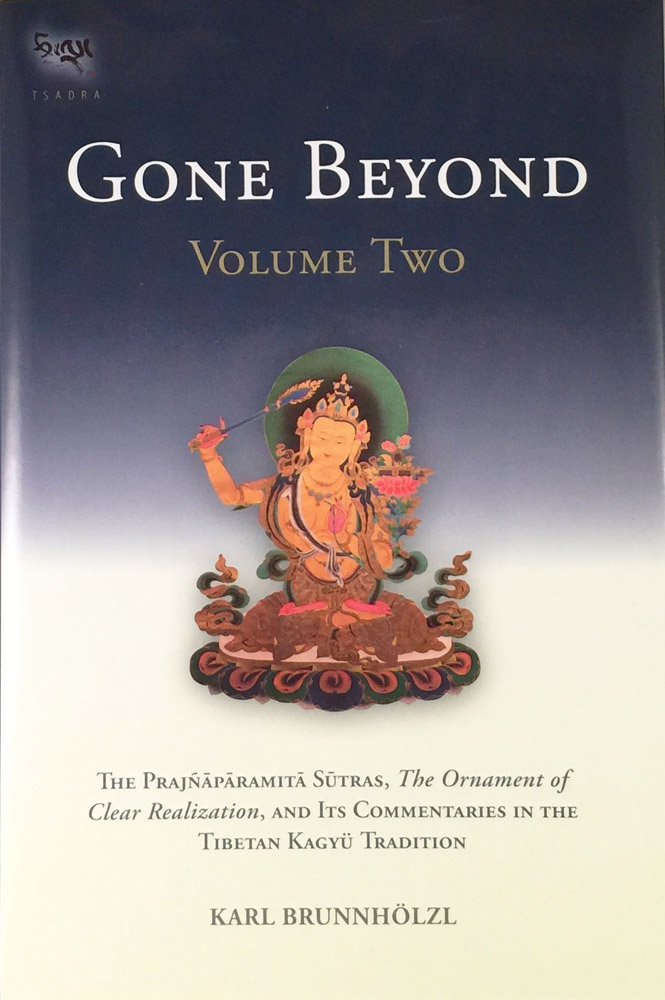
Gone Beyond contains the first in-depth study of the Abhisamayalamkara (the text studied most extensively in higher Tibetan Buddhist education) and its commentaries in the Kagyu School. This study (in two volumes) includes translations of Maitreya's famous text and its commentary by the Fifth Shamarpa Goncho Yenla (the first translation ever of a complete commentary on the Abhisamayalamkara into English), which are supplemented by extensive excerpts from the commentaries by the Third, Seventh, and Eighth Karmapas and others. Thus it closes a long-standing gap in the modern scholarship on the Prajnaparamita Sutras and the literature on paths and bhumis in mahayana Buddhism.
The first volume presents an English translation of the first three chapters of the Abhisamayalamkara and its commentary by the Fifth Shamarpa. The second volume presents an English translation of the final five chapters and its commentary by the Fifth Shamarpa. (Source: Shambhala Publications)
- An Aspiration by H.H. The Seventeenth Karmapa, Ogyen Trinley Dorje 14
- Foreword by H.H. The Seventeenth Karmapa, Ogyen Trinley Dorje 16
- Foreword by Dzogchen Ponlop Rinpoche 18
- Acknowledgements 19
- Introduction 21
- The prajñāpāramitā sūtras 21
- The Abhisamayālaṃkāra and its commentaries 54
- What is the view of the Abhisamayālaṃkāra? 103
- The Abhisamayālaṃkāra in its traditional setting 119
- The place of the prajñāpāramitā sūtras and the Abhisamayālaṃkāra in modern scholarship 137
- Is there any practical relevance of the Abhisamayālaṃkāra? 142
- The Abhisamayālaṃkāra as a contemplative manual 151
- Some remarks on the distinct exegetical approaches of the commentaries by the Eighth Karmapa and the Fifth Shamarpa 163
- Overview of the present three-volume study of commentaries on the AA 260
- Translation: A Concise Elucidation of the Abhisamayālaṃkāra (Topics One To Three) 264
- 1. The ancillary features provided by the lotsāwas who translated the treatise 267
- 1.1. Stating the title due its noble source and in order to realize its meaning 267
- 1.2. Paying homage in order to complete the translation 268
- 2. Explanation of the actual treatise that is endowed with these ancillary features 269
- 2.1. Paying homage, which is the cause for other persons giving rise to openness for the fruitional mother 269
- 2.2. The purpose and the connection, which are the causes for others giving rise to openness for this treatise 286
- 2.3. The explanation of clear realization—the subject matter of the treatise to be engaged 289
- 2.3.1. Teaching the clear realizations as eight for persons interested in the detailed version 289
- 2.3.1.1. Presentation of the body of the text 289
- 2.3.1.1.1. Brief introduction 289
- 2.3.1.1.2. Detailed explanation 291
- 2.3.1.1.2.1. The eight topics as what is to be explained 291
- 2.3.1.1.2.1.1. The meaning of each of the eight topics 291
- 2.3.1.1.2.1.1.1. The knowledge of all aspects 292
- 2.3.1.1.2.1.1.2. The knowledge of the path 293
- 2.3.1.1.2.1.1.3. The all-knowledge 294
- 2.3.1.1.2.1.1.4. The training in completely realizing all aspects 294
- 2.3.1.1.2.1.1.5. The culminating training 295
- 2.3.1.1.2.1.1.6. The serial [training] 295
- 2.3.1.1.2.1.1.7. The instantaneous training 296
- 2.3.1.1.2.1.1.8. The dharmakāya 296
- 2.3.1.1.2.1.2. The definite order of the eight topics 296
- 2.3.1.1.2.1.3. Matching them with the sūtras 297
- 2.3.1.1.2.1.1. The meaning of each of the eight topics 291
- 2.3.1.1.2.2. Explaining the seventy points as the means to explain the eight topics 298
- 2.3.1.1.2.2.1. Explaining the three knowledges by way of what defines them 298
- 2.3.1.1.2.2.2. Explaining the four trainings by way of their natures 302
- 2.3.1.1.2.2.3. Explaining the dharmakāya 305
- 2.3.1.1.2.1. The eight topics as what is to be explained 291
- 2.3.1.2. Detailed explanation of the branches 306
- 2.3.1.2.1. The three knowledges (the objects) 306
- 2.3.1.2.1.1. The knowledge of all aspects (what is to be attained) 306
- 2.3.1.2.1.1.1. The generation of bodhicitta (the motivation) 306
- 2.3.1.2.1.1.1.1. General topic 306
- 2.3.1.2.1.1.1.2. Meaning of the text 309
- 2.3.1.2.1.1.2. The practice (the training) 316
- 2.3.1.2.1.1.2.1. The instructions that teach the means of practice 316
- 2.3.1.2.1.1.2.2. The explanation of [the branches of] penetration (the result of practicing the [instructions]) 350
- 2.3.1.2.1.1.2.3. Explanation of practice's own nature 380
- 2.3.1.2.1.1.1. The generation of bodhicitta (the motivation) 306
- 2.3.1.2.1.2. The knowledge of the path (the means to attain the knowledge of all aspects 452
- 2.3.1.2.1.2.1. Presenting the connection 452
- 2.3.1.2.1.2.2. Explaining the defining points 452
- 2.3.1.2.1.2.2.1. The causes of the knowledge of the path 452
- 2.3.1.2.1.2.2.2. The knowledge of the path that arises from these [causes] 455
- 2.3.1.2.1.3. The knowledge of entities (the root of the knowledge of all aspects, which includes the points to go astray) 492
- 2.3.1.2.1.3.1. Presenting the connection 492
- 2.3.1.2.1.3.2. Explanation of the knowledge of entities 492
- 2.3.1.2.1.3.2.1. Ascertaining the phenomena to be known 492
- 2.3.1.2.1.3.2.2. Explanation of the classificatory templates of the knowledge of entities (that which knows them) 498
- 2.3.1.2.1.3.3. Concluding summary of the three knowledges 512
- 2.3.1.2.1.1. The knowledge of all aspects (what is to be attained) 306
- 2.3.1.2.1. The three knowledges (the objects) 306
- 2.3.1.1. Presentation of the body of the text 289
- 2.3.1. Teaching the clear realizations as eight for persons interested in the detailed version 289
- 1. The ancillary features provided by the lotsāwas who translated the treatise 267
- Appendix I: Selected General Topics From JG and JNS 514
- 1) The knowledge of all aspects 514
- A) Bodhicitta 514
- JG’s presentation 514
- JNS’s presentation 549
- B) The instructions 553
- JG’s presentation 553
- JNS’s presentation 560
- C) The two realities 566
- D) The path of preparation 582
- 1) The four stages of the path of preparation 582
- 2) The focal object and aspects of the path of preparation 586
- 3) The four conceptions in the context of the path of preparation 591
- E) The disposition 598
- 1) General explanation 598
- 2) The disposition is not a nonimplicative negation 624
- 3) The single yāna and buddha nature in all beings 626
- 4) Other commentaries on the disposition 636
- F) The focal object of practice 673
- G) The equipment of wisdom 679
- 1) The nature of phenomena and wisdom in relation to being self-empty versus other-empty 679
- 2) The explanation of emptiness (the object) and the way in which it is observed by wisdom (its subject) 683
- 3) Various ways of asserting the definite number of emptinesses (including the wisdoms that correspond to the twenty emptinesses) 692
- 4) The basis of emptiness 698
- 5) The manner of being empty 700
- 6) Nondual wisdom 701
- H) The equipment of the ten bhūmis 711
- 1) The nature of the bhūmis, which are the remedies 711
- 2) The nature of the object of meditative equipoise 728
- 3) The nature of the obstacles to be relinquished 742
- A) Bodhicitta 514
- 2) The knowledge of the path 766
- A) The five causes of the knowledge of the path 766
- B) The knowledge of the path of śrāvakas 782
- C) The knowledge of the path of pratyekabuddhas 793
- D) The knowledge of the path of bodhisattvas 799
- E) The path of familiarization 832
- 1) The path of familiarization and its function in general 832
- 2) The path of familiarization as aspiration 842
- 3) The path of familiarization as dedication 847
- 4) The uncontaminated path of familiarization 859
- 5) The utterly pure path of familiarization 860
- 6) Removing qualms about the manner in which the stains are relinquished 865
- 3) The all-knowledge 868
- A) The presentation of the objects of knowledge (skandhas, dhātus, and āyatanas) 868
- 1) The explanation of the five skandhas 868
- 2) The way in which they correspond to the dhātus and the āyatanas 878
- 3) The way in which they correspond to the four realities, the five bases, and so on 881
- B) Śrāvakas and pratyekabuddhas do not realize phenomenal identitylessness 884
- C) The three natures 889
- 1) How they are taught in the sūtras 889
- 2) Explanation according to the scriptural system of Yogācāra 890
- A) The presentation of the objects of knowledge (skandhas, dhātus, and āyatanas) 868
- 1) The knowledge of all aspects 514
- Appendix II: Charts 896
- Endnotes 956


-front.jpg)
Gone Beyond contains the first in-depth study of the Abhisamayalamkara (the text studied most extensively in higher Tibetan Buddhist education) and its commentaries in the Kagyu School. This study (in two volumes) includes translations of Maitreya's famous text and its commentary by the Fifth Shamarpa Goncho Yenla (the first translation ever of a complete commentary on the Abhisamayalamkara into English), which are supplemented by extensive excerpts from the commentaries by the Third, Seventh, and Eighth Karmapas and others. Thus it closes a long-standing gap in the modern scholarship on the Prajnaparamita Sutras and the literature on paths and bhumis in mahayana Buddhism.
The first volume presents an English translation of the first three chapters of the Abhisamayalamkara and its commentary by the Fifth Shamarpa. The second volume presents an English translation of the final five chapters and its commentary by the Fifth Shamarpa. (Source: Shambhala Publications)