| 🤓 Admin Zone 🛠️ hidden to non-admins | |
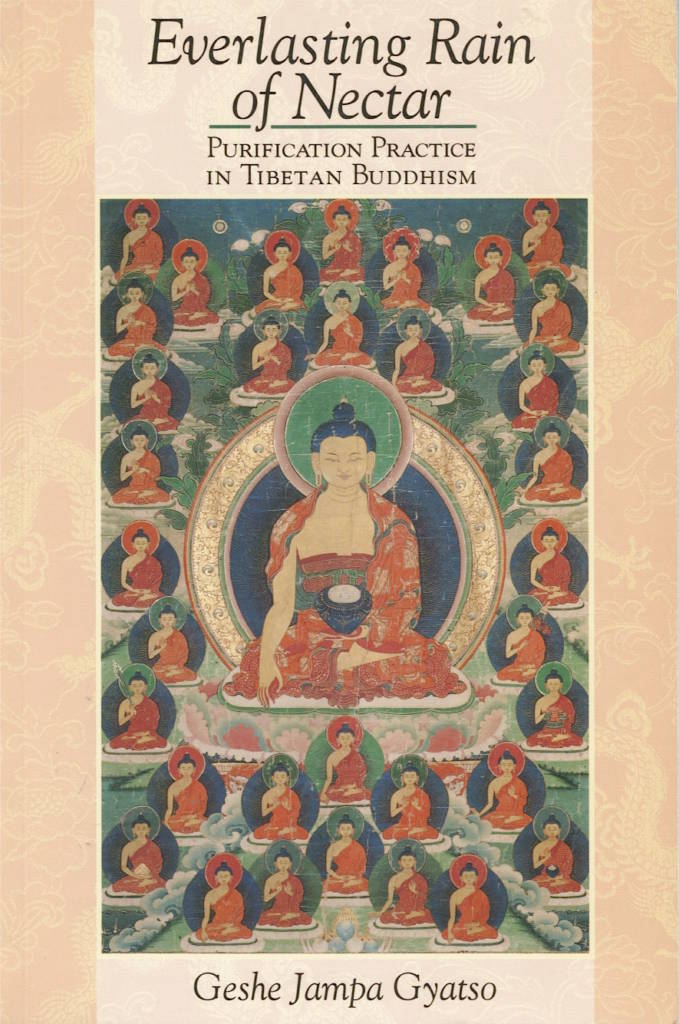
Everlasting Rain of Nectar: Purification Practice in Tibetan Buddhism
Book
Please note that many items in our library are simply pages that represent a detailed library catalog entry and citation of someone else's work, presentation, or performance. Read our General Disclaimer for more information. You can find more information about this item on the publisher website.

Description
In Purification in Tibetan Buddhism, Geshe Jampa Gyatso explains The Bodhisattva’s Confession of Downfalls, a daily practice for purifying negativities. This essential practice helps us to clear negative thoughts and actions from our body, speech, and mind.
In his delightfully conversational manner, Geshe Jampa teaches us the details of the law of cause and effect, the powerful use of the four opponent powers, and the proper manner and movements of prostrating, and provides clear descriptions of each of the thirty-five confession buddhas. (Source: Wisdom Publications)
Citation
Gyatso, Geshe Jampa. Everlasting Rain of Nectar: Purification Practice in Tibetan Buddhism. Translated by Joan Nicell and George Churinoff. Edited by Joan Nicell. Boston: Wisdom Publications, 1996.
Publisher Link
Table of contents
- ForewordVII
- Editor's AcknowledgmentsXI
- Publisher's AcknowledgmentsXII
- PrefaceXIII
- Technical NoteXV
- A Short Biography of Sanggye YesheXIX
- XXIII Introduction by Geshe Jampa Gyatso
- The Text1
- Introduction by Sanggye Yeshe3
- Part One: Purifying Negativities And Downfalls7
- 1. The Four Opponent Forces9
- 2. The Force of the Basis13
- 3. The Force of Applying All Antidotes31
- 4. The Force of Total Repudiation47
- 5. The Force of Turning Away from Faults in the Future63
- Part Two: Accumulating Merit69
- 6. Dedicating Virtues71
- 7. The Seven Limbs81
- Part Three: Conclusion85
- 8. Overcoming the Afflictions87
- 9. Final Dedications95
- Appendices97
- 1. The Bodhisattva's Confession of Downfalls99
- 2. Woodblock Prints of the Thirty-five Tathagatas103
- 3. Phonetics of The Bodhisattva's Confession of Downfalls109
- 4. Sanskrit Names of the Thirty-five Tathagatas113
- 5. Tibetan Text: The Bodhisattva's Confession of Downfalls115
- 6. Outline: A Significant Sight125
- 7. How to Perform Full-length Prostrations127
- Notes135
- Glossary139
- Bibliography147
- About the Author155
Interconnections
1 Full translation of

The Sūtra of the Three Heaps (Skt. Triskandhakasūtra; Tib. 'Phags pa phung po gsum pa zhes bya ba theg pa chen po'i mdo, Toh 284) is a Mahāyāna liturgical sūtra set at hermitage called chos kyi dbye dgon pa. Its first part is an extended practice in which the practitioner offers homage, makes offerings, confesses all obscuring karma, rejoices in the virtue of all beings, exhorts the buddhas to turn the wheel of Dharma, and supplicates them not to pass into nirvāṇa. The practitioner then takes all roots of virtue as their own, dedicates them to awakening, and generates bodhicitta on the model of past buddhas and bodhisattvas. In the second part, Mañjuśrī teaches the bodhisattva Sarvadharmapratijñāsthita the "irreproachable" heaps of confession, rejoicing, exhortation, supplication, and dedication, understood in the light of emptiness and non-apprehension.
This text should be distinguished from the popular confession liturgy addressed to the thirty-five buddhas, widely recited as the "Three Heaps" or Bodhisattva's Confession of Downfalls. That liturgy circulates under the same Tibetan title, 'Phags pa phung po gsum pa zhes bya ba theg pa chen po'i mdo, but its content is an excerpt from the Upāliparipṛcchā (Toh 68), which itself calls the practice the "Dharma discourse of the Three Heaps." It is the Upāliparipṛcchā passage, not Toh 284, that Śāntideva quotes in the Śikṣāsamuccaya (ch. 8) and prescribes for recitation three times by day and three times by night in the Bodhicaryāvatāra (5.98).