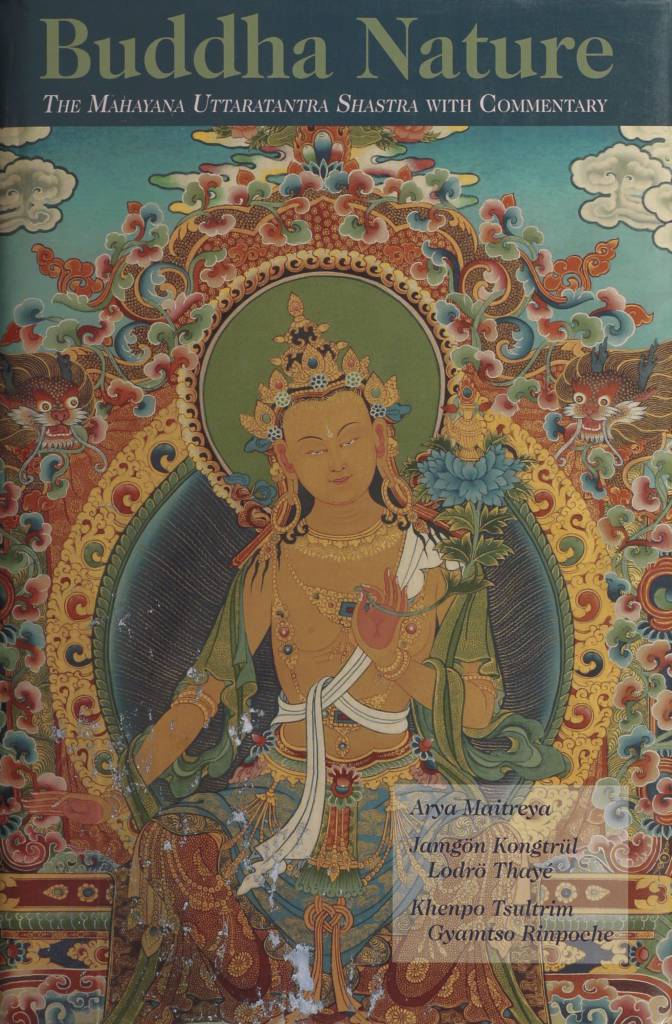
Buddha Nature: The Mahayana Uttaratantra Shastra
From Bodhicitta
< BooksBooks/Buddha Nature: The Mahayana Uttaratantra Shastra
| 🤓 Admin Zone 🛠️ hidden to non-admins | |
Buddha Nature: The Mahayana Uttaratantra Shastra
Book
Please note that many items in our library are simply pages that represent a detailed library catalog entry and citation of someone else's work, presentation, or performance. Read our General Disclaimer for more information. You can find more information about this item on the publisher website.

Description
All sentient beings, without exception, have buddha nature, the inherent purity and perfection of the mind, untouched by changing mental states. The Mahayana Uttaratantra Shastra, one of the "Five Treatises" said to have been dictated to Asanga by the Bodhisattva Maitreya, presents the Buddha's definitive teachings on how we should understand this ground of enlightenment and clarifies the nature and qualities of buddhahood. This seminal text details with great clarity the view which forms the basis for Vajrayana, and especially Mahamudra, practice. Thus it builds a bridge between the Sutrayana and the Vajrayana levels of the Buddha's teaching, elaborated here in Jamgön Kongtrül's commentary. (Source: Shambhala Publications)
Citation
Fuchs, Rosemarie, trans. Buddha Nature: The Mahayana Uttaratantra Shastra. By Arya Maitreya. Written down by Arya Asanga. With a commentary by Jamgön Kongtrül Lodrö Thayé ('jam mgon kong sprul blo gros mtha' yas) "The Unassailable Lion's Roar," and explanations by Khenpo Tsultrim Gyamsto Rinpoche. Ithaca, NY: Snow Lion Publications, 2000.
Publisher Link
Table of contents
- Foreword by Tenzin Dorjee 8
- Preface by Rosemarie Fuchs 10
- Introduction by Acharya Lodrö Namgyal 12
- Part One: Root Text 17
- 1. Tathagatagarbha 19
- Introduction 19
- The First Three Vajra Points: The Three Jewels 20
- Buddha 20
- Dharma 20
- Sangha 21
- The Three Refuges 22
- The Last Four Vajra Points 22
- The Fourth Vajra Point: The Element 23
- 2. The Fifth Vajra Point: Enlightenment 43
- 3. The Sixth Vajra Point: Qualities 53
- 4. The Seventh Vajra Point: Activity 59
- 5. Benefit 73
- Part Two: Commentary, The Unassailable Lion’s Roar 79
- Table of Contents 81
- 1. Tathagatagarbha 97
- Introduction 97
- The First Three Vajra Points: The Three Jewels 101
- The First Vajra Point: Buddha 101
- The Second Vajra Point: Dharma 105
- The Third Vajra Point: Sangha 108
- The Three Refuges 112
- The Last Four Vajra Points 114
- The Fourth Vajra Point: The Element 117
- 2. The Fifth Vajra Point: Enlightenment 182
- 3. The Sixth Vajra Point: Qualities 218
- 4. The Seventh Vajra Point: Activity 238
- 5. Benefit 283
- Part Three: Explanations by Khenpo Tsultrim Gyamtso Rinpoche 299
- Part Four: Translator’s Notes 391
Interconnections
1 Full translation of
.jpg)
The Ratnagotravibhāga, commonly known as the Uttaratantra, or Gyu Lama in Tibetan, is one of the main Indian scriptural sources for buddha-nature theory. It was likely composed during the fifth century, by whom we do not know. Comprised of verses interspersed with prose commentary, it systematizes the buddha-nature teachings that were circulating in multiple sūtras such as the Tathāgatagarbhasūtra, the Mahāparinirvāṇasūtra, and the Śrīmaladevisūtra. The Tibetan tradition attributes the verses to the Bodhisattva Maitreya and the commentary to Asaṅga, and treats the two as separate texts, although this division is not attested to in surviving Indian versions. The Chinese tradition attributes the text to *Sāramati (娑囉末底), but the translation itself does not include the name of the author, and the matter remains unsettled. It was translated into Chinese in the early sixth century by Ratnamati and first translated into Tibetan by Atiśa, although this text is not known to survive. Ngok Loden Sherab translated it a second time based on teachings from the Kashmiri Pandita Sajjana, and theirs remains the standard translation. It has been translated into English several times, and recently into French. See the Ratnagotravibhāgavyākhyā, read more about the Ratnagotravibhāga, or take a look at the most complete English translation in When the Clouds Part by Karl Brunnholzl.
1 Teaching based on
The Ratnagotravibhāga, commonly known as the Uttaratantra, or Gyu Lama in Tibetan, is one of the main Indian scriptural sources for buddha-nature theory. It was likely composed during the fifth century, by whom we do not know. Comprised of verses interspersed with prose commentary, it systematizes the buddha-nature teachings that were circulating in multiple sūtras such as the Tathāgatagarbhasūtra, the Mahāparinirvāṇasūtra, and the Śrīmaladevisūtra. The Tibetan tradition attributes the verses to the Bodhisattva Maitreya and the commentary to Asaṅga, and treats the two as separate texts, although this division is not attested to in surviving Indian versions. The Chinese tradition attributes the text to *Sāramati (娑囉末底), but the translation itself does not include the name of the author, and the matter remains unsettled. It was translated into Chinese in the early sixth century by Ratnamati and first translated into Tibetan by Atiśa, although this text is not known to survive. Ngok Loden Sherab translated it a second time based on teachings from the Kashmiri Pandita Sajjana, and theirs remains the standard translation. It has been translated into English several times, and recently into French. See the Ratnagotravibhāgavyākhyā, read more about the Ratnagotravibhāga, or take a look at the most complete English translation in When the Clouds Part by Karl Brunnholzl.