Śikshā-samuccaya: A Compendium of Buddhist Doctrine

From Bodhicitta
LibraryBooksŚikshā-samuccaya: A Compendium of Buddhist Doctrine
< Books
Books/Śikshā-samuccaya: A Compendium of Buddhist Doctrine

Śikshā-samuccaya: A Compendium of Buddhist Doctrine
Book


Please note that many items in our library are simply pages that represent a detailed library catalog entry and citation of someone else's work, presentation, or performance. Read our General Disclaimer for more information.
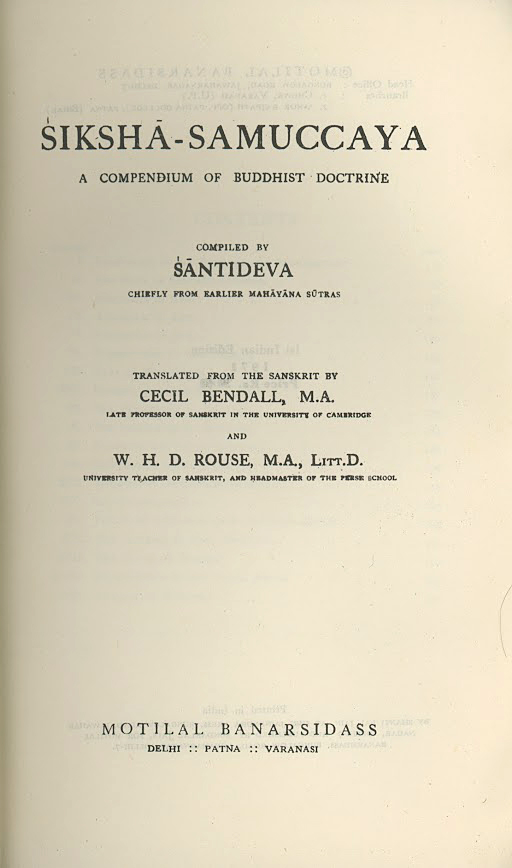
Śikshā-Samuccaya A Compendium of Buddhist Doctrine 1st Indian Edition 1971-front.jpg

Description

This is the first Indian edition of the English translation of Siksasamuccaya- a Mahayana Buddhist treatise edited by Dr. Bendall from a single Nepalese manuscript for the Russian Bibliotheca Buddhica.

The book is a compendium of Buddhist doctrine preserved in the schools of the great Vehicle-Mahayana. It presents as its subject matter the code of righteous conduct for the enlightenment of the aspirant.

The translation is authentic and authoritative. The book is interesting and instructive. There is also an alphabetical index of quoted works and a general index. (Source: Motilal Banarsidass)

Citation
Bendall, Cecil, and William Henry Denham Rouse, trans. Śikshā-samuccaya: A Compendium of Buddhist Doctrine. Compiled by Śāntideva. 1st Indian edition. Delhi: Motilal Banarsidass, 1971.
Texts Translated
  1. Bendall, Cecil, ed. Çikshāsamuccaya: A Compendium of Buddhistic Teaching. Compiled by Çāntideva. Bibliotheca Buddhica 1. St. Petersburg: Commissionnaires de l'Académie Impériale des Sciences, 1897–1902. http://www.orientalstudies.ru/eng/images/pdf/bibliotheca_buddhica_1_1897-1902_bendall.pdf. For the text in Tibetan, see: Śāntideva (zhi ba lha). Śikṣāsamuccaya (Bslab pa kun las btus pa). In Derge Tengyur D3940, dbu ma, vol. 111, khi 3a2-194b5. See rKTs etexts, Columbia AIBS, ACIP etexts, Buda by BDRC Logo.jpg.


Other editions

 
Çikshāsamuccaya: A Compendium of Buddhistic Teaching (1897–1902)
A critical Sanskrit edition of the Śikṣāsamuccaya, edited by Cecil Bendall, with an introduction, summary, kārikās in Sanskrit, Tibetan, and English, and indexes.
Book
 
Çikshāsamuccaya: A Compendium of Buddhistic Teaching (1992)
The first Indian edition of the critical Sanskrit edition of the Śikṣāsamuccaya, originally edited by Cecil Bendall in 1897–1902. Published by Motilal Banarsidass, 1992.
Book
 
Śikshā-samuccaya: A Compendium of Buddhist Doctrine (1922)
Chandrakirti laid the foundations and initiated the Prasangika Madhyamika school of Buddhist thought, but Shantideva provided it with mystic vision and ecstatic fervour. Born in the eighth century, he was a son of the ruler of Saurashtra, a small kingdom in modern Gujarat. While still a child, he was vouchsafed a vision of Manjushri, the Bodhisattva of wisdom, and the vision was repeated near the time for his accession to the throne. Manjushr I declared that he was Shantideva’s kalyanamitra, spiritual friend, and warned him not to take the throne of Saurashtra. At about the same time, Shantideva had a dream in which Tara, the feminine aspect and counterpart of Avalokiteshvara, appeared to him in the guise of his mother and consecrated him. In an act reflecting the renunciation of Buddha, he fled the kingdom and wandered in a forest for twenty-one days. He came upon a woman who offered him sweet water and led him to a yogin who initiated him into Buddhist doctrine and meditation. He soon attained samadhi and recognized the woman and the yogin as Tara and Manjushri. From that moment, the vision of Manjushri remained with him throughout his life. While at Nalanda, Shantideva composed the Shikshasamuccaya, a “Compendium of Buddhist Doctrines”, which drew together citations from a vast number of sutras and texts. It emphasizes the moral dimension of the Bodhisattva Path, whilst the Bodhicaryavatara focusses on the Path from the stand point of consciousness. The book is translated from the Sanskrit by Cecil Bendall, Late Professor of Sanskrit in the University of Cambridge and W.H.D. Rouse, Late University teacher of Sanskrit. (Source Accessed Jan 6, 2022)
Book


  • I. Salutation to all Buddhas and Bodhisatvas1
  • II. The Duty of Self-Preservation37
  • III. Avoidance of Evil46
  • IV. Avoidance of Evil61
  • V. Avoidance of Evil100
  • VI. Preservation of the Person117
  • VII. Care of Enjoyments142
  • VIII. Purification from Sin157
  • IX. The Perfection of Patience175
  • X. The Perfection of Strength184
  • XI. Praise of the Forest Seclusion188
  • XII. Preparation of the Thought196
  • XIII. Subjects of Intent Contemplation216
  • XIV. Self-Purification225
  • XV. Purity in Enjoyment and Religious Action245
  • XVI. The Increase of Good Conduct251
  • XVII. The Praise of Worship270
  • XVIII. Recollection of the Three Jewels283
  • XIX. Increase of Holiness307