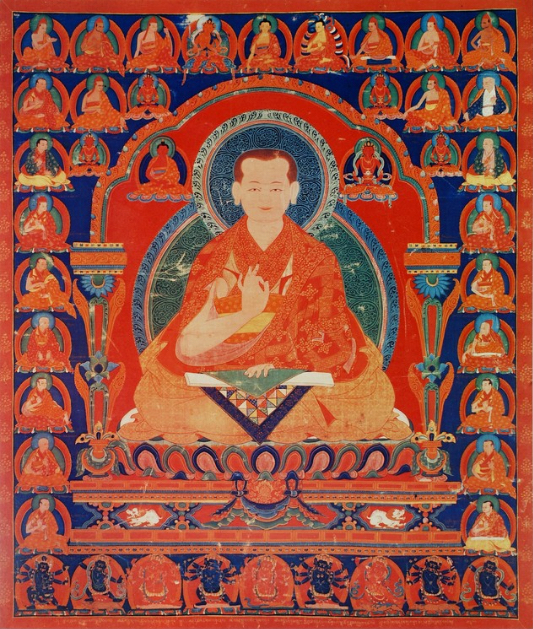
Rongtönpa's Instructions on the Bodhicaryāvatāra: The Interplay of View and Practice
| 🤓 Admin Zone 🛠️ hidden to non-admins | |
Rongtönpa (1367–1449), known as the "Master of the Ten Scriptures," was one of fifteenth-century Tibet's most influential scholar-practitioners who emphasized the integration of scholarly study with contemplative practice. His meditation manual The Precious Garland (Byang chub sems dpa'i spyod pa la 'jug pa'i sgom rim rin chen rgyan phreng) presents a systematic method for practicing the essential teachings of Śāntideva's Bodhicaryāvatāra.
The Precious Garland distills the vast Bodhicaryāvatāra into three key stages: foundational cultivation of aspirational and engaged bodhicitta, training in the six perfections with practical application, and dedication of merit. Rongtönpa's distinctive approach moves practitioners from analytical meditation to deeper contemplative states through a graduated method that first establishes conceptual understanding of the two truths, then progresses to meditation on emptiness using conventional appearances as the object, and finally achieves direct realization through sustained practice. Drawing explicitly on Atiśa's tradition, his instructions emphasize becoming familiar with appearances as illusion-like before resting in space-like meditation.
This concise text exemplifies Rongtönpa's broader contribution to Tibetan Buddhism: demonstrating that even the eighty-four thousand dharmas can be condensed into essential practice while maintaining both philosophical rigor and practical effectiveness. His approach addresses the fundamental unity of study and meditation, offering contemporary practitioners a clear framework for integrating the profound teachings of the Bodhicaryāvatāra into daily practice.Featured on
Introduction
Rongtönpa (Rong ston shes bya kun rig, 1367–1449) stands as one of the most influential scholar-practitioners of fifteenth-century Tibet. Born in Gyal mo rong (Rgyal mo rong) in Eastern Tibet, he emerged from a Bönpo family background to become a central figure in the transmission and interpretation of Buddhist teachings. His life exemplified the ideal of scholarly erudition that characterized the greatest masters of Tibetan Buddhism of his time.[1] As a prolific commentator, Rongtönpa's contributions to Tibetan Buddhist scholarship and practice continue to influence practitioners today. He wrote a very short text with concise practice instructions based on the Bodhicaryāvatāra and Atiśa's tradition.
Early Life and Education
At age seventeen (1384), Rongtönpa departed his homeland for the prestigious Sangpu Neutok (Gsang phu Ne'u thog) Monastery in Central Tibet. There, under the guidance of eminent scholars like Rinchen Namgyal (Rin chen rnam rgyal 1318–1388) and Lodrö Wangchuk (Blo gros dbang phyug), he mastered the core Buddhist philosophical curriculum, including Prajñāpāramitā, Pramāṇa, and foundational dialectics. His exceptional scholarly abilities manifested early. By age twenty-one, he had already composed his first major commentary on the Pramāṇaviniścaya.[2]
Rongtönpa's education was remarkable for its breadth and depth. Beyond his initial training at Sangpu, he studied with over twenty renowned masters, including Yaktön Sangye Pal (G.yag ston Sangs rgyas dpal, 1348–1414), who was particularly influential in shaping his understanding of Prajñāpāramitā philosophy.[3] During this period, he received extensive teachings on the Bodhicaryāvatāra and its practice traditions, which would later inform his distinctive approach to integrating study and meditation.
The Master of the Ten Scriptures
Rongtönpa's scholarly achievements were matched by his contributions to Tibetan Buddhism as a teacher and institutional figure. He played a central role at Sangpu. His title, "Master of the Ten Scriptures" (bka' bcu pa), reflects his exceptional command over Buddhist canonical texts. This title signified his mastery of an expansive curriculum and underscored his reputation as a preeminent scholar of his time.[4]
Rongtönpa's mastery of Buddhist philosophy was perhaps most dramatically demonstrated in his renowned debates with some of Tibet's greatest scholars. Historical records document two particularly significant encounters that established his reputation as a formidable dialectician. According to the biography of Śākya Chokden (ShAkya mchog ldan, 1428–1507), Rongtönpa famously debated Tsongkhapa (Tsong kha pa, 1357–1419) himself in Lhasa on the intricate subject of the stages of the path in the Prajñāpāramitā-Abhisamayālaṃkāra system. The debate concluded with Tsongkhapa's defeat, though sources note he graciously acknowledged this by offering Rongtönpa a roll of cloth.[5] Even more noteworthy perhaps was Rongtönpa's decisive victory over Gyaltsap Je (Rgyal tshab rje, 1364–1432) at Sangpu during the latter's scholastic examination round (grwa skor), where Rongtönpa systematically dismantled the twelve theses defended by Gyaltsap Je.[6]
Rongtönpa's influence thus extended far beyond his immediate circle of students. As a teacher at Sangpu and later as the founder of Nālendra Monastery in 1436, he shaped the curricula and practice traditions of major Tibetan Buddhist institutions. By the time he was in his early sixties (c. 1427), all teachers at Sangpu were his disciples—a level of influence not seen since Chapa Chökyi Senge (Phywa pa Chos kyi seng ge, 1109–1169).[7] His teaching career was remarkable not only for its duration but also for its scope. According to his biography by Śākya Chokden, Rongtönpa had "more students who understood philosophical texts than any Tibetan teacher of all time."[8] His immediate assembly at Nālendra numbered several hundred disciples, and his influence extended to all major schools of Tibetan Buddhism, including the emerging Geluk (Dge lugs) tradition.[9]
Before examining his specific approach to the Bodhicaryāvatāra, it is important to note Rongtönpa's broader contributions to Buddhist scholarship. He composed approximately forty detailed commentaries and various other treatises, with his collected works forming thirteen to twenty physical volumes preserved at Sakya (Sa skya) and Nālendra.[10] His commentarial work was characterized by careful attention to both philosophical precision and practical application, an approach that is characteristic of his pith instructions on how to practice the essence of the Bodhicaryāvatāra.
Rongtönpa's Practice Instructions on the Bodhicaryāvatāra
Rongtönpa's instructions on the Bodhicaryāvatāra are preserved in his meditation manual The Precious Garland (Byang chub sems dpa'i spyod pa la 'jug pa'i sgom rim rin chen rgyan phreng), which presents a systematic method for integrating study and practice.[11] This very short text is found in his collected works together with other very concise practice instructions on the main scholastic treatises, such as the Madhyamakāvatāra.[12] His instructions on the Bodhicaryāvatāra emphasize three key aspects:
- The foundational cultivation of bodhicitta in its two aspects—aspirational and engaged.
- The training in the six perfections, with special emphasis on their practical application.
- The dedication of merit, which he considers essential for sustaining the bodhisattva path.
In The Precious Garland, Rongtönpa states:
First, taking as the foundation the two types of generating bodhicitta, the training in the engaged bodhicitta is explained through the six perfections.
Finally, all virtuous actions are dedicated to enlightenment.
What distinguishes Rongtön's approach is his emphasis on the integration of conceptual understanding with direct experience. In The Precious Garland, he provides detailed instructions for practice that move from analytical meditation to deeper contemplative states. His core instructions read:
First, generate the wisdom that understands the two truths.
Then, taking the conventional appearances as the object of meditation, one should meditate on emptiness, the ultimate truth.
When meditating, one must use appearances as the object of meditation, for without establishing the basis, one cannot eliminate misconceptions about its qualities.
This instruction reflects the influence of Atiśa's tradition, which Rongtön explicitly acknowledges and elaborates:
First, one should become familiar with and accustomed to the meaning of appearances being without inherent nature, like illusions.
Having mastered this, the aspect of appearances will vanish like a rainbow dissolving in the sky, and one should rest evenly, like in the midst of space.
The approaches of meditation with and without appearances should be understood from these two stages.
Rongtön concludes these meditation instructions with a powerful aspiration that encapsulates the purpose of practice:
By the virtue of this, pure as the autumn moon, May all beings be liberated from the ocean of existence And reach the island of omniscient liberation!
The originality of Rongtönpa's concise teaching in this text lies in his ability to unite a complex philosophical view with a simple and practical meditation instruction. In The Precious Garland, he emphasizes that even the vast collection of Buddhist teachings (the eighty four thousand dharmas) can be condensed into this essential practice approach. His teaching on the topic involves three key stages:
- Conceptual understanding through study and analysis
- Meditative familiarity with both appearances and emptiness
- Direct realization through sustained practice
This graduated approach ensures that practitioners develop both intellectual clarity and experiential realization.
Legacy and Contemporary Relevance
Rongtönpa's approach to Buddhist practice must be understood within the broader context of fifteenth-century Tibet's religious development. His era saw significant debates about the relationship between scholarly study and meditation practice, with some traditions emphasizing one over the other. Rongtönpa's distinctive contribution was his insistence on their fundamental unity, an approach that would influence generations of practitioners across sectarian boundaries. His founding of Nālendra Monastery in 1436 provided an institutional framework for this integrated approach. The monastery's curriculum, which he personally designed, reflected his commitment to balancing scholarly rigor with contemplative practice. According to historical records, Rongtönpa continued teaching actively at Nālendra until his final years, maintaining this balanced approach even as he aged.[13] Rongtönpa's practice instructions remain remarkably relevant for modern practitioners of Buddhism engaged with the Bodhicaryāvatāra for several reasons.
Firstly, his systematic approach provides clear stages of practice that accommodate different levels of understanding. Modern practitioners who struggle to bridge traditional Buddhist thought with contemporary life will find in Rongtönpa's graduated method a simple but powerful framework for their daily practice.
Secondly, the emphasis on integrating philosophical understanding with meditation addresses a common challenge faced by contemporary practitioners. Rongtönpa's instructions on how to merge study and practice offers a model for avoiding the pitfalls of either pure intellectualization or mindless meditation.
Thirdly, his method exemplifies the classical Tibetan ideal of the scholar-practitioner (mkhas grub), who unifies penetrating intellectual analysis with deep contemplative realization. This integration of scholarship and practice offers practitioners a path for transcending the false dichotomy between study and meditation, showing how rigorous analysis can enrich contemplative experience and vice versa.
Through Rongtönpa's clear and concise instructions on the bodhisattva path, practitioners can integrate the profound teachings of the Bodhicaryāvatāra into their daily lives and practice.
The Precious Garland: A Graduated Meditation Guide on The Way of the Bodhisattva
Homage to the teacher and the supreme deity!
I respectfully pay homage to the Lord of Sages and Mañjuśrī who, Through countless emanations in infinite realms, Turn the vast wheel of Dharma And brings disciples to complete maturity.
I respectfully pay homage To Śāntideva, who possesses infinite noble qualities, Whose eloquent words with limitless marvels, Bring beauty to the passage of ears of the wise beings.
For the benefit of others, I shall explain well in a concise way How to meditate on the essential points Of The Way of the Bodhisattva.
To begin with, taking as foundation the two types of generating bodhicitta [aspiring and engaging], I will summarize and explain through the six perfections the precepts of engaging bodhicitta. Then, I will explain the dedication chapter in which all virtues are dedicated to enlightenment.
Among the six perfections (pāramitās), the first five ones are taught as branches leading to the completion of the perfection of wisdom. The perfection of wisdom is the actual antidote that completely severs all sufferings without exception. As it is said [by Śāntideva in The Way of the Bodhisattva v. 9.1]:
All these branches Were taught by the Sage for the sake of wisdom. Therefore, those who wish to pacify Suffering should cultivate wisdom.
How do you generate wisdom?
First, generate the wisdom that understands the two truths. Then, taking the conventional appearances as the object of meditation, meditate on their fundamental condition, emptiness, the ultimate truth.
When meditating, use appearances as the object of your meditation, for without determining the basis of characteristics, one cannot eliminate superimpositions about these characteristics.[14] As stated in the Abhisamayālaṃkāra:
All phenomena are the objects of meditation.[15]
The meaning of this [statement] should be properly understood.
Lord Atiśa also taught:
First, one should become familiar with and accustomed to the fact that appearances are without inherent nature, like illusions.[16]
Once you have mastered this, manifest appearances [as experienced by ordinary perception] will vanish like a rainbow dissolving in the sky. At this point, rest evenly, as if in the midst of space. The approaches of meditation with and without appearances should be understood from these two stages. Know that this approach of Lord Atiśa is what truly accords with the way things are.
Even the eighty-four thousand collections of teachings, When their meaning is condensed, amount to nothing but this. Those who are wise should practice the instructions of other [lineage teachers] According to the stages explained here. By means of whatever virtue, pure as the moonlight in autumn,[17] Has been attained through this, May all beings be liberated from the ocean of existence And reach the island of omniscient liberation!
This graduated way to practice based on The Way of the Bodhisattva was composed by the great Rongtön Sheja Kunrik at Nālendra Monastery in [1447], the [first] year of the sixty-year calendar.[18]
Notes
- ↑ See David Jackson, ed., Rang-ston on the Prajñāpāramitā Philosophy of the Abhisamayālaṃkāra: His Sub-commentary on Haribhadra's 'Sphuṭārthā' (Kyoto: Nagata Bunshodo, 1988), I–II.
- ↑ Jackson, Rang-ston on the Prajñāpāramitā, II–III.
- ↑ Jackson, Rang-ston on the Prajñāpāramitā, II–IV.
- ↑ David Jackson, "Rong ston bKa' bcu pa: Notes on the Title and Travels of a Great Tibetan Scholastic," in Pramāṇakīrtiḥ: Papers Dedicated to Ernst Steinkellner on the Occasion of His 70th Birthday, Part 1, ed. Birgit Kellner et al. (Vienna: Arbeitskreis für Tibetische und Buddhistische Studien Universität Wien, 2007), 347.
- ↑ Jackson, Rang-ston on the Prajñāpāramitā, V.
- ↑ See Jackson, "Rong ston bKa' bcu pa," 355n36.
- ↑ See Jackson, Rang-ston on the Prajñāpāramitā, V.
- ↑ See Jackson, Rang-ston on the Prajñāpāramitā, IV.
- ↑ See Jackson, "Rong ston bKa' bcu pa," 356 and Jackson, Rang-ston on the Prajñāpāramitā, IV–VI.
- ↑ Jackson, Rang-ston on the Prajñāpāramitā, XIV–XV.
- ↑ Rong ston shes bya kun rig, "Byang chub sems dpa'i spyod pa la 'jug pa'i sgom rim rin chen rgyan phreng," in Rong ston shākya rgyal mtshan gyi gsung skor (Kathmandu: Sa skya rgyal yongs gsung rab slob gnyer khang, 1999), 2:562–64, Buddhist Digital Resource Center (BDRC), purl.bdrc.io/resource/MW23637_A1A02A. bla ma dang lhag pa'i lha la phyag 'tshal lo/ /byang chub sems dpa'i spyod pa la 'jug pa'i sgom rim rin chen rgyan phreng zhes bya ba/ mtha' yas zhing du sprul pa dpag med kyis/ /chos kyi 'khor lo rgya chen bskor mdzad nas/ /gdul bya yongs su smin mdzad thub dbang dang/ /'jam dpal dbyangs la gus pas phyag 'tshal lo/ngo mtshar dpag med bstan pa'i gtam gyis ni/ /mkhas pa rnams kyi rna ba'i lam mdzes pa/ /dpag med yon tan ldan pa'i zhi ba lha/ /gang la bdag gis gus pas phyag 'tshal lo/ /byang chub sems kyi spyod pa la/ /'jug pa'i gnad kyi man ngag rnams/ /ji ltar bsgom tshul legs bsdus nas/ /gzhan la phan phyir bshad par bya/ /de la thog mar byang chub mchog tu sems bskyed pa gnyis kyis gzhi bzung/'jug pa sems bskyed kyis bslab bya pha rol phyin pa drug bsdus te bshad/rjes dge ba gang byas pa thams cad byang chub tu bsngo/zhes pa 'di ni bsngo ba'i le'u bstan no/ /pha rol tu phyin pa drug las/ shes rab kyi pha rol tu phyin pa mthar phyin pa'i yan lag tu phar phyin dang po lnga bstan pa yin la/sdug bsngal ma lus pa dngos su gcod pa'i dngos gnyen sher phyin yin te/ji skad du/yan lag 'di dag thams cad/ /thub pas shes rab don du gsungs/ /de yi phyir na sdug bsngal dag/zhi bar 'dod pas shes rab bskyed/ /ces so/shes rab bskyed pa'i thabs ji lta bu zhe na/thog mar bden pa gnyis khong du chud pa'i shes rab bskyed nas/kun rdzob snang ba'i cha la dmigs te des gnas tshul don dam pa'i bden pa stong pa nyid bsgom par bya'o/ /sgom pa'i tshe snang ba dmigs yul du byas nas sgom dgos te/khyad gzhi ma bzung bar khyad chos la sgro 'dogs mi chod pa'i phyir/mngon rtogs rgyan las/dmigs pa chos rnams thams cad de/ /zhes gsungs pa'i don legs par bzung ngo/ /jobo rjes kyang/thog mar snang la rang bzhin med pa sgyu ma lta bu'i don la goms shing 'dris par bya'o zhes gsungs pas/'di la 'byongs nas/ des snang ba'i cha yang nam mkha' la 'ja' yal ba bzhin song nas/ nam mkha'i dkyil ltar mnyam par bzhag par bya'o/ /snang bcas snang med kyi 'dod tshul yang rim pa 'di gnyis las shes par bya'ong rim pa 'di gnyis las shes par bya'o/ /jo bo'i bzhed tshul 'di nyid don la gnas par shes par bya'o/ /brgyad khri bzhi stong chos kyi phung po yang/ /don kun bsdus na 'di nyid kho nar zad/ /mkhas pa rnams kyis gzhan gyi man ngag rnams/ /'dir bshad rim pas bsgom par bya ba yin/ /'di yi dge ba ston ka'i zla ba ltar/ / /rab dkar gang zhib/thob pa de dag gis/ /'gro kun srid pa'i rgya mtsho las bsgral nas/ /rnam mkhyen thar pa'i gling du phyin par shog/ces byang chub sems dpa'i spyod pa la 'jug pa'i sgom tshul gyi rim pa 'di ni rong ston chen po shes bya kun rigs gis dpal nA len+d+ra'i dgon par rab byung gi lo la sbyar ba'o. See translation below.
- ↑ This text belongs to a significant collection of meditation manuals (sgom rim) composed by Rongtön on major Indian philosophical texts, preserved in his Collected Minor Works (Gsung 'bum thor bu). Similar manuals exist for the Madhyamakāvatāra, Madhyāntavibhāga, Uttaratantra, and notably even for epistemological works like the Pramāṇavārttika (Tshad ma rnam 'grel gyi lam rim). These instructions seem to have been composed shortly before his death. Through these works, Rongtön adapted scholastic treatises traditionally approached through academic study into bases for meditation practice, exemplifying the Tibetan Buddhist integration of philosophical learning with contemplative practice. This genre of writing reflects his broader effort to bridge philosophical understanding with meditative implementation, an approach characteristic of Sakya scholasticism. The term man ngag (pith instructions) in many titles from this collection specifically indicates their function as practical guidance rather than theoretical exposition. See Pod kha pa (2) of Rong ston shAkya rgyal mtshan gyi gsung skor (Kathmandu: Sa skya rgyal yongs gsung rab slob gnyer khang, 1999), Buddhist Digital Resource Center (BDRC), purl.bdrc.io/resource/MW23637_9A41E1.
- ↑ Jackson, Rang-ston on the Prajñāpāramitā, XI–XII.
- ↑ The term khyad gzhi (literally "qualifying basis") is a technical term in Buddhist logic and epistemology referring to the subject or basis that possesses certain qualities or characteristics (khyad chos). In the context of meditation, it refers to conventional appearances that serve as the necessary foundation for understanding their ultimate nature. The text argues that without first establishing this conventional basis, one cannot effectively eliminate misconceptions about its qualities or nature.
- ↑ ālambanaṃ sarvadharmāste punaḥ kuśalādayaḥ / laukikādhigamākhyāśca ye ca lokottarā matāḥ // v. 1.41 (All those phenomena are the object of meditation—the virtuous ones and so forth, those known as worldly realizations and those considered supramundane). Although it appears that v. 1.41 in the Sanskrit has a more limited scope in terms of what dharmas are included as ālambanas, v. 1.42 confirms Rongtönpa's reading: sāsravānāsravā dharmāḥ saṃskṛtāsaṃskṛtāśca ye / śiṣyasādhāraṇā dharmā ye cāsādhāraṇā muneḥ || (Phenomena that are contaminated and uncontaminated, and those that are conditioned and unconditioned; phenomena common to disciples and those unique to the Sage).
- ↑ Similar statements are found in the two texts included in Atiśa's Bodhisattvacaryāvatārabhāṣya.
- ↑ The autumn moon is considered to be the clearest and brightest.
- ↑ Rab byung gi lo refers to the first year of the sixty-year cycle of the Tibetan calendar (i.e., the year of the Fire Hare). Since Rongtön founded Nalanda Monastery in the 1430s and passed away in 1449, the text was composed two years before his death.