Playful Primers on the Path

From Bodhicitta
LibraryArticlesPlayful Primers on the PathFull text
< Articles
Articles/Playful Primers on the Path

Playful Primers on the Path
Article


Please note that many items in our library are simply pages that represent a detailed library catalog entry and citation of someone else's work, presentation, or performance. Read our General Disclaimer for more information. You can find more information about this item on the publisher website.

Description

This chapter examines two pedagogical works by the nineteenth-century Tibetan master Dza Patrul Rinpoche that exemplify his distinctive teaching style—accessible yet profound, playful yet spiritually sophisticated. The Low-Born Sage Speaks: The Ladder to Liberation presents Buddhist categories through interlocking verses that ultimately reduce the entire path to simple practices like examining one's own mind. The Explanation of Chudrulü offers a tongue-in-cheek etymology of a colloquial Tibetan expression, functioning simultaneously as humor, critique of excessive scholasticism, and subtle allegory about Buddhist practice. Both texts frame themselves as performances responding to challenges, showcasing Patrul's virtuosity through puns, wordplay, and multilayered meanings. They demonstrate how Patrul's compositional skill made complex Buddhist teachings comprehensible to ordinary practitioners while embedding deeper significance for advanced students. The chapter also explores Patrul's ecumenical approach to Buddhist lineages and his critique of overly scholastic methods, situating these works within the broader context of nineteenth-century Kham and the rime (nonsectarian) movement.
Citation
Schapiro, Joshua. "Playful Primers on the Path." In A Gathering of Brilliant Moons: Practice Advice from the Rimé Masters of Tibet, edited by Holly Gayley and Joshua Schapiro, 47–82. Somerville, MA: Wisdom Publications, 2017.
Publisher Link


Translation of

 
Chos dang 'jig rten shes pa'i bstan bcos gdol pa'i drang srong gi gtam thar pa'i them skas
This text presents itself as a teaching delivered by a sage living in a retreat cave who responds to visitors' challenging questions about fundamental Buddhist categories—the three objects of refuge, three vows, and three vehicles. The sage answers with interlocking verses in varying meters, introducing vocabulary, defining terms, and relating concepts to one another to create a network of Buddhist ideas and practices. Despite the maze-like complexity, the sage miraculously reduces the entire Buddhist path to one or two simple practices by the end of each sermon. The work functions simultaneously as a primer for beginners, with its short verses and nursery-rhyme rhythms making it accessible to public audiences, and as a sophisticated architectural achievement for advanced practitioners. The introductory content on the Three Jewels and vehicles eventually leads to pinnacle Nyingma instructions on reaching liberation by facing the nature of one's own mind. The text also playfully addresses sectarianism, as the sage artfully dodges questions about which Buddhist lineages are superior, instead focusing on universal practices like devotion to the guru and mindfulness training. (Source: based on the introduction by Joshua Schapiro in "Playful Primers on the Path," in A Gathering of Brilliant Moons: Practice Advice from the Rimé Masters of Tibet)
Text
 
Chu gru lus kyi rnam bshad
This nine-page work, explicitly labeled a humorous discourse, offers a playful critique of Buddhist practitioners obsessed with religious talk, textual commentary, and monastic debate. Patrul creates a tongue-in-cheek etymology of chudrulü, a colloquial Derge expression meaning "nothing at all." In the text, a group of youth explain to older monks that chudrulü can be split into three Tibetan words—chu (water), dru (boat), and (body)—arguing that just as these things travel to different places without fundamentally changing, so too do the youth travel without learning anything new worth reporting. The work operates on multiple levels: as a joke teasing scholars for their constant thirst for new teachings, as a defense of creative and informal instruction, and potentially as an allegory about Buddhist practice or the unchanging nature of mind. The youth ultimately credit Patrul himself with the chudrulü teaching, demonstrating his ability to deliver brilliant discourse even about the silliest topics, proving his intelligence "can never be used up" even when teaching about "nothing." (Source: based on the introduction by Joshua Schapiro in "Playful Primers on the Path," in A Gathering of Brilliant Moons: Practice Advice from the Rimé Masters of Tibet)
Text

Chapter or part of

 
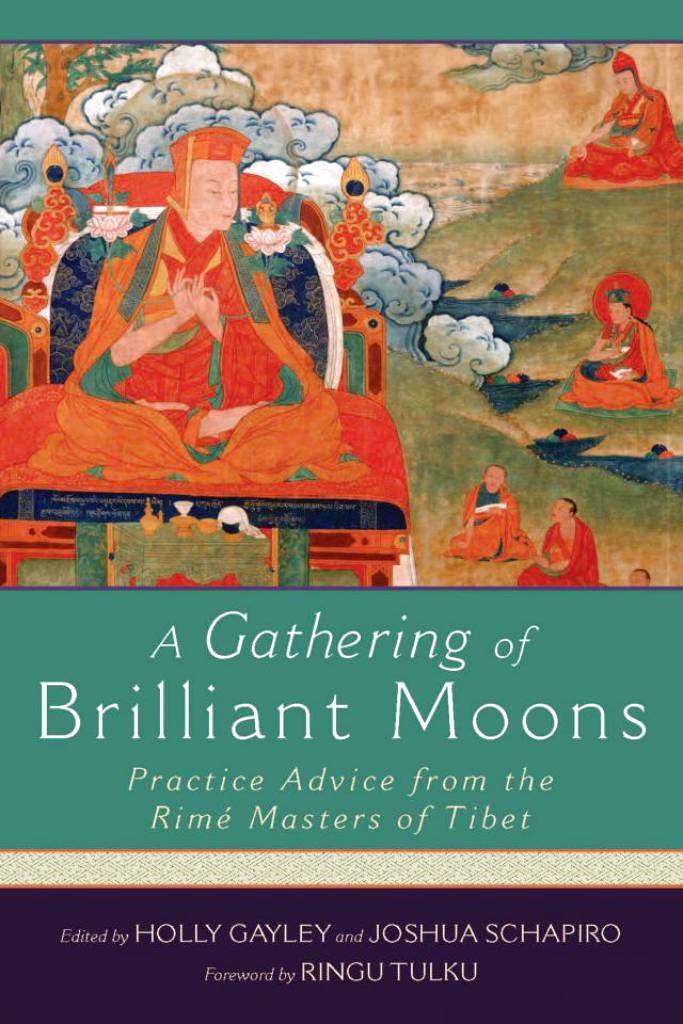
A Gathering of Brilliant Moons
This collection focuses on an influential and inspiring generation of Buddhist teachers: the nineteenth-century ecumenical, or rimé, tradition of eastern Tibet. A Gathering of Brilliant Moons provides lively translations of nineteen pithy and profound works by these great masters, along with essays by their translators which explore the aesthetic qualities of their chosen works, highlight their ecumenical features, and comment on the journey of translation.

Includes works from Jamgon Kongtrul, Dza Patrul Rinpoché, Ju Mipham Rinpoché, Dudjom Lingpa, The Third Dodrupchen, Do Khyentsé, Tokden Sakya Sri, Jikmé Lingpa, Shardza Tashi Gyaltsen, Getsé Mahapandita, Shangton Tenpa Gyatso, and Bamda Thupten Gelek Gyatso.

This book arose from a unique conference on Tibetan translation, where the fourteen translators shared their process with each other and received feedback from their peers with a special focus on the literary aspects of the source texts. As a reflection of this genesis, the accompanying essays in this volume by the translators explore the aesthetic qualities of their chosen works, highlight ecumenical features in them, and comment on the journey of translation. This unique book will be welcomed by religious scholars, Buddhist practitioners, and meditators. (Source: Wisdom Experience)

On the topic of buddha-nature, see especially Tina Draszczyk's translation of Jamgön Kongtrul's Immaculate Vajra Moonrays: An Instruction for the View of Shentong, the Great Madhyamaka in chapter 12, Putting Buddha Nature into Practice.

Book