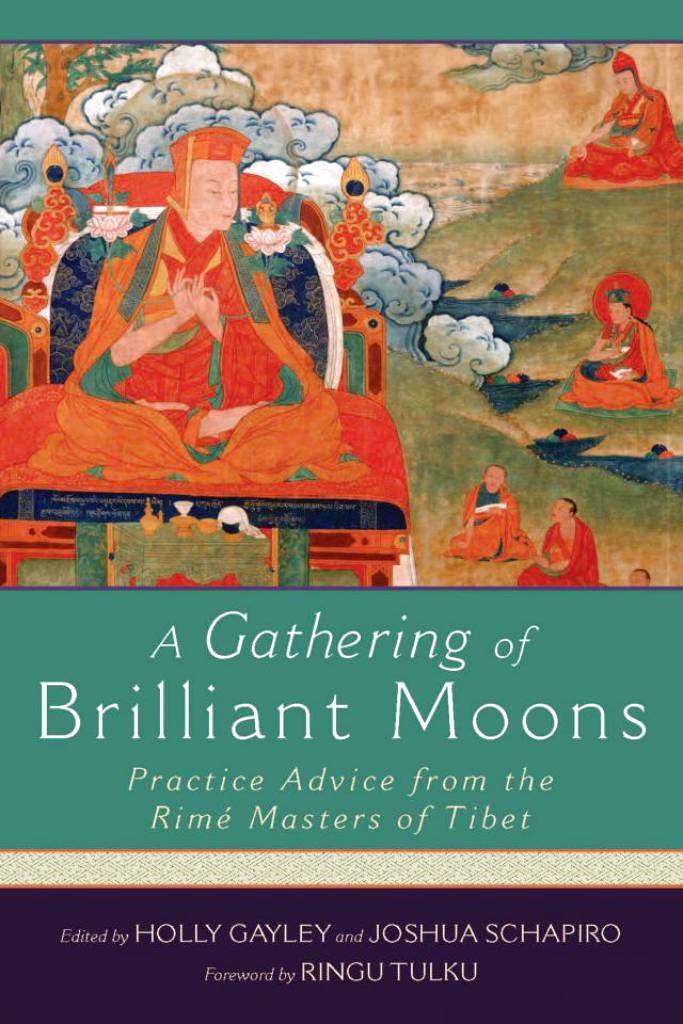
A Gathering of Brilliant Moons
| 🤓 Admin Zone 🛠️ hidden to non-admins | |

Description
Includes works from Jamgon Kongtrul, Dza Patrul Rinpoché, Ju Mipham Rinpoché, Dudjom Lingpa, The Third Dodrupchen, Do Khyentsé, Tokden Sakya Sri, Jikmé Lingpa, Shardza Tashi Gyaltsen, Getsé Mahapandita, Shangton Tenpa Gyatso, and Bamda Thupten Gelek Gyatso.
This book arose from a unique conference on Tibetan translation, where the fourteen translators shared their process with each other and received feedback from their peers with a special focus on the literary aspects of the source texts. As a reflection of this genesis, the accompanying essays in this volume by the translators explore the aesthetic qualities of their chosen works, highlight ecumenical features in them, and comment on the journey of translation. This unique book will be welcomed by religious scholars, Buddhist practitioners, and meditators. (Source: Wisdom Experience)
On the topic of buddha-nature, see especially Tina Draszczyk's translation of Jamgön Kongtrul's Immaculate Vajra Moonrays: An Instruction for the View of Shentong, the Great Madhyamaka in chapter 12, Putting Buddha Nature into Practice.
- Foreword
- Ringu Tulkuix
- Prefacexi
- Introduction1
- Holly Gayley and Joshua Schapiro
- Part I: Worldly Counsel21
- 1. Facing Your Mind23
- Jamgön Kongtrul and Dudjom Lingpa
- Translated by John Canti
- Jamgön Kongtrul and Dudjom Lingpa
- 2. Playful Primers on the Path47
- Dza Patrul Rinpoché
- Translated by Joshua Schapiro
- Dza Patrul Rinpoché
- 3. Dictums for Developing Virtue83
- Shangtön Tenpa Gyatso
- Translated by Gedun Rabsal and Nicole Willock
- Shangtön Tenpa Gyatso
- 4. Bold Judgments on Eating Meat97
- Shardza Tashi Gyaltsen
- Translated by Geoffrey Barstow
- Shardza Tashi Gyaltsen
- 5. A Letter to the Queen109
- Jikmé Lingpa and Getsé Mahāpaṇḍita
- Translated by Jann Ronis
- Jikmé Lingpa and Getsé Mahāpaṇḍita
- 1. Facing Your Mind23
- Part II: Meditation Advice123
- 6. Advice for Solitary Retreat125
- Do Khyentsé, Dza Patrul Rinpoché, and the Third Dodrupchen
- Translated by Holly Gayley
- Do Khyentsé, Dza Patrul Rinpoché, and the Third Dodrupchen
- 7. Encouragement to Pursue the Path171
- Bamda Thupten Gelek Gyatso
- Translated by Michael Sheehy
- Bamda Thupten Gelek Gyatso
- 8. How to Practice When Ill191
- Jikmé Lingpa
- Translated by Wulstan Fletcher
- Jikmé Lingpa
- 9. An Intimate Exhortation201
- Tokden Śākya Śrī
- Translated by Amy Holmes-Tagchungdarpa
- Tokden Śākya Śrī
- 10. A Meditation Instructor's Manual211
- Dza Patrul Rinpoché
- Translated by Sarah Harding
- Dza Patrul Rinpoché
- 6. Advice for Solitary Retreat125
- Part III: Esoteric Instructions239
- 11. Pointing to the Nature of Awareness241
- Ju Mipham Rinpoché
- Translated by Douglas Duckworth
- Ju Mipham Rinpoché
- 12. Putting Buddha Nature into Practice251
- Jamgön Kongtrul
- Translated by Tina Draszczyk
- Jamgön Kongtrul
- 13. Instructions on the Great Perfection285
- Jamgön Kongtrul
- Translated by Marc-Henri Deroche
- Jamgön Kongtrul
- 11. Pointing to the Nature of Awareness241
- Glossary303
- Tibetan Proper Names317
- Contributors327


- Library Items
- Books
- Gayley, H.
- Schapiro, J.
- Fletcher, W.
- Harding, S.
- Draszczyk, M.
- Canti, J.
- Sheehy, M.
- Duckworth, D.
- Ronis, J.
- Deroche, M.
- Holmes-Tagchungdarpa, A.
- Willock, N.
- Barstow, G.
- 'jam mgon kong sprul
- Bdud 'joms gling pa
- 'jigs med gling pa
- Dpal sprul rin po che
- Mi pham rgya mtsho
- Dodrupchen, 3rd
- Mdo mkhyen brtse
- ShAkya shrI
- Shar rdza bkra shis rgyal mtshan
- Dge rtse ma hA paN+Di ta tshe dbang mchog grub
- Zhang ston bstan pa rgya mtsho
- Thub bstan dge legs rgya mtsho
- Wisdom Publications
- Decade: 2010s