Literary and Socio-historical Background
| 🤓 Admin Zone 🛠️ hidden to non-admins | |
Description
By situating specific controversies within a broader historical context, this overview helps readers appreciate the significance of these debates beyond mere philosophical disagreements. It demonstrates how polemical literature served as a means for different schools to define their identities and claim legitimacy, highlighting the intricate ways in which Tibetan scholars engaged with their intellectual heritage and creatively reinterpreted earlier ideas to address contemporary concerns.
Featured on
The debates between Mi pham and his Dge lugs opponents did not emerge upon a blank slate. They occurred in a specific historical setting and can be viewed as a product of the interplay of various (religious, sociological, political, etc.) factors, and also the debates had certain historical repercussions. This horizontal perspective of investigating the socio-historical background of the debates, and, in particular, the question of how religio-political issues may have played a role in the debates, is the topic of the second part of this chapter.
Apart from that, the debates can also be situated in a vertical line of development, as an example of a specific type of discourse and a literary genre they are part of. Rooted in the rich Indian tradition of religious-philosophical disputation, the phenomenon of debating in Tibet is an integral element of monastic scholarship as it developed on the plateau. In the course of monastic education, specific types of debates are utilised as a heuristic method that facilitates a student’s entrance into the intricacies of Buddhist philosophical thought.[1] Beyond the frame of everyday monastic courtyard debating, debates between different factions and schools serve not only as a pedagogical means, but often exhibit a more antagonistic nature.[2] While Tibetan history is full of accounts of – at times very fierce – personal disputations, there are no records informing us about the exact development of these. As opponents were not always proximate in terms of space and time, debates also materialised in the form of polemical texts, composed to refute a (living or dead) opponent, and came to form an independent genre of Tibetan literature. It is as examples of this specific type of literature and debate that the controversies around Mi pham's Nor bu ke ta ka are analysed in this study. To place the debates in the line of the general development of the genre of which they are one of the most important manifestations is the task of the first part of the present chapter. In the process, we will also investigate the connections to earlier disputes that are made in the course of the debates, and the repercussions of these debates on later controversies.
The Controversies in the History of dgag lan Debate
"Polemics" as a Literary Genre
The categorisation of Tibetan literature as "polemical" entails some ambiguities. Donald Lopez, in his seminal article about this very genre of literature, suggested "polemics" as the translation of the Tibetan term dgag lan.[3] Of course, as José Cabezón has pointed out, there are various terms in Tibetan that denote a type of literature that might be called "polemical":[4]
The indigenous Tibetan nomenclature used to designate a literary work as polemical is twofold: (a) terms that are used to refer to works that bring forth charges (of inconsistencies, fallacies, etc.) against opponents, and that therefore initiate polemical exchanges, and (b) terms that are used to refer to works that respond to the charges made by others. As examples of the former – what we might call the accusatorial moment that initiates a polemical exchange – we find terms like "debate/dispute/argument" (rtsod pa), "disputational document or record" (rtsod yig), "refutation" (dgag pa), "record of a refutation" (dgag yig) "adversarial speech" (rgol ngag), and "critique/repudiation" (sun 'byin). As examples of the latter terms – the terms used to designate the responsorial moments in polemical exchanges – we find words like "response to a dispute/argument" (rtsod lan), "countering/overturning an argument" (rtsod spong, rtsod bzlog), "response to a refutation" (dgag lan, honorific gsung lan), and "rebuttal" (brgal lan).
The latter type of polemical literature – the responsorial moment of a polemical exchange – can be clearly defined. It usually focuses on one specific text that is regarded as an objection to one's own position. As an answer to these objections, this type of literature then tries to disprove the objections of the other party. As its main aim is the attempt to ward off the opponent's attack, the nature of this latter type of literature is entirely polemical.[5]
More ambiguous, however, is the determination of the first kind of this literature – the initiating moment of a debate. The goal of a text might be to directly and explicitly criticise certain positions of another party and thus start a polemical interchange. More often, though, critical elements appear in a certain text whose overall agenda is a different one. Despite the general non-polemical nature of the text, an opponent might focus on the polemical elements and regard the whole text as a "disputational document" (rtsod yig) that criticises his own positions, and might see himself forced to provide a "response to the objections" (rtsod lan). Thus, what is seen as the initiating moment of a debate depends on the viewpoint of the reader or recipient. This ambiguity can also be perceived in the case of Mi pham and his opponents: although it contains some polemical elements, Mi pham clearly marked his Nor bu ke ta ka as a commentary (rnam bshad/vyākhyā) to the BCA, and, as such, it can hardly be seen primarily as a "disputational document."[6] From his point of view, a debate was initiated by the Dge lugs scholars who criticised his commentary through various rtsod yig, which again led to Mi pham's answers to these objections.[7] The view changes when the events are described from the viewpoint of Mi pham's opponents. Here, Mi pham is seen as the aggressor who was criticising doctrines of the Dge lugs school with his Nor bu ke ta ka, criticism to which the Dge lugs scholars were then responding.[8]
Not only does this suggest that the role of the aggressor in a debate is an unpopular one, but it further makes clear that the genre-determination of a certain text might be unclear: a text might be composed, for example, primarily in the form of a commentary, but could nevertheless function also as a polemical text.[9]
Polemical Literature in Tibet
An extended history of the genre of polemical literature remains to be written, but José Cabezón, in the introduction to his translation of Go rams pa's Lta ba'i shan 'byed, provides us with an "impressionistic" overview of this literature as it developed in Tibet. In the following, I will highlight some cornerstones of this development in order to understand the place of the disputes around Mi pham's Nor bu ke ta ka in the line of polemical literature and debate.[10]
Surveying polemical literature as a whole, three general topics that served as focal points of discussion can be distinguished: practices, texts, and doctrines. When Buddhism took hold in Tibet, controversies about the right practice of religion arose not only between established practices, often associated with the Bon tradition, and the Buddhist newcomers, but also within the Buddhist tradition itself. Cabezón mentions the ordinance (bka' shog) of the Pu hrangs-king Ye shes 'od (late tenth, early eleventh centuries) as what could probably be called "the earliest polemical document in the history of Tibetan literature."[11] The short work expresses a concern about the way Buddhism is practiced by tantrikas (sngags pa) in rural areas, and condemns certain practices in ritual, such as sex, killing, human sacrifice, etc. The Bka' chems ka khol ma, which was discovered by Atiśa (b. 972/982), shares these worries about the proper practice of Buddhism, but also addresses the issue of proper belief, that is, of Buddhist doctrine. In the following centuries, doctrines were to become the focus of the majority of controversies, which does not mean that the question of right practice was completely off the agenda. Even six centuries after the composition of Ye shes 'od's text, the Rnying ma scholar Sog zlog pa Blo gros rgyal mtshan (1552–1624) regarded the work as a criticism of the practices of his own school and felt inspired to respond to it. The most famous controversy about proper practice in the last few centuries developed only recently, in the 1970s, and is still very much a hot topic, namely the issue of the practice of the Dge lugs Dharma protector (chos skyong,srung ma) Rdo rje shugs ldan.[12]
After Ye shes 'od, it was the celebrated translator Rin chen bzang po (958–1055), who, being under the patronage of the former, initiated the criticism of tantric texts. In his own ordinance, Pho brang Zhi ba 'od (second half of the eleventh century), the grand nephew of Ye shes 'od, claims that many of the texts that were central to the Rnying ma tradition were not authentic, meaning that they were not translations from texts originating from India.[13] This accusation of the apocryphal nature of the Rnying ma tantras eventually led to their exclusion from the Buddhist canon that was compiled by Bu ston (1290–1364).[14] The question of authenticity was also carried forward to other tantric traditions such as the Hevajra-tantra, central to the Sa skya tradition, as well as to the overall body of Gter ma literature, and, in turn, evoked the expected disapproval from their followers, which manifested itself in the production of polemical literature by both sides.
In the debates about Mi pham's Nor bu ke ta ka, questions about the acceptance of practices and general bodies of texts play a minor role; rather, their focus is on specific doctrines, a topic that became more important with the sophistication and differentiation of the Tibetan Buddhist tradition, but that was also crucial to its very beginnings. Even though its exact development (and some say even its historicity in general) is left obscure, the socalled "Great Debate" – the debate that allegedly was held at the monastic centre of Bsam yas at the end of the eighth century – forms a seminal moment in the way the historical development of doctrinal controversies in Tibet is imagined.[15] While the Tibetan sources report a "classical" debate between two parties, headed by a judge, the Chinese sources from Dunhuang describe, rather, a kind of interrogation, polemical questions that were put to one party, and its subsequent replies. Both sources, however, agree on the subject matter of the debate: the question about which way to awakening is preferable, the "gradualist' (rim gyis pa) way that emphasises the practice of the six pāramitās and the soteriological value of certain concepts such as compassion, or the "simultaneist" (cig car ba) way that views any conceptual state of mind as an obscuration on the path to buddhahood. The respective views were represented by the Indian scholar Kamalaśīla on the one side and the Chinese Ch'an master Hwa shang Mahāyāna on the other. In this constellation, it is clear that the two masters not only stood for their individual views, but for a more Indian or a more Chinese implementation of Buddhism in Tibet in general. Most of the Tibetan sources inform us about the victory of Kamalaśīla and a subsequent decree of Khri srong lde btsan, the judge of the debates and ruler of Tibet, which established the view of Nāgārjuna and the practice of the six pāramitās as the proper system for Buddhism under his reign. Thus, the Indian interpretation of Buddhism in Tibet was enforced, while the Chinese tradition and its representative Hwa shang Mahāyāna were banned from the country. Leaving questions of historical accuracy aside, it was this image of the debates that was most influential in the remembrance of later Tibetan generations. In the following centuries, Hwa shang Mahāyāna became the archetype of an erring and allegedly losing opponent, and various scholars accused their opponents of adhering to a "Hwa shang view" (hwa shang gi lta ba), a view that was deemed to be nihilistic.[16] The idea of a possible presence of such a wrong view is also reflected in the interpretation of the story of "Hwa shang's lost shoe." It is said that the defeated Hwa shang left behind one shoe when he left the debate arena, which in turn was seen as an omen that proponents of his view would still be present – left over – or come back to Tibet in later times.[17] In the present debates, too, this topic resonates strongly, as Mi pham is accused repeatedly by his Dge lugs opponents that he adheres to a Hwa shang type of view.
While the beginning of the "later diffusion" (phyi dar) was marked by questions about proper practice and texts that were discussed by the rulers and their followers in West Tibet, soon a shift of interests evolved. With Rngog Legs pa'i shes rab's establishment of Gsang phu Monastery in 1073 in Central Tibet, the foundation was laid for a more detailed commitment to Buddhist philosophy and the reassessment of its doctrines. Famous for his criticism of Candrakīrti's Madhyamaka and innovations in Pramāṇa theory is Phya pa Chos kyi seng ge (1109–69),[18] an early abbot of Gsang phu, who was criticised by later scholars for his stance. Sa skya Paṇḍita's (1182–1251) Tshad ma rig gter, for example, can be seen as such a criticism. In Sa Paṇ's other works, such as his work on the three vows, the Sdom gsum rab dbye, too, the polemical element is very much present. His criticism of the Mahāmudrā tradition of the Bka' brgyud school is eminent, but also the disagreement on the subject of the three vows between him and his contemporary 'Jig rten mgon po (1143–1217), the founder of the 'Bri gung bka' brgyud sect.[19]
In the fourteenth century, two of the most prominent figures step onto the stage of polemical exchange, prominent not so much because of their own polemical verve, but rather, as Cabezón rightly notices, for being "the object of others' polemics."[20] The first, Dol po pa Shes rab rgyal mtshan (1292–1361), the father of the Jo nang tradition, is known for his interpretation of emptiness as "empty of what is other" (gzhan stong), which established an – often seemingly irreconcilable – division among Tibetan Mādhyamikas into followers of the rang stong or gzhan stong traditions, respectively. The second, Tsong kha pa Blo bzang grags pa (1357–1419), is probably the most influential of all Tibetan philosophers. His approach is generally distinguished by the rigorous employment of logic, even for such lofty subjects as the determination of the absolute (don dam/paramārtha), an approach that was preserved and refined by his immediate disciples, such as Rgyal tshab Dar ma rin chen (1364–1432) and Mkhas grub Dge legs dpal bzang (1385–1438), and later scholars of the Dga' ldan (later Dge lugs) tradition that he founded.
Dol po pa was criticised by Sa skya masters, such as Rong ston Shes bya kun rig (1367–1450), Red mda' ba Gzhon nu blo gros (1349–1412), and Go rams pa Bsod nams seng ge (1429–89). Also Tsong kha pa, who was a student of Red mda' ba, is known to have refuted Dol po pa, a criticism that – with the growth of power in the Dge lugs tradition – only became stronger in the subsequent generations of scholars, and can be seen as a contributing factor that led to the conversion of Jo nang monasteries into Dge lugs institutions and the ban of Jo nang texts under the rule of the fifth Dalai Lama Ngag dbang blo bzang rgya mtsho (1617–1682), a fate that the Jo nang pas shared with the Bka' brgyud tradition.[21]
As much as Tsong kha pa's innovations were celebrated in his own surroundings, they were objected to by scholars of other traditions, the Sa skya school in particular. This, in turn, led to the expected counteractions and the production of a considerable corpus of polemical literature between the fifteenth and eighteenth centuries. As for the most famous critics of Tsong kha pa, Stag tshang lo tsā ba (b. 1405), Shākya mchog ldan (1428–1507), Go rams pa, and the Eighth Karma pa Mi bskyod rdo rje (1507– 54) must be mentioned. Stag tshang's criticism was then objected to by the First Paṇ chen bla ma Blo bzang chos kyi rgyal mtshan (1570–1662), 'Jam dbyangs bzhad pa (1570–1662), and Phur lcog Ngag dbang byams pa (1682–1762). Rje btsun Chos kyi rgyal mtshan (1469–1544/6), the composer of the yig cha of the Se ra byes college, responded to the other three critics of Tsong kha pa mentioned, Shākya mchog ldan, Go rams pa, and Mi bskyod rdo rje.[22] Responses to Go rams pa were further written by 'Jam dbyangs dga' ba'i blo gros (1429–1503) and Lcang lung Paṇḍita (1770–1845). The philosophical controversy between the Dge lugs tradition and – mainly – scholars of the Sa skya school was not followed by a large-scale confinement of their tradition, as was the case for the Jo nang school, but individual authors, such as Go rams pa and Shākya mchog ldan, were suppressed under the rule of the Dga' ldan pho brang.
The nineteenth century was marked by the controversies between Mi pham and several scholars, mainly from the Dge lugs tradition, events whose exact developments have already been discussed in the last chapter. Many of the doctrinal and hermeneutical issues that were discussed for centuries by earlier scholars surface here again, and add to a general divide between the Dge lugs school and non-Dge lugs traditions in scholastic matters.
Some centuries later, the Dge lugs stance of Madhyamaka was even criticised from inside the Dge lugs tradition, when the famous A mdo libertine Dge 'dun chos 'phel (1903–1951) passed down his Klu sgrub dgongs rgyan.[23] Dge 'dun chos 'phel's work was deemed close to views associated with the Rnying ma tradition and viciously rejected among orthodox Dge lugs circles, for example, by Dze smad Rin po che (1927–96) and his former teacher Rdo sbis Dge bshes Shes rab rgya mtsho (1884–1968), which again led to further defending and attacking of the different positions.[24]
In the nineteenth and twentieth centuries, the corpus of polemical literature expanded rapidly, making it difficult to keep track of all its developments. In recent times, polemical discourse has also discovered Tibetan-language periodicals, as well as the internet, as suitable media.[25]
In the current state of research on polemical literature, evaluating its overall development appears a very bold and speculative venture. Nevertheless, I will dare to make a few – tentative – remarks in this regard. Reviewing the corpus of literature that the TBRC database lists under the rubric "polemic," and comparing it with the dates of the individual works or the dates of their authors, at least gives us an idea of the development of the genre in terms of quantity.[26] TBRC's list hardly contains any examples of polemical literature before the end of the fourteenth century, which seems to imply that there were only a few works of this genre composed in this period, or that existing works were lost, or, probably, both. The situation changes clearly with the fifteenth century, where several works are listed. The figures go down for the sixteenth century and remain stable for the following period, including the eighteenth century. Then, the numbers rise again in the nineteenth century, a development that culminates in the twentieth century with an enormous production of polemical literature.
How can this development be interpreted? Two points seem significant: the rise of polemical literature in the fifteenth century, and its enormous growth, starting with the nineteenth century. In both periods, major conflicts were taking place – the controversy between Sa skya and Dge lugs scholars in the fifteenth century, and the controversy between Dge lugs scholars and Mi pham in the nineteenth century – and it seems plausible to think of these debates as initiating moments that entailed subsequent controversies, thus leading to the growth of polemical literature. Such an explanation can, of course, only be applied to a part of the literature and – most importantly – does not concern the beginning of a controversy.[27] Exploring the conditions for the start of a debate remains the task of further research; in the case of the debates on Mi pham's Nor bu ke ta ka, these conditions will be dealt with in the second part of the present chapter.
In terms of content and character, it may be useful to view the overall development of polemical literature as a continuous process of differentiation that evolves from the coarser to the more subtle: from debates about the right tradition (Bsam yas) and religion (chos vs. bon) in the first propagation (snga dar), through questions about the right practice (critique of māntrika practice by Ye shes 'od and Atiśa) and texts (the exclusion of the Rnying ma tantras from the Bka' 'gyur) within the Buddhist tradition in the second propagation (phyi dar), to questions about the right doctrines between adherents of different schools (e.g., the Sa skya-Dge lugs controversy) and questions about the right doctrines among scholars of the same school (e.g., certain Dge lugs scholars that belonged to different colleges; the debate between Mi pham and Rdo grub Dam chos) at the climax of Tibetan scholasticism. As such, every debate can be read as a communication, where one side criticises and excludes the other (religion, tradition, practice, text, doctrine, etc.) and by that very act constitutes the borders of its own system. In the course of Tibetan scholasticism, these systems split and differentiate, forming new units that act as references for the identity of their adherents.
Connections to Earlier Controversies
In view of the lack of detailed studies in the field of polemical literature, drawing precise connections in terms of similarities of positions and arguments between the debates under consideration and earlier controversies is rather tedious. However, the participants of the debates make reference to earlier developments and ascribe to themselves and their opponent(s) a place in the larger context of philosophical controversies in Tibet. It is on these contextualisations, found usually as an introductory framework to the content proper of a text, that we will focus in the following.
In the introductions of two of the texts that Dge lugs scholars sent to Mi pham in order to criticise him, explicit reference is made to some of the earlier debates. Rab gsal, in his first critique,[28] begins by establishing Tsong kha pa, the founder of his native tradition, as an incontestable authority, who was not only predicted by "trustworthy scriptures and excellent beings,"[29] but also lived up to their expectations. Nevertheless, so Rab gsal stated, he was criticised by Stag tshang Shes rab rin chen, the famous first critic of Tsong kha pa, described above. The reason for his criticism is obvious: he could not see the greatness of Tsong kha pa as he "had a mind that is afflicted by the defect of Timira,"[30] a disease where one's vision is disturbed by apparently existing, but actually non-existent hairs – a typical example of someone whose perception is not to be trusted. Those of sharp faculties (dbang rnon), on the other hand, certainly understood the profundity of Tsong kha pa's findings. Nowadays, however, Rab gsal continues, there is a composer of a commentary of the ninth chapter of the BCA who has all sorts of flaws. Mi pham is described as "short-tempered" (blo sna thung) and "having a partial view" (phyogs re'i mig can);[31] he "criticises any text of his own or another's [tradition] without consideration and, in particular, he is clueless with regard to the path of reasoning [...]."[32] This suggests that Mi pham, just like Stag tshang Lo tsā ba earlier, is unjustly criticising Tsong kha pa. For Rab gsal there is a clear distinction among Tibetan thinkers: as Tsong kha pa is the benchmark for what is right, everyone who follows in his tradition can be established as a proper heir of Buddhist thought, while everyone who is in contradiction to Tsong kha pa must inevitably be wrong.
A similar division is made by Ldan ma Blo chos, who, in the introduction to his own critique of Mi pham, sums up the development of philosophical controversies in Tibet in the following way:[33] Initiated by Nāgārjuna, the second Buddha, the Madhyamaka tradition was spread by masters of the Prāsaṅgika and Svātantrika traditions and was flourishing in India. Then, gradually, it came to Tibet, where "the collections of the profound and vast Dharma [...] were translated well," thanks to the combined efforts of translators and rulers. Even though Buddhism was able to establish itself in the tradition of the Early Translation (sngar 'gyur) with an abundance of followers, thus being likened to "a gathering of bees," "the strength of the interest of the disciples gradually diminished and hence the majority turned away from the correct path: some took their own view to be the highest, and pretended it was the sermon of the Buddha, others came into contact with wrong views such as [that of] Hā shang [...]. These people of wrong views and practices were refuted by Kamalaśīla." Further, Atiśa criticised those who took up the path of the Vajrayāna without basing themselves on the ordinary path (of proper discipline etc.) first, and "adorned Tibet with the Bka' gdams pa teaching." Later, this teaching was obstructed by "the mistaken people from earlier times" (sngar gyi log rtog rnams). At that stage, it was time for Tsong kha pa to point out the correct path once again. He and his followers succeeded, but soon afterwards "the black banner of the proponents of wrong [positions] was woven by the three, Go, Shag, and Stag," i.e., the famous Sa skya critics Go rams pa, Shākya mchog ldan, and Stag tshang lo tsā ba. Of course, the followers of the Dge lugs tradition did not allow these wrong views to prevail; hence Rje btsun Chos kyi rgyal mtshan, 'Jam dbyangs dga' ba'i blo gros, and Paṇ chen Chos rgyan "cut [these wrong views] with the sharp knives of scriptures and reasoning and knocked them down." In the present day, Ldan ma Blo chos continues, there is again a detractor of the Lord Tsong kha pa. This time it is the "fearless" Mi pham, who composed "sarcastic refutations with regard to the positions (thugs bzhed) of the Lord [Tsong kha pa]'s own tradition that clarify the difficult points of the Prajñā[nāma]mūla[madhyamakakārikā] by way of the eight great theses of the Prāsaṅgika [tradition]." Mi pham's criticism was answered by Brag dkar Sprul sku, to whom Mi pham responded with his Brgal lan nyin snang. In Blo chos' conclusion, the problem is that Tsong kha pa follows the scriptures of Candrakīrti, Buddhapālita, and ultimately Nāgārjuna in a correct way, while Mi pham "expounds these scriptures in a wrong way, by [giving] crooked explanations."
While Ldan ma Blo chos' account is much more elaborate than that of Dpa' ris Rab gsal, we can see that Blo chos too, draws a clear-cut line between what is right and what is wrong among Tibetan philosophers. In its Madhyamaka stance, Tibetan philosophy goes back to the Indian master Nāgārjuna, and for Ldan ma Blo chos the right interpretation and preservation of Nāgārjuna's ideas is essential. In India, Nāgārjuna's thought was disseminated by the masters of the Prāsaṅgika and Svātantrika traditions, and when Buddhism spread to Tibet, it was masters such as Kamalaśīla and Atiśa who carried on Nāgārjuna's heritage. Through this line of transmission, Madhyamaka philosophy came to Tsong kha pa, who "spread it as the great sound of the correct Dharma,"[34] and – at least for followers of the Dge lugs tradition – it is in his native tradition that this "correct Dharma" is preserved.
Since this lineage of transmission is "correct" and "pure," it exposes itself to infiltration and attack, and must therefore be defended. In Ldan ma Blo chos' account, first Kamalaśīla had to ward off Hwa shang and others of wrong views and conduct. After him, it was Atiśa who had to fight misguided tantrikas. Even though each of them succeeded, new times brought new dangers to the correct lineage of the transmission of Buddhism from India to Tibet. Again, Tsong kha pa is described as the benchmark, who, just as his predecessors, was able to ensure the continuation of the proper understanding of Nāgārjuna – in his case against "the mistaken people from earlier times," referring probably to the aforementioned followers of the mistaken Hwa shang and certain tantrikas. After Tsong kha pa, a new threat arose with various Sa skya scholars. For Ldan ma Blo chos, Tsong kha pa embodies the standard of Tibetan philosophy, and hence any criticism of him endangers the preservation of Nāgārjuna's thought. Tsong kha pa's own followers therefore fought back against the criticism from the Sa skya side; in more recent times, scholars such as Brag dkar Sprul sku have guarded Tsong kha pa's heritage against the qualms raised by Mi pham.
In Ldan ma Blo chos' description, the lineage of proper transmission is thus contrasted with a lineage of "impure transmission," or threat to the former. In this lineage, Mi pham is placed in a line with Hwa shang, certain misguided tantrikas, their successors, and the critics of Tsong kha pa from the Sa skya tradition.
Turning to the texts that were exchanged between Mi pham and Dpa' ris Rab gsal – the major object of this study – we find two recurring elements in the content proper of the debates that also locate Mi pham in this lineage: the claim that Mi pham's position resembles that of Hwa shang, and the claim that his interpretation would conflict with that of Tsong kha pa.
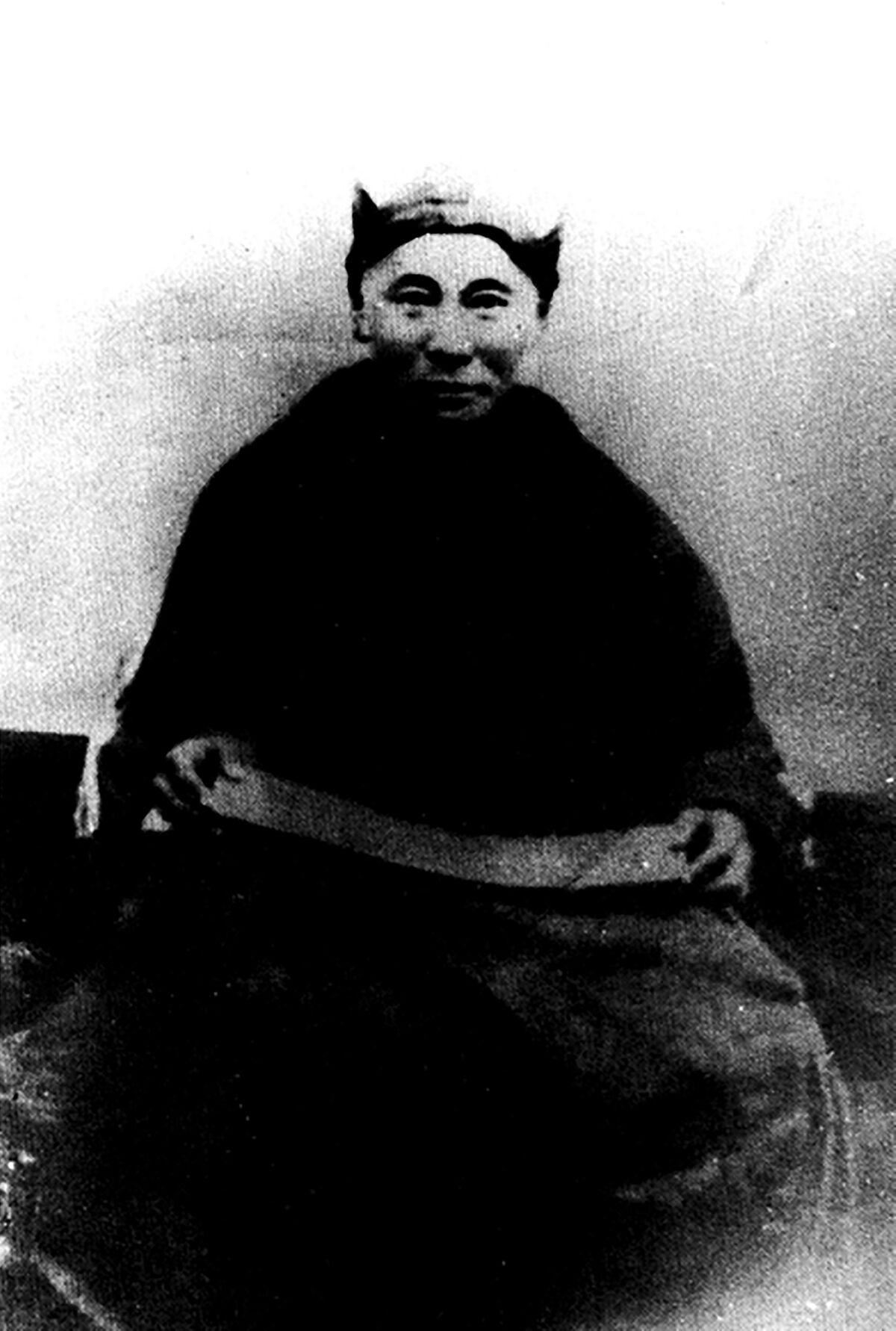
Photographer unknown
In both philosophical discussion and purely rhetorical polemic,[35] Rab gsal accuses Mi pham of adhering to a Hwa shang view,[36] of basing his arguments on the same scriptures as Hwa shang,[37] and of "coming from China in the guise of a present-day monk."[38] Further, Mi pham "is also not to blame [for adhering to the Hwa shang view], since he received his (i.e., Hwa shang's) old boot as a reward."[39] All these examples are intended to indicate a strong connection between Mi pham and Hwa shang, a figure that, in the development of Tibetan philosophy, "has become the quintessential philosophical other."[40]
The second issue, the question of whether Mi pham contradicts Tsong kha pa, is another prominent theme in the debates. Rab gsal uses Tsong kha pa as the authority in all philosophical matters;[41] for him, the Dge lugs founder (and also his heirs) assures the proper transmission of the lineage coming from India through masters such as Atiśa and 'Brom ston.[42] Mi pham, on the other hand, is depicted as being in contradiction to the Dge lugs leader.[43] In both cases, i.e., the charges that Mi pham adheres to the Hwa shang view or contradicts Tsong kha pa, the implications are the same: if either of the accusations could be established, Mi pham clearly would have overstepped the bounds of proper philosophy.
How does Mi pham then react to these charges, and how does he place himself and his opponents within the larger context of philosophical controversies in Tibet? Mi pham is clearly in a much more defensive position. In his texts we do not find any attempts to locate the opponent within a long tradition of mistaken understanding; instead, Mi pham is occupied with warding off the charges made against him. In an elaborate way he argues that his position is not that of Hwa shang, and, in view of the lack of concrete texts from the Hwa shang tradition, also asks for more care when accusing someone of holding the view of Hwa shang.[44] Further, he denies that he contradicts the position of Tsong kha pa. Mi pham joins his Dge lugs opponents in praising their leader[45] and refers to certain texts by Tsong kha pa in order to prove the ultimate consensus between himself and the Dge lugs founder.[46] Mi pham thus makes clear that he accepts Tsong kha pa's authority; he argues that, rather than his contradicting Tsong kha pa, it is the "present holders of the lineage of Lord [Tsong kha pa],"[47] or, even more pointedly, the "present people that assert to hold the lineage of Lord [Tsong kha pa], the Mahātma,"[48] who do not understand the intention of their founding master, and hence see a contradiction between him and Mi pham. Mi pham emphasises the ultimate unity of himself and Tsong kha pa, and thus places himself – along with Tsong kha pa – in the lineage of proper transmission of Buddhist thought. According to him then, it is only those who do not see this unity who have gone astray from the proper path.
On the other hand, Mi pham also has to acknowledge certain differences between his tradition and that of Tsong kha pa. Mi pham describes this disparity as a "difference insofar as the position (bzhed tshul) of the earlier Tibetan [thinkers] (bod snga rabs pa) and of the later scholars (phyis kyi mkhas pa) is slightly different."[49] Among Tibetan Madhyamaka philosophers, a common classification is that one either belongs to the tradition of "the ones from earlier times" (snga rabs pa) or the tradition of the "ones from later times" (phyi rabs pa). "Snga rabs pa" denotes the rang stong branch of Madhyamaka that developed prior to Tsong kha pa, including scholars from the Sa skya, Rnying ma, and Bka' brgyud traditions, while the tradition that is based on Tsong kha pa's interpretation is termed "Phyi rabs pa."[50] Mi pham explains the differences between himself and Tsong kha pa as a result of the affiliation with these two disparate traditions, the Phyi rabs pa tradition that Tsong kha pa founded, and the Snga rabs pa tradition, in which Mi pham places his own philosophy. This identification with the Snga rabs pa tradition, to which Mi pham frequently refers, has a clear advantage:[51] even in the case of – as Mi pham would say, superficial – disparity between his and Tsong kha pa's thought, it is not the result of a critique of Tsong kha pa, but only of the affiliation of his own school. Mi pham explains that he "was born in this life at the feet of the teaching of the Earlier Translation (snga 'gyur pa)" – the Rnying ma tradition – and that he "received the nectar [of the teaching] from the mouths of great holders of the teaching." Hence, devotion arose in him and he "simply was not caught by the demon of terrible destruction, that means, an evil attitude of disparaging the profound long-standing tradition of the Highest (i.e. the Buddha)," but his "explanations follow the earlier highest [masters]."[52] Thus, Mi pham establishes his position on firm ground; as a disciple of the Rnying ma tradition, and, as such, being affiliated with the Snga rabs pa tradition of Tibetan Madhyamaka, his thought does not deviate from the lineage of the proper transmission of Buddhism, even though it might not be in line with the philosophy of Tsong kha pa in every aspect. Put in this context, difference is natural, and not a deviation from the proper way, as Mi pham points out: "[my] view is in accordance with the Tibetan Snga rabs pa [tradition] and some people who belong to the Phyi rabs pa [tradition] announce it to be a 'private Dharma'."[53]
We have seen how the Dge lugs scholars Ldan ma Chos dbyings and Dpa' ris Rab gsal use references to earlier controversies to distinguish a proper transmission of Buddhist thought from its improper counterpart. In their view, Tsong kha pa and his followers assure the continuation of the earlier, while any deviation from Tsong kha pa's thought – such as the philosophy of Mi pham or earlier misguided scholars – is perceived as a threat to this transmission. Mi pham, on the other hand, takes a defensive position. He tries to refute the charges made against him and establishes his own thought as part of his own Rnying ma school and the Snga rabs pa interpretation of Tibetan Madhyamaka.
Impact of the Debates on Later Controversies
As noted above, the enormous growth in the production of polemical literature in the nineteenth and twentieth centuries makes it difficult to keep track of all its developments. While the debates around Mi pham's Nor bu ke ta ka have had their impact on a number of these controversies, I will focus only on a single, particularly well-known example. Dge 'dun chos 'phel with his Klu sgrub dgongs rgyan is probably the most famous critique of his own Dge lugs tradition in the twentieth century. Even though his work does not make any direct reference to the debates surrounding Mi pham's Nor bu ke ta ka, certain parallels suggest a connection between the two controversies.[54]
Just as in the earlier debates, the issues under discussion centre on the specific manners of interpretation of two different Tibetan Madhyamaka traditions, the Snga rabs pa and the Phyi rabs pa traditions. Dge 'dun chos 'phel frequently refers to the Snga rabs pa tradition and defends it against his native Phyi rabs pa tradition and its founder Tsong kha pa.[55] As a consequence, Dge 'dun chos 'phel's work addresses many of the topics that were discussed earlier by Mi pham and his opponents, and, before them, among Dge lugs and mainly Sa skya scholars in the period between the fifteenth and the eighteenth centuries: the reliability of conventional valid cognition (tha snyad tshad ma); a too narrow or too broad determination of the negandum (dgag bya); a literal understanding of the Madhyamaka principle that things are "neither existent nor non-existent" (yod min med min) versus an interpretation through the insertion of qualifiers/specifiers; a conception of emptiness as being free from two (yod, med) or four extremes (yod, med, gnyis, gnyis min); the role of assertions (dam bca', khas len) in Prāsaṅgika Madhyamaka; the scope of logic; etc.[56]
Based on the similarity of certain ideas, Donald Lopez refers to the famous Sa skya trio Stag tshang lo tsā ba, Go rams pa, and Shākya mchog ldan as precedents for Dge 'dun chos 'phel's views.[57] Surely we can add Mi pham to this list of Snga rabs pa philosophers, as Dge 'dun chos 'phel – growing up in the same area as Dpa' ris Rab gsal, one of the main opponents of Mi pham, and studying at 'Bras spungs, the monastic institute of Brag dkar Sprul sku and Ldan ma Chos dbyings, Mi pham's two other Dge lugs opponents – must have been aware of the controversies surrounding Mi pham's Nor bu ke ta ka.[58] Moreover, parallels between Dge 'dun chos 'phel's work and the texts of Mi pham are not limited to specific philosophical ideas alone, but can also be observed in the sources that are consulted to verify these ideas.[59]
Obviously, Dge 'dun chos 'phel was in a state of abeyance and held both Tsong kha pa and Mi pham – two of the greatest masters of quite divergent schools – in great esteem, as expressed in one of his last wishes before his death that a poem of each of the two masters should be read to him.[60] That Dge 'dun chos 'phel was seen as holding an arbitrary position between Tsong kha pa and Mi pham is also illustrated by an anecdote related by his student, friend, and companion Shes rab rgya mtsho:[61]
One day, as an aside to the accounts of the Lamas, I asked [Dge
'dun chos 'phel]: "Who of the two, Lord [Tsong kha pa], the
Mahātma, and the Dharma Lord Mi pham, is wiser?" He said:
"I have thought this issue over many times. Those two are very
similar: their minds are emanations of the Buddha and both
had visions of Mañjuśrī. If both were present today and en-
gaged in debate, Lord [Tsong kha pa] would probably come
out as the wiser, as the Precious Lord [Tsong kha pa] had en-
gaged in academic training for a long time. That is what I think.
With regard to skill in acute intelligence, ability to understand,
way of explanation, and so forth, Mi pham is terrific. But if oth-
ers hear this, they could well object. This is truly what I say."
In the present context, Shes rab rgya mtsho's question is even more interesting than Dge 'dun chos 'phel's pointed answer. The question suggests that the two masters, Tsong kha pa and Mi pham, could be compared in terms of their intellectual achievements, that – ultimately – there is a struggle of supremacy between these two scholars. It seems that Shes rab rgya mtsho – just like Mi pham's direct opponents – does not view the tensions between Mi pham and the Dge lugs school in their specific historical context, as a debate between contemporary figures, but shifts the tensions back in time and conceptualises them as a struggle between Mi pham and Tsong kha pa.
As mentioned earlier, Dge 'dun chos 'phel's work was criticised rather strongly by orthodox Dge lugs scholars such as Dze smad Rin po che and Dge 'dun chos 'phel's teacher, Rdo sbis Shes rab rgya mtsho (not to be confused with his aforementioned friend who bears the same name). The most fundamental point of criticism made by later scholars was to question the authenticity of the work in general. According to its colophon, it was composed by Dge 'dun chos 'phel's student Zla ba bzang po, who belonged to the Rnying ma tradition, but based on the oral instructions of Dge 'dun chos 'phel. Bdud 'joms Rin po che, another famous Rnying ma scholar, is reported to have financed the whole undertaking and also added three verses of his own to it.[62] Some scholars thus did not regard the Klu sgrub dgongs rgyan as a proper work of Dge 'dun chos 'phel, but rather as a "mixture" that was deemed to be greatly influenced by Rnying ma ideas.[63] Dge 'dun chos 'phel's friend Hor khang Bsod nams dpal 'bar writes in this regard:[64]
Concerning whether or not the Adornment for Nāgārjuna's Thought is an actual composition of that excellent being, there is a difference of opinion between the Dge lugs and the Rnying ma. Some say that it is not the statements of Dge 'dun chos 'phel and that it is a mixture, with a great deal added to Zla ba bzang po's notes. Others identify it as an actual composition of Dge 'dun chos 'phel.
Also, defenders of Dge 'dun chos 'phel's work noticed a connection to traditional Rnying ma ideas. Thub bstan blo gros in his Dgag lan mun sel sgron me refutes not only attacks on the Klu sgrub dgongs rgyan, but also attacks on the thought of Mi pham. Further, Blo bzang chos grags, in his criticism of the Dgag lan mun sel sgron me, links the Klu sgrub dgongs rgyan to Mi pham's philosophical stance.[65]
This suggests that salient issues of the previous controversies resonate in Dge 'dun chos 'phel's work, as it has been conceived of by both his supporters and opponents. The controversies connected to Mi pham's Nor bu ke ta ka are, then, not only a logical continuation of the discussions of earlier scholastics, but they also provide an important impetus for the ways Madhyamaka thought has been discussed in the twentieth century and continues to be in the twenty-first.
Notes
- ↑ See Dreyfus 2003b for a detailed description of the role of debate in the monastic education system.
- ↑ This does not imply that the debates in the courtyard of monastic institutions are always free from a sense of rivalry. In every debate, competitiveness and the notion of winning and losing are of importance, but it makes a difference as to whether a debate is part of a daily routine, where one argues for hours with members of the same monastic community who basically share the same views, or whether one enters a debate on a specific occasion with an opponent who belongs to another religious order, and thus has a very different viewpoint.
- ↑ Lopez 1996: 218; cf. p. 222, n.2 for the rationale behind the translation "polemics," contrasted with the meaning of "apologetics."
- ↑ Cabezón & Dargyay 2007: 12.
- ↑ Disproving the opponent might also make it necessary to restate one's own position and thereby also help to sharpen a certain point of view, but the main aim of this literature is generally not the — pedagogically easily approachable – exposition of a certain doctrinal system, as it is, for example, for other genres, such as doxographical texts or "stages of the doctrine" (bstan rim) literature.
- ↑ The inclusion of polemical elements in a commentary is not surprising at all. Rather, as Vasubandhu laid out in his Vyākhyāyukti – a standard work for exegetical practice, commonly referred to also by later Tibetan commentators – the polemical format is one of the five aspects a good commentary should pay attention to. In relation to the text it comments on, a commentary has to clarify: 1) intention (dgos pa/prayojana), 2) summarised meaning (bsdus pa'i don/piṇḍārtha), 3) meaning of the words (tshig don/padārtha), 4) connections (mtshams sbyor/anusandhi), 5) response to objections (brgal lan/codyaparihāra); see Verhagen 2005: 574f.
- ↑ This view is clearly expressed in the way Mi pham relates to texts of his opponents. In the response that he sent to Brag dkar Sprul sku, Mi pham explains that he composed the work as "an answer to the people who say that the commentary on the chapter of insight of the BCA that I (i.e., Mi pham) have written is incorrect" (spyod 'jug shes rab le'u'i 'grel pa bdag gis bris pa de la mi 'thad par smra ba'i lan), cf. Brgal lan nyin snang 98.1–2. A similar passage is also found in the response to Blo bzang rab gsal: "Now, in the present days, someone from Dpal ri [sic], called Blo bzang rab gsal, who is known as the lord of the logicians, proclaimed a refutation of the words and the meaning of the Sher 'grel ke ta ka" ('dir deng sang gi skabs na rigs pa smra ba'i dbang phyug tu grags pa dpal ri pa blo bzang rab gsal zhes bya bas/ sher 'grel ke ta ka'i tshig dang don la dgag pa brjod pa); cf. Rab lan 193.1–2. Mi pham implies that the debate was started by Rab gsal who criticised Mi pham's commentary in the work he sent, a text that Mi pham continually refers to as "rtsod yig," the initiatory moment of a debate.
- ↑ This perception is made explicit in Ldan ma Blo bzang chos dbyings' criticism of Mi pham's Nor bu ke ta ka when he describes the development of the earlier controversies. It was Mi pham who first criticised the thought (thugs bzhed) of Tsong kha pa in the form of "sarcastic refutations" (zur za'i dgag pa). These refutations were then responded to by Brag dkar Sprul sku; cf. Ga bur thig pa'i spun zla 131.14–19. Here, Mi pham is depicted as the aggressor, while the Dge lugs scholars appear merely as the defenders of their master Tsong kha pa. This view of the events is also suggested by the choice of the titles used for the works of the Dge lugs scholars. Blo bzang chos dbyings' text, for example, is described as "an answer to the disputational document (rtsod yig) of 'Ju Mi pham 'jam dbyangs rnam rgyal rgya mtsho" ('ju mi pham 'jam dbyangs rnam rgyal rgya mtsho'i rtsod yig gi lan); cf. Ga bur thig pa'i spun zla 128.1.
- ↑ Another famous example for such a double function is Go rams pa's Lta ba ngan sel. Formally composed as a commentary on difficult points (dka' 'grel/pañjikā) of Candrakīrti's
Madhyamakāvatāra, Go ram pa's work offers considerable criticism of traditional Dge lugs views. To Dge lugs scholars such as Rje btsun Chos kyi rgyal mtshan, it appeared as "a denigration of Lord Tsong kha pa that is beyond measure" (rje tsong kha pa la skur ba dpag tu med pa), that has the character of a "pseudo-refutation" (dgag pa ltar snang); cf. Go lan 354.15–17. As such, Go rams pa's work was seen as an attack on the Dge lugs tradition, against which Rje btsun Chos kyi rgyal mtshan had to defend his tradition by writing a response, his famous Go lan.
The ambiguity with regard to the initiating moment of a controversy may be the reason that TBRC in its classification of texts as "polemic" is focused more on the responsorial moment of controversies, also represented in its choice of the name variants for "polemic": brgal lan, dgag lan and rtsod lan (c.f. http://www.tbrc.org/#library_topic_Object-T102 [accessed February 11, 2011]. - ↑ Cf. Cabezón & Dargyay 2007: 18ff. Although different aspects are emphasised, my description follows, to a large extent, the elaborations of Cabezón.
Reference must also be made to Karma Phuntsho's embedding of the debates. Karma Phuntsho is interested in the debates between Mi pham and the Dge lugs pa insofar as they relate to Madhyamaka, and situates them among the more general developments of Madhyamaka thought in India and Tibet, a line of development he traces back to preNāgārjunian times; cf. Phuntsho 2005: 40–54. - ↑ Cabezón & Dargyay 2007: 21. For a translation of this ordinance, see Karmay 2003.
- ↑ For the background of this controversy and its development, see Dreyfus 1998 and Brück 2001.
- ↑ An edition and translation of this work is provided in Karmay 1980.
- ↑ Dates according to TBRC, http://www.tbrc.org/#library_person_Object-P155 [accessed February 11, 2011].
- ↑ 15
- ↑ According to Cabezón, an analogous development can be observed for Kamalaśīla (Cabezón & Dargyay 2007: 21): "[...] just as Hwa shang becomes the paradigmatic 'other,' Kamalaśila becomes in some ways the paradigmatic defender of the faith [...]." As such, Kamalaśīla's Bhāvanākramas serve to a certain extent as role models for later polemical literature.
- ↑ On the symbolism connected with Hwa shang's shoe, see Lopez 1996: 223, n.5
- ↑ For an example of his criticism, see his Dbu ma shar gsum, edited by Helmut Tauscher (Tauscher 1999).
- ↑ This is reflected in the later commentarial literature of 'Jig rten mgon po's central work on the three-vow theory, the Dgongs gcig; see, e.g., Rig 'dzin Chos kyi grag pa's commentary Dgongs gcig dka' 'grel mun sel sgron me (for an edition and translation, see Viehbeck 2009b).
- ↑ Cabezón & Dargyay 2007: 30.
- ↑ It is difficult to determine the exact relation between philosophical dispute and political persecution. It may well be that the earlier disputes between Dge lugs and Jo nang scholars established the other party in each case as paradigmatic other and that, in this way, the debates about doctrinal issues might have paved the way for the later events.
- ↑ Rje btsun Chos kyi rgyal mtshan's responses are available in a recent compilation that gathers all three texts into a single volume, cf. Gsung lan shā lan go lan.
- ↑ There is some ambiguity regarding the date of composition of the Klu sgrub dgongs rgyan and its authenticity. Its colophon reports that it was composed by Dge 'dun chos 'phel's student Zla ba bzang po after the death of his master in the twelfth Tibetan month of the Iron Hare year, so at the beginning of the year 1952 according to Gregorian calculation. The Rnying ma master Bdud 'joms Rin po che is stated to have been the sponsor of the undertaking. In contrast, Bla chung a pho, a friend of Dge 'dun chos 'phel, mentions that blocks of the Klu sgrub dongs rgyan had been ordered by the Tibetan minister Ka shod pa prior to Dge 'dun cho 'phel's death. Scholars are also divided about the question of the authenticity of the Klu sgrub dgongs rgyan. Some assert that it is an original work of Dge 'dun chos 'phel, while others regard it as highly corrupted by Rnying ma ideas, the latter opinion being prominent among orthodox Dge lugs circles. For a brief discussion of these issues, see Lopez 2006: 116–120. In this volume, Lopez also offers an excellent translation of the Klu sgrub dgongs rgyan.
- ↑ For an overview of Dge 'dun chos 'phel's critics, see Lopez 2006: 230–244. Thub bstan blo gros' Dgag lan mun sel sgron me may serve as an example for defending Dge 'dun chos 'phel. According to the TBRC database, this work refutes attacks on the Madhyamaka writings of Mi pham and Dge 'dun chos 'phel; cf. TBRC, http://www.tbrc.org/#library_work_Object-W25117 [accessed February 13, 2011]. It was attacked later by Blo bzang chos grags in his Dgag lan mun sel sgron me la rnam par dpyad pa log rtog nyes rdul sprug pa'i rnga yab; see Rnga yab.
- ↑ Cabezón mentions different examples from the journal Jangzhon. Another example would be a debate amongst Dge lugs and Rnying ma scholars about the relation between the view of Hwa shang and the view of the Rnying ma tradition, which erupted recently and is still evolving. The position of the Rnying ma scholars is laid out in two texts, Rnying mas hwa shang gi lta ba rgyun skyong byas yod med skor la dpyad pa by Thub bstan nyi ma (2002) and Rtog grol bshad pa'i sgra dbyangs la dpyad pa phyogs zhen dri ma 'khrud pa'i a ru ra by Go jo Bkra shis rdo rje (2004), published in the magazine Padma'i rang mdangs in 2002 and 2004, respectively. One example of the Dge lugs counterposition is Yon tan rgya mtsho's Byis pa'i lab rdol 'joms byed rtog grol bzhad pa'i sgra dbyangs, published in Cang shes rmig sgra 4/5 (2002/2003). Much of my – at present very limited – knowledge of this controversy is based on communication with Yon tan rgya mtsho of Se ra byes Monastery, Bylakupe, one of the Dge lugs scholars involved in this debate.
A particular popular portal, also for the exchange of polemics, among the younger generation of Tibetan scholars is Kabhda, cf. http://www.khabdha.org [accessed February 13, 2011]. - ↑ For a list of these works, see http://www.tbrc.org/#library_topic_Object-T102 [accessed February 14, 2011]. Some features of this list must be remarked upon: first, as noted above (p.42), it includes only works that have a clearly polemical character, typically the responsive moment of a controversy, while works that are only partly polemical, such as commentaries, are not included. Second, TBRC's list is certainly not complete, and the paucity of early works of the genre might simply be the result of the loss of these works. Furthermore, one has to consider that, in many cases, TBRC gives only the life dates of the author, but not the date of composition of the respective work. In these cases, only a likely period of composition can be estimated. Scholars of polemical texts often composed several polemical treatises. The inclusion of a single productive polemicist in the TBRC database then changes the picture of an entire century.
- ↑ A closer look at the individual texts of TBRC's list indeed confirms that a large part of polemical literature is connected in one way or another to earlier disputes, but, especially in the twentieth century, fresh disputes, such as the Rdor rje shugs ldan controversy, have arisen as well.
- ↑ See 'Ju lan 370.4–371.3
- ↑ 'Ju lan 370.4: yid ches pa'i lung dang skyes bu dam pa.
- ↑ 'Ju lan 370.6: rab rib kyi skyon chags pa'i blo ldan.
- ↑ Cf. ’Ju lan 371.1.
- ↑ 'Ju lan 371.1–2: gya tshom du rang gzhan gyi gzhung gang la'ang skyon brjod cing/ khyad par rigs pa'i lam la rgyus med pas [...].
- ↑ The following alternates between summary, paraphrase, and exact translation of Blo chos' account. For the sake of transparency, I provide the whole passage in Tibetan: sangs rgyas gnyis pa'i mtshan don ldan du 'dzin pa'i 'phags mchog klu sgrub kyis yod med kyi mtha' thams cad bkag nas/ dbu ma'i shing rta srol phye ba'i rtsa ba shes rab sogs rigs tshogs kyi bstan bcos chen po drug mdzad do// de yi rjes su 'brangs te thal rang gi slob dpon chen po rnams kyis 'phags pa yab sras kyi dgongs pa rang rang gi lugs su bkral te/ bstan pa'i snying po dbu ma'i lugs bzang mi nub pa'i rgyal mtshan chen po 'phags yul du ci yang bsgrengs so/ de nas rim gyis thugs bskyed dag pa'i shugs dang smon lam rlabs po ches gangs ri'i ljongs 'dir bsam bzhin skye ba bzhes pa'i sems dpa' chen po rnams kyi sprul pa'i rnam par rol pas 'ga' zhig lo tsā ba dang// gzhan dag rgyal po sogs kyi tshul 'dzin te/ rgyu 'bras kyi theg pas bsdus pa'i zab rgyas chos kyi phung po rnams skad gnyis mtshams sbyar gyis legs par bsgyur/ gangs ljongs kyi lha lam du sangs rgyas gnyis pa mkhan slob kyi nyi zla dus gcig shar te| sngar 'gyur theg pa'i padmo'i 'dab brgya 'god pa'i tshal du bshad sgrub kyi zil mngar la ngoms par med pa'i skal pa mchog gi rigs kyi bu'i bung ba'i tshogs dag ci dgar rol cing rang gi mngon par shes pa'i so sor rang rig gi glu dbyangs len te/ ljongs 'di'i phra ba'i rdul phran tshun chad lha brgya'i gtsug gis btud pa'i mchod rten du bsgyur to// de ltar na'ang gdul bya rnams kyi dang mos kyi stobs rim gyis bri bas phal cher yang dag pa'i lam la rgyab kyis phyogs shing/ 'ga' zhig rang lta mchog 'dzin gyis gsung rab la dbang za ba dang/ la la ni hā shang sogs kyis log pa'i lta ba la sbyar te/ lta ba ci yang yid la mi byed pa dang/ spyod pa phyin drug la zhe rtsis med pa'i lta spyod log pa rnams kā ma la shi las sun phyung/ chos gsang ba bla med du gyur na/ gang zag kyang gsang ba bla med kyi rnal 'byor pa ’gyur bas thun mong ba'i lam gyi rim pa dang/ rdo rje'i theg pa'i lam gyi mthar thug snga phyi rgyu 'bras kyi rim pa 'dod bzhin/ rgyu med kyi 'bras bu zab mo'i lam 'di kho bos rnyed nas khyod la sbyin no// zhes pa'i 'gal 'du'i phung po dag dpal mar me mdzad kyis sun phyung nas mdo sngags kyi bka' mtha' dag gang zag gcig 'tshang rgya ba'i gdams ngag tu 'char ba'i bka' gdams kyi bstan pas gangs ljongs mdzes par byas so// slar yang dam pa'i nyi ma de dag nub ri'i phrag tu zhar nas sngar gyi log rtog rnams sha khon gyis le lan bda' ba bzhin du ljongs 'di'i blo dman yongs la cig car bslad nas rmongs pa'i mun chen thibs kyis dkrigs pa'i tshe/ 'jam dpal gzhon nur gyur pa tha mal pa'i rnam pas sangs rgyas nyid dang mtshungs pa'i sangs rgyas kyi mdzad pa ston pa'i lung bstan pa bzhin 'jam mgon bla ma shar tsong kha pa de nyid kyis yang dag pa'i chos kyi sgra chen por bsgrags te/ rnam par dkar ba'i 'phrin las kyis srid gsum dog por byas pas 'di las gzhan du smra ba rnams kyis bzod pa'i go cha 'dor ba bzhin du sbrul dang ma ghi rtsi ltar rang gi ngang gis ldog ste/ cang mi smra ba'i brtul zhugs bzung ngo// slad mar rje yab sras re zhig dgongs pa chos dbyings su thim rjes bde gshegs kyi mtshan nas smos te phyogs sngar bkod pa la'ang 'jigs med kyi spobs pa bdud kyis byin pa'i go shag stag gsum gyis log par smra ba'i ba dan nag po g.yo ba nyid/ 'jam dpal dbyangs rje btsun chos kyi rgyal mtshan dang/ byams mgon mi yi rnam par shar ba'i 'jam dbyangs dga' ba'i blo gros dang/ snang mtha'i mgon po paṇ chen chos rgyan rnams kyis lung rigs kyi ral gri rnon pas bcad cing sgyel te/ ming tsam du lhag pa la'ang log par smra ba'i mtshan ma btab ste bzhag go// deng dus kyi skabs 'dir sngar 'gyur theg pa'i ring lugs 'dzin pa rnams kyi nang nas rgyal mtshan gyi tog ltar spobs pa mtho ba'i mkhas pa'i mdun sar 'jigs pa med pa'i mi pham rnam rgyal gyis rje rang lugs kyi thugs bzhed thal 'gyur ba'i dam bca' chen po brgyad kyis rtsa ba shes rab kyi dka' gnad gsal bar mdzad pa la/ zur za'i dgag pa rnams kyi brgal lan brag sbrul [sic] rin po che nas gnang ba la slar yang brgal lan nyin snang grags pa'i bstan bcos zhig byas te/ rje nyid kyis zla ba'i zhabs kyi lugs bzhin mtha’ gzhan rigs pa dri ma med pas bkag rigs pa de dag kyang tshig zin gyis snyon med du gsal bar thon pa'i 'phags pa yab sras sangs rgyas skyangs dpal ldan zla ba'i gzhung rnams drangs nas bka' drin bla lhag tu stsal ba la/ khyod kyis 'khyog bshad kyis gzhung de dag log par bkral te/ (Ga bur thig pa'i spun zla 129.20–132.2).
- ↑ Ga bur thig pa'i spun zla 131.6: yang dag pa'i chos kyi sgra chen por bsgrags te/.
- ↑ I suggest that the polemical treatises considered in this investigation (and, by extension, also other works of that genre) show a clear distinction of two levels of polemics: formal discussion, where each accusation must be not only concrete and specific, but also backed up by proper argumentation, and, secondly, rhetorical polemics, commonly enjoyed for the use of often offensive language. For the relation between those two elements, see Viehbeck (forthcoming), "The Yogi and the Scholar: Rhetorical Polemics as Frame and Framework."
- ↑ Cf. 'Jiu lan 398.1.
- ↑ Cf. 'Ju lan. 404.2
- ↑ 'Ju lan 404.2–3: rgya nag nas da lta rab byung gi gzugs kyis byon pa.
- ↑ 'Ju lan 398.1: lham lus pa bgo skal du thob pa'i phyir le lan bda' ba'ang med do/. Rab gsal's remark is certainly meant as irony and refers to the commonly known story that Hwa shang had left one boot in the debating yard upon his defeat by Kamalaśīla. See earlier, p.45.
- ↑ Cabezon & Dargyay 2007: 20.
- ↑ See, e.g., 'Ju lan' 370.4–5, 373.1, 380.6, 389.3, 395.6.
- ↑ Cf. 'Ju lan 416.5–417.1.
- ↑ This position of Rab gsal is implicit throughout the whole discussion, but also made explicit on various occassions: Rab gsal accuses Mi pham of being pretentious when praising Tsong kha pa, that his praise is only an attempt to "avoid being intimidated by ill-considered talk" (mis kha nyen pa 'gog pa), since he criticised Tsong kha pa strongly in his Nor bu ke ta ka; cf. Ga bur chu rgyun 434.2–3. He also accuses Mi pham of not trusting Tsong kha pa's information about the tradition of Hwa shang; cf. Ga bur chu rgyun 441.6 and 460.6.
- ↑ Mi pham's argumentation against the Hwa shang charge pervades all of the texts concerned; two passages in which Mi pham argues against a simplistic conception of the Hwa shang position are particularly noteworthy. In Rab lan 366.1ff., Mi pham brings up the scarcity of information about the Hwa shang position; the little information that exists in the form of "mere sayings" (gtam rgyun tsam) is simply not enough to provide a clear picture of what Hwa shang actually thought. Further, in Rab lan 423.1ff., Mi pham pleads for reconsideration and care with the Hwa shang label; neither is it the case that any state of not grasping anything (cir yang ma bzung ba) could simply be associated with the view of Hwa shang, nor can the view of Hwa shang be considered in every respect an "annihilationist view" (chad lta).
- ↑ For an expression of Mi pham's great admiration of Tsong kha pa, see foremost Rab lan 456.2–457.1.
- ↑ Cf. Rab lan 416.5–421.4, where Mi pham mentions Tsong kha pa's Shog dril, Lam gtso rnam gsum, his commentaries on the Mūlamadhyamakakārikā (MMK) and the Madhyamakāvatāra, and his "later compositions" (phyis rtsom) in general. According to Seyfort Ruegg, the term phyis rtsom refers to Tsong kha pa's Rnam bshad rigs pa'i rgya mtsho, i.e., his commentary on the MMK, and his Dgongs pa rab gsal; (Seyfort Ruegg 2002: 156, n. 30).
- ↑ Rab lan 420.6: deng sang rje'i brgyud 'dzin rnams.
- ↑ Rab lan 194.3: deng sang rje bdag nyid chen po'i brgyud pa 'dzin par khas 'che ba dag.
- ↑ Brgal lan nyin snang 98.2–3: bod snga rabs pa dang phyis kyi mkhas pa dag gi bzhed tshul cung zad mi 'dra ba'i khyad par.
- ↑ Cf. Phuntsho 2005: 245, n. 72, for a short explanation of the ideas held in common by Snga rabs pa scholars.
- ↑ In the texts exchanged between him and his Dge lugs opponents, references to Mi pham's identification with the Snga rabs pa tradition are abundant. Two passages are particularly noteworthy: the beginning of Mi pham's Brgal lan nyin snang (ff. 98.2ff.) and the beginning of his second letter to Dpa' ris Rab gsal (Yang lan 464.6f.).
- ↑ Cf. Brgal lan nyin snang 98.3–4: bdag ni skye ba 'dir snga 'gyur pa'i bstan zhabs su skyes shing bstan 'dzin chen po rnams kyi zhal gyi bdud rtsi nod pa las snga 'gyur gyi bstan pa dang de 'dzin la gus pa yar 'phel du gyur pa las/ dam pa'i ring lugs zab mo sun 'byin gyi blo ngan phung khrol ngan pa'i gdon gyis ma zin tsam gyi dwang [sic] ba gtso bor byas nas gzhung lugs kyi bshad pa cung zad re byas pa rnams sngon gyi dam pa dag gi rjes su brjod pa yin la/
- ↑ Yang lan 464.6–465.1: lta ba ni bod snga rabs pa dang mthun pa dang/ phyi rabs pa kha cig gis sger chos su bka' stsal pa.
- ↑ The name of another, yet still missing piece of Dge 'dun chos 'phel titled Nor bu ke ta ka'i skor led to some speculation as to whether this might be directly connected to Mi pham's work, or another work by Sum pa mkhan po also named Nor bu ke ta ka; see Seyfort Ruegg 1989b: 309f. This assumption is based on the similarity of the titles alone, with no other hints indicating such a connection. It seems that this work was among several original manuscripts of Dge 'dun chos 'phel that Kirti Rinpoche was able to locate, see Kirti Rinpoche 2013: 11.
- ↑ See, for example, his defense of the Snga rabs pa tradition in Klu sgrub dgongs rgyan 97.15ff., 98.20ff., and 129.5ff. (Lopez 2006: 55, § 32, 56, § 33, and 76, § 115). While criticism of Tsong kha pa is expressed throughout the whole work, explicit reference to the Phyi rabs pa tradition is only made occasionally, see, e.g., Klu sgrub dgongs rgyan 129.6 and 167.9 (Lopez 2006: 76, § 115 and 103, § 198).
- ↑ Many of the topics just mentioned permeate Dge 'dun chos 'phel's work and reappear at different stages. A particularly pointed passage in his critique of the – traditional – Dge lugs approach to identifying the negandum is Klu sgrub dgongs rgyan 100.8ff. (for a translation, see Lopez 2006: 57, § 37ff.); for his opinion on "neither existent nor non-existent" (yod min med min), see pp. 95.21ff. (Lopez 2006: 54, § 29ff.); on assertions in Prāsaṅgika Madhyamaka, see pp. 105. 12ff. and 111.18ff. (Lopez 2006: 60, § 51ff. and 64, § 77ff.); on his critique of the insertion of qualifiers, see pp. 119.21ff. (Lopez 2006: 70, § 96ff.).
- ↑ See Lopez 2006: 242f.
- ↑ As indicated earlier, much more research on the positions of the individual philosophers is necessary to determine the exact relations between earlier and later scholars, in order to see which of the earlier ideas were taken over by later scholars, such as Mi pham and Dge 'dun chos 'phel, and which were modified or refuted. Such a comprehensive approach is clearly beyond the scope of this study, which focuses solely on the discussion of these fundamental Madhyamaka topics within the framework of the controversies surrounding the Nor bu ke ta ka, described in detail in Chapter Four.
- ↑ E.g., while objecting to the Dge lugs determination of the negandum (dgag bya), Dge 'dun chos 'phel quotes two verse lines from Lcang skya Rol pa rdo rje's (1717–1786) Lta mgur: snang ba ling ling 'di rang sor bzhag nas/ dgag rgyu rwa can zhig 'tshol bar 'dug ste/ (cf. Klu sgrub dgongs rgyan 102.2f. and 121.12f., or, Lopez 2006: 58, § 41 and 71, §99, respectively), a passage that is widely known among Snga rabs pa scholars, and which was also quoted by Mi pham in the earlier debates (cf. Rab lan 194.5). Further, Dge 'dun chos 'phel, just like Mi pham, refers to Tsong kha pa's Shog dril as a text where Tsong kha pa formulates his thoughts in a way that Dge 'dun chos 'phel and Mi pham, respectively, could agree with; cf. Klu sgrub dgongs rgyan 114.3 and 135.16 (Lopez 2006: 66, § 81 and 81, § 124) and Rab lan 287.6 and 416.6, respectively.
- ↑ See Lopez 2006: 45.
- ↑ Dge 'dun chos 'phel rnam thar 377.19–378.9: nyin gcig bla ma rnams kyi lo rgyus 'phros zhig la kho bos/ khyed kyis rje bdag nyid chen po dang/ chos rje mi pham gnyis su mkhas dgongs kyi yod zhus pas/ go de ngas bsam blo mang po btang rgyu byung/ khong gnyis thugs sangs rgyas kyi rnam 'phrul la 'jam dpal zhal gzigs pa 'dra 'dra red/ deng sang gnyis ka bzhugs yod na rtsod pa zhig mdzad na rje rin po che gra [sic] skor rgyun ring mdzad tsa rje mkhas pa mi yong ngam snyam gyi yod/ rtsa ba'i rig pa'i rtsal dang/ go stobs bshad stangs sogs mi pham 'jigs gi/ gzhan gyis go na dgongs pa 'gal yong/ ngas ngo ma bshad ni yin gsungs/.
- ↑ See Lopez 2006: 116–120.
- ↑ Cf. Lopez 2006: 241, n.11
- ↑ 64
- ↑ The precise relation between the issues criticised in the Klu sgrub dgongs rgyan and in Mi pham's works would require a close comparative study of the respective works. See Rnga yab p. 10f. and p. 17, for instance, where a connection between the thought of Mi pham and Dge 'dun chos 'phel's work is implied. Unfortunately, I was not able to obtain a copy of the Dgag lan mun sel sgron me; information on its content is provided by the TBRC database: http://www.tbrc.org/#library_work_Object-W25117 [accessed February 17, 2011].