| 🤓 Admin Zone 🛠️ hidden to non-admins | |
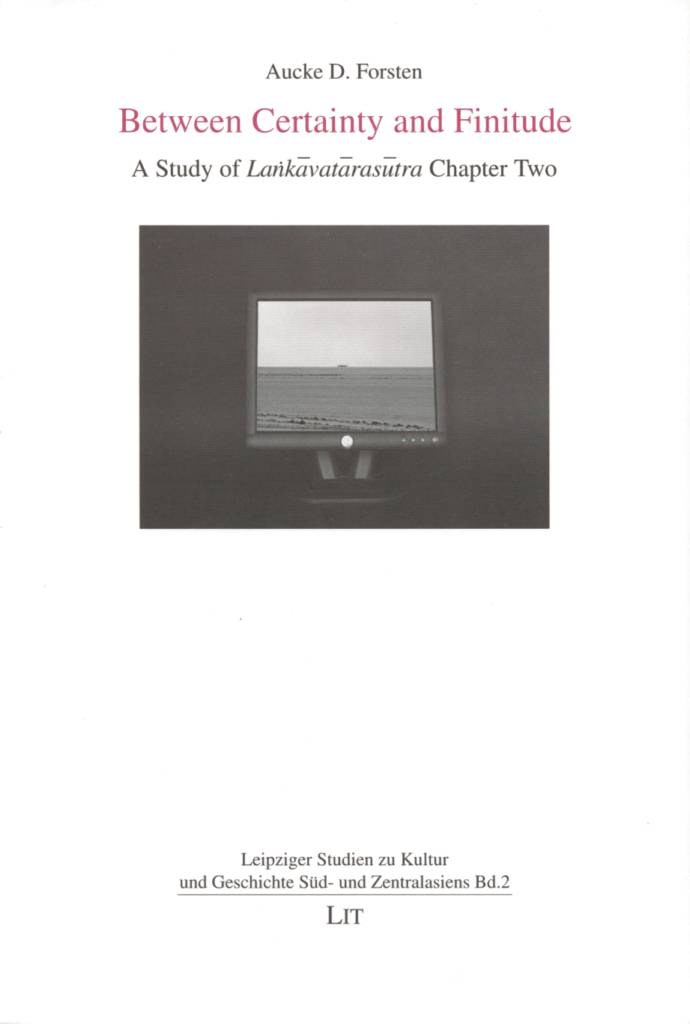
Between Certainty and Finitude: A Study of Laṅkāvatārasūtra Chapter Two
Book
Please note that many items in our library are simply pages that represent a detailed library catalog entry and citation of someone else's work, presentation, or performance. Read our General Disclaimer for more information. You can find more information about this item on the publisher website.

Description
This book confronts two ways of approaching an Indo-Buddhist text with one another. The first is the historico-philological method, which takes the Cartesian ideal of certainty as its starting point. The second approach follows the lead of the philosophy of Hans-Georg Gadamer. This approach assumes that all human understanding is finite. In this light, it raises questions such as: what are the preliminary assumptions with which a buddhologist addresses a buddhist text? In analogy with these two ways of looking at a text, the book is divided into two parts. Part One is a historico-philological study of the Sanskrit compound sva-citta-dr'sya-matra as it is represented in the second chapter of the Indo-Buddhist text Lankavatarasutra (fifth century). Part Two then examines the unquestioned acceptances of this buddhological research from a philosophical point of view. The book opens up an entirely new perspective on methodological problems concerning any study of an alien culture.
Citation
Forsten, Aucke D. Between Certainty and Finitude: A Study of Laṅkāvatārasūtra Chapter Two. Berlin: LIT Verlag, 2006.
Publisher Link
Interconnections
1 Scholarship on

An important Mahāyāna sūtra that was highly influential in East Asia as well as in Nepal, where a manuscript was discovered that remains the only extant Sanskrit recension of this text. It is notable for its inclusion of many doctrinal features that would come to be associated with the Yogācāra philosophy of Mind-Only (Cittamātra), such as the ālayavijñāna, or store-house consciousness, that acts as a repository for the seeds of karmic actions. It also includes several lengthy discussions of tathāgatagarbha and, though it is never actually referenced in the Uttaratantra, it is often listed among the so-called tathāgatagarbha sūtras. While its lack of mention in the Uttaratantra has been interpreted by scholars as evidence that the sūtra postdates the treatise, it should be noted that the ways in which the tathāgatagarbha is discussed in the sūtra is often at odds with its presentation in the Uttaratantra.