(CSV import of Library Items) |
No edit summary |
||
| Line 1: | Line 1: | ||
{{LibraryItem}} | {{LibraryItem | ||
|FullRead=No | |||
|DisableRedirects=No | |||
|CheckQuotes=No | |||
}} | |||
Revision as of 14:34, 18 March 2022
| 🤓 Admin Zone 🛠️ hidden to non-admins | |
डशभूमिकसूत्र
Daśabhūmikasūtra
འཕགས་པ་ས་བཅུ་པ་ཞེས་བྱ་བ་ཐེག་པ་ཆེན་པོའི་མདོ།
'phags pa sa bcu pa zhes bya ba theg pa chen po'i mdo
The Ten Bhūmis (84000)
Text
Please note that many items in our library are simply pages that represent a detailed library catalog entry and citation of someone else's work, presentation, or performance. Read our General Disclaimer for more information.


Description
Daśabhūmikasūtra. (T. Sa bcu pa'i mdo; C. Shidi jing/Shizhu jing; J. Jūjikyō/Jūjūkyō; K. Sipchi kyǒng/Sipchu kyǒng 十地經. In Sanskrit, "Scripture of the Ten Stages"; the definitive scriptural account of the ten "grounds" or "stages" (daśabhūmi) at the upper reaches of the bodhisattva path (mārga). In the sūtra, each of the ten stages is correlated with seminal doctrines of mainstream Buddhism, as well as with mastery of one of a list of ten perfections (pāramitā) completed in the course of training as a bodhisattva. The sūtra appears as one of the chapters of the Avatamsakasūtra [chapter 31] and also circulated as an independent text. (Source: "Daśabhūmikasūtra." In The Princeton Dictionary of Buddhism, 220. Princeton University Press, 2014. http://www.jstor.org/stable/j.ctt46n41q.27.)
Quoted in the aligned translations
Reference
Daśabhūmikasūtra [डशभूमिकसूत्र]. 'phags pa sa bcu pa zhes bya ba theg pa chen po'i mdo [འཕགས་པ་ས་བཅུ་པ་ཞེས་བྱ་བ་ཐེག་པ་ཆེན་པོའི་མདོ།]. [The Ten Bhūmis (84000)]. Kangyur, RKTSK 857 http://www.rkts.org/cat.php?id=857&typ=1.
Interconnections
All 41Books 22Articles 7Classical Works 8Dissertations 4
9 Recensions

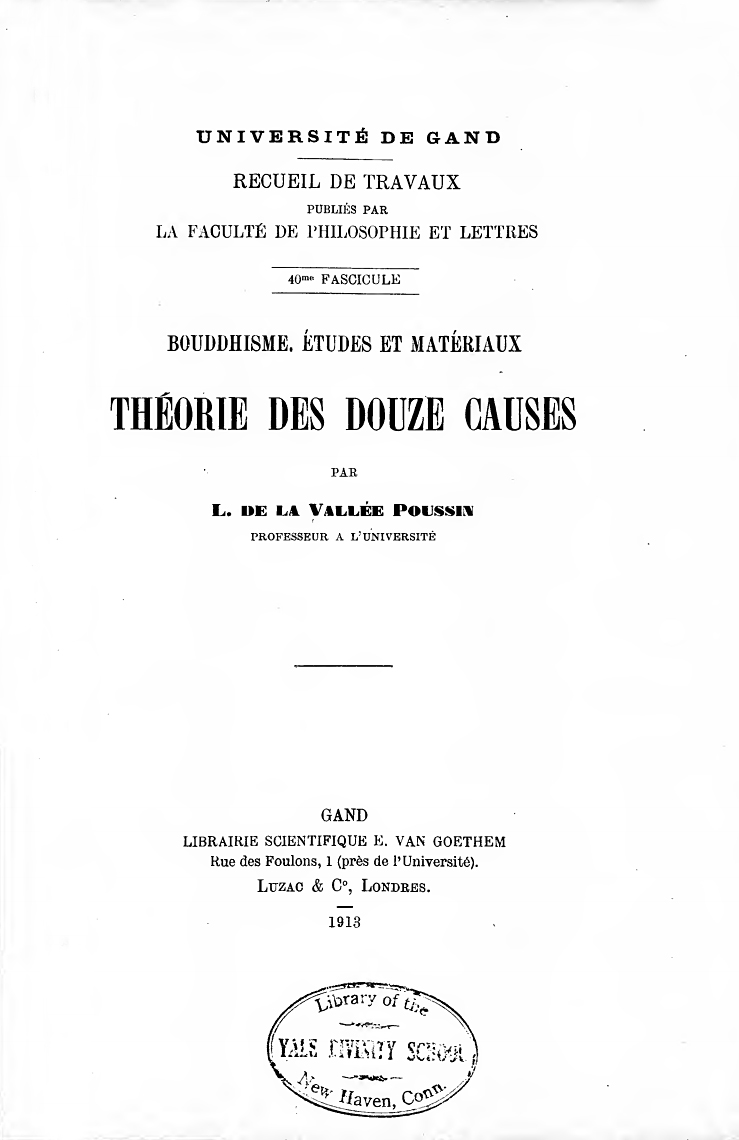
La Vallée Poussin, Louis de, ed. Bouddhisme, études et matériaux: Théorie des douze causes. Recueil de travaux publiés par la faculté de philosophie et lettres de l'Université de Gand 40. Ghent, Belgium: E. Van Goethem, 1913.

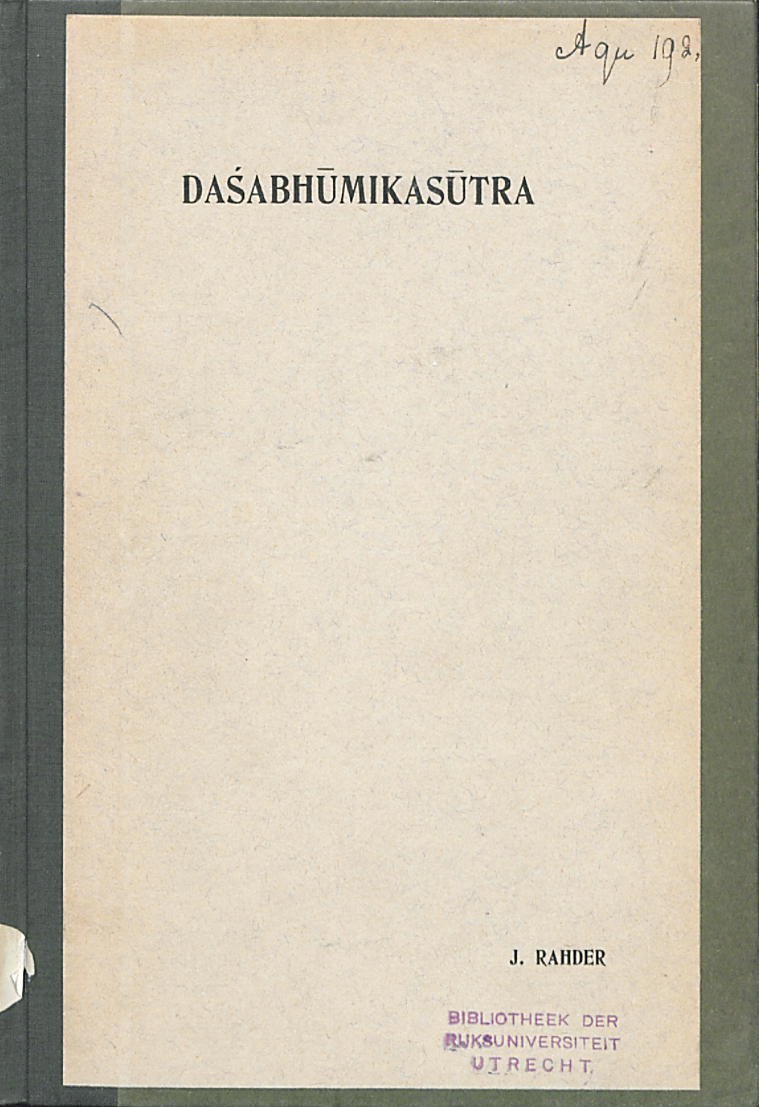
Johannes Rahder's dissertation contains the Sanskrit text of the Daśabhūmikasūtra, a translation of Vasubandhu's commentary, and an appendix with the Bodhisattvabhūmi.

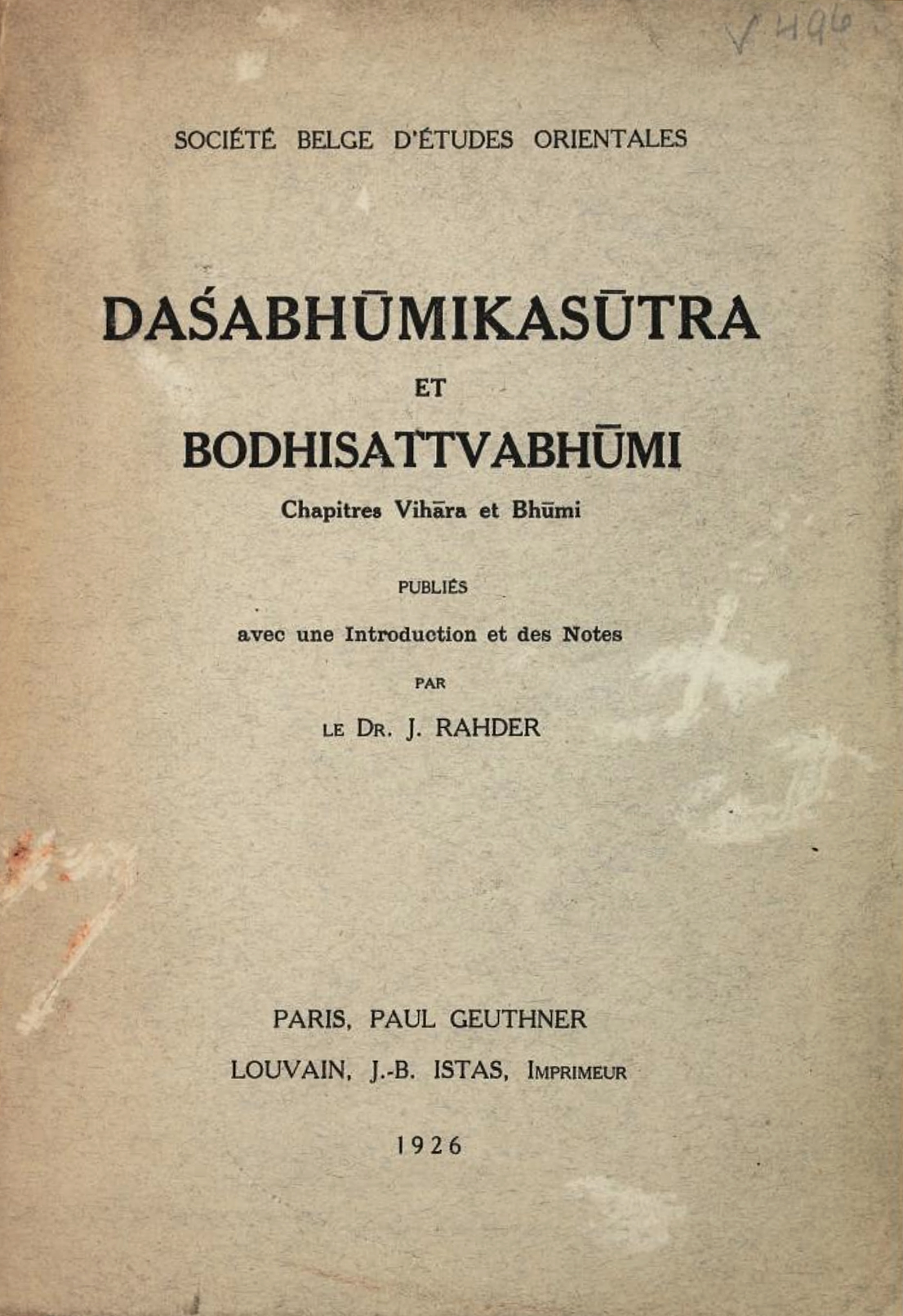
A critical Sanskrit edition (Roman) of the Daśabhūmikasūtra and Bodhisattvabhūmi, edited by Johannes Rahder, with an introduction and notes in French.

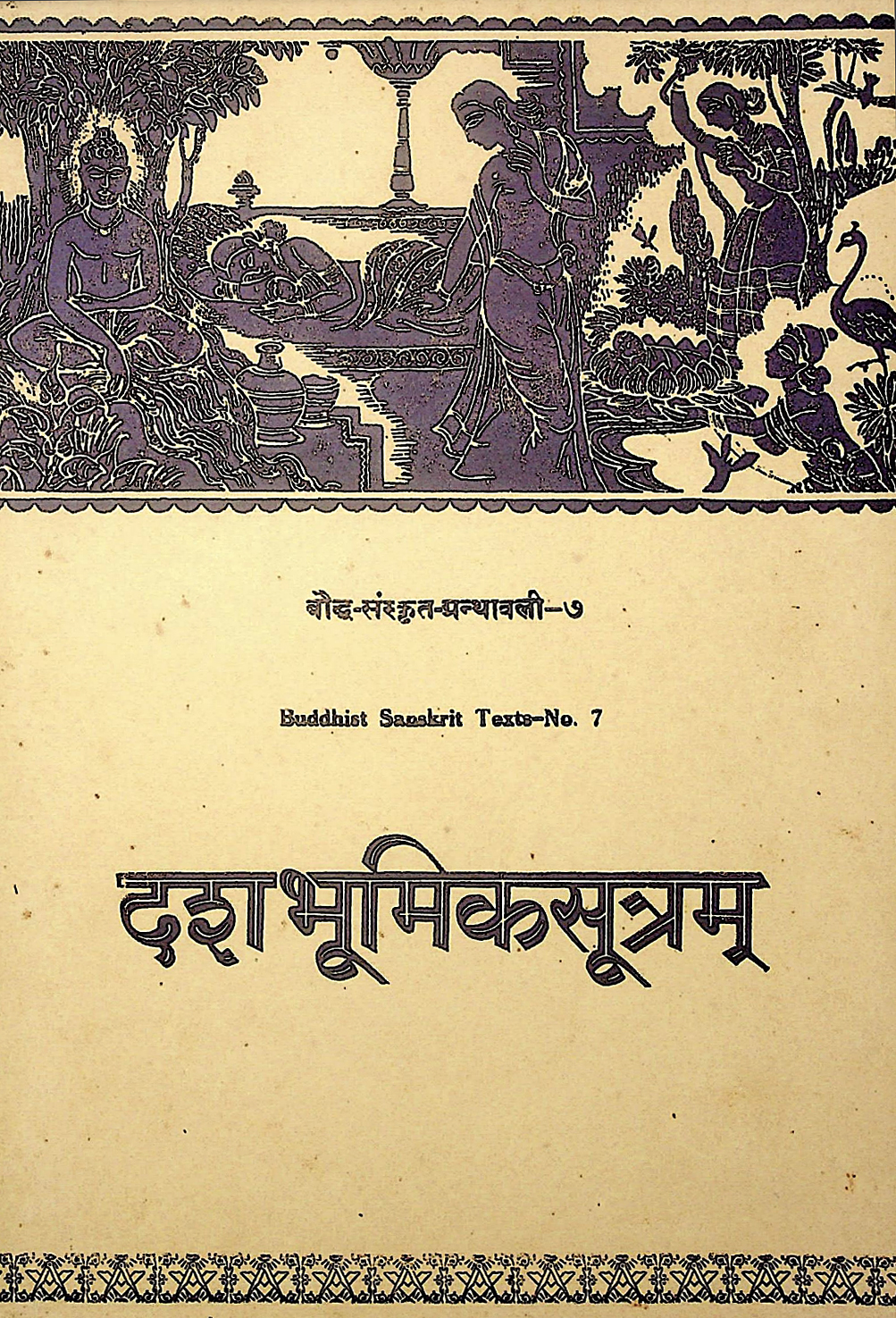
Critical edition of the Daśabhūmikasūtra. In Sanskrit with introduction in Hindi and English.

A critical Sanskrit edition of the Daśabhūmikasūtra with Japanese introduction. Revised and edited by Ryūko Kondo.

A critical Sanskrit edition of gāthās 1–5 of the Daśabhūmikasūtra, edited by Johannes Rahder and Shinryu Susa. Published in The Eastern Buddhist 5, no. 4, 1931.
A critical Sanskrit edition of gāthās 6–10 of the Daśabhūmikasūtra, edited by Johannes Rahder and Shinryu Susa. Published in The Eastern Buddhist 6, no. 1, 1932.

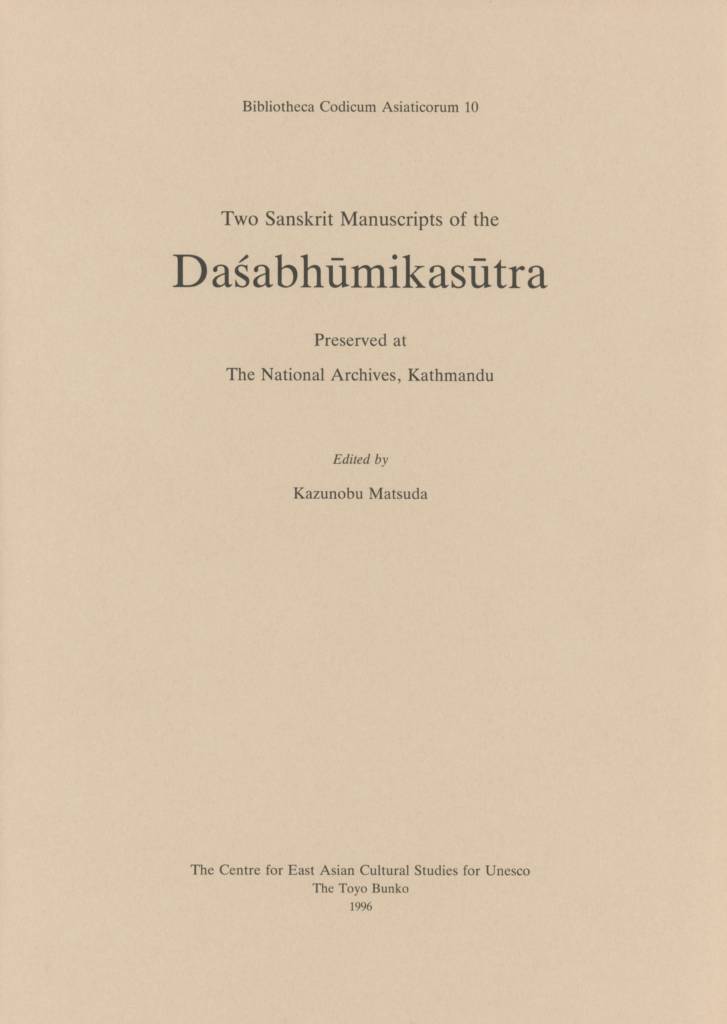
This work contains two Sanskrit manuscripts of the Daśabhūmikasūtra preserved at The National Archives, Kathmandu. Edited by Kazunobu Matsuda.

A critical Sanskrit edition of the Daśabhūmikasūtra, edited by Herākājī Vajrācārya, with Newari translation by Divyavajra Vajrācārya.
5 Full translations
Megumu Honda's translation of the Daśabhūmikasūtra, revised by Johannes Rahder and published in Studies in South, East and Central Asia, 1968.
Johannes Rahder's dissertation contains the Sanskrit text of the Daśabhūmikasūtra, a translation of Vasubandhu's commentary, and an appendix with the Bodhisattvabhūmi.

A French translation of the Daśabhūmikasūtra by Patrick Carré from the Chinese edition of Śikṣānanda (T279). Published by Fayard, 2004.

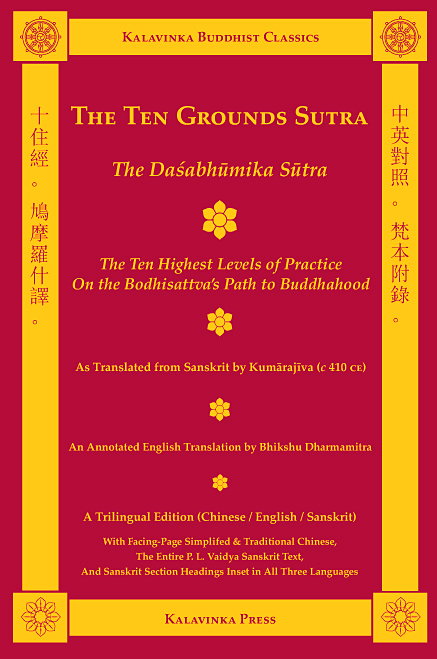
An annotated English Translation by Bhikshu Dharmamitra of Tripitaka Master Kumārajīva’s circa 410 ce Sanskrit-to-Chinese translation of the Daśabhūmika Sūtra.
A critical Sanskrit edition of the Daśabhūmikasūtra, edited by Herākājī Vajrācārya, with Newari translation by Divyavajra Vajrācārya.
3 Classical commentaries

Commentary on the Daśabhūmikasūtra, which survives in Chinese. It is attributed to Nāgārjuna.

The Daśabhūmisūtranidānabhāṣya (Tib. 'Phags pa sa bcu'i mdo sde'i gleng gzhi bshad pa, "An Explanation of the Introduction to the Sūtra of the Ten Bhūmis") is a short commentary attributed to Śākyabuddhi (Slob dpon shAkya'i blo). It does not comment on the Daśabhūmikasūtra as a whole, only on its introduction (nidāna): the passage describing the great assembly of bodhisattvas gathered to hear the teaching. Śākyabuddhi explains the assembly's greatness in terms of its qualities and its numbers, and sets out the bodhisattvas' qualities under five headings: having received the Buddha's prophecy in person, as irreversible bodhisattvas of the eighth bhūmi; being close to buddhahood, needing only one more birth; and their miraculous powers of mind, body, and speech. Under the powers of mind he explains, among other things, how wisdom keeps the bodhisattva from abiding in saṃsāra and great compassion from abiding in nirvāṇa. The commentary ends by noting that the bodhisattvas named in the sūtra, such as Vajragarbha, represent the assembly's great number. The colophon names the author but no translators.

In Sanskrit, "Explanation of the Daśabhūmikasūtra"; a commentary on the Daśabhūmikasūtra attributed to the Indian exegete Vasubandhu. The work served as the basis for the Chinese Di Lun Zong, "School of Di lun Exegetes," a lineage of Buddhist scholiasts who studied this text. (Di lun is an abbreviation of the Shidijing lun, the Chinese translation of the Daśabhūmivyākhyāna.) The school is considered to be one of the earliest of the indigenous scholastic traditions of East Asian Mahāyāna Buddhism, and its thought draws on strands of Indic thought that derive from both the Yogācāra and Tathāgatagarbha traditions. (Source: "Daśabhūmivyākhyāna." In The Princeton Dictionary of Buddhism, 220. Princeton University Press, 2014. http://www.jstor.org/stable/j.ctt46n41q.27.)
1 Similar title

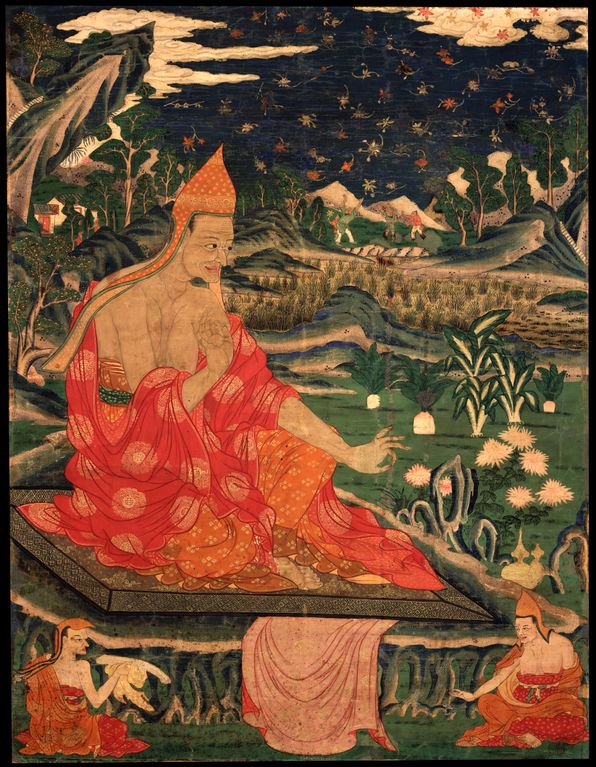
After his attainment of buddhahood, the Buddha Śākyamuni is present in many locations simultaneously. The Ten Bhūmis takes place two weeks after his enlightenment, while he is sitting silently in meditation in the central palace in the highest paradise of the desire realm. Countless bodhisattvas have assembled there. Through the power of the Buddha, the bodhisattva Vajragarbha enters samādhi and is blessed by countless buddhas, also named Vajragarbha, to give a Dharma teaching to the bodhisattvas. In response to the questions of the bodhisattva Vimukticandra, Vajragarbha describes successively the ten bhūmis of a bodhisattva. Countless bodhisattvas arrive and report that this same event is occurring simultaneously in the highest paradises of all other worlds. The Buddha is pleased by Vajragarbha’s teaching. (Source: 84000)
5 Scholarship
Johannes Rahder's dissertation contains the Sanskrit text of the Daśabhūmikasūtra, a translation of Vasubandhu's commentary, and an appendix with the Bodhisattvabhūmi.
A critical Sanskrit edition (Roman) of the Daśabhūmikasūtra and Bodhisattvabhūmi, edited by Johannes Rahder, with an introduction and notes in French.
A critical Sanskrit edition of the Daśabhūmikasūtra with Japanese introduction. Revised and edited by Ryūko Kondo.
This work contains two Sanskrit manuscripts of the Daśabhūmikasūtra preserved at The National Archives, Kathmandu. Edited by Kazunobu Matsuda.
A critical Sanskrit edition of the Daśabhūmikasūtra, edited by Herākājī Vajrācārya, with Newari translation by Divyavajra Vajrācārya.
18 A topic of
Megumu Honda's translation of the Daśabhūmikasūtra, revised by Johannes Rahder and published in Studies in South, East and Central Asia, 1968.
La Vallée Poussin, Louis de, ed. Bouddhisme, études et matériaux: Théorie des douze causes. Recueil de travaux publiés par la faculté de philosophie et lettres de l'Université de Gand 40. Ghent, Belgium: E. Van Goethem, 1913.
Johannes Rahder's dissertation contains the Sanskrit text of the Daśabhūmikasūtra, a translation of Vasubandhu's commentary, and an appendix with the Bodhisattvabhūmi.
A critical Sanskrit edition (Roman) of the Daśabhūmikasūtra and Bodhisattvabhūmi, edited by Johannes Rahder, with an introduction and notes in French.
Critical edition of the Daśabhūmikasūtra. In Sanskrit with introduction in Hindi and English.
Commentary on the Daśabhūmikasūtra, which survives in Chinese. It is attributed to Nāgārjuna.
The Daśabhūmisūtranidānabhāṣya (Tib. 'Phags pa sa bcu'i mdo sde'i gleng gzhi bshad pa, "An Explanation of the Introduction to the Sūtra of the Ten Bhūmis") is a short commentary attributed to Śākyabuddhi (Slob dpon shAkya'i blo). It does not comment on the Daśabhūmikasūtra as a whole, only on its introduction (nidāna): the passage describing the great assembly of bodhisattvas gathered to hear the teaching. Śākyabuddhi explains the assembly's greatness in terms of its qualities and its numbers, and sets out the bodhisattvas' qualities under five headings: having received the Buddha's prophecy in person, as irreversible bodhisattvas of the eighth bhūmi; being close to buddhahood, needing only one more birth; and their miraculous powers of mind, body, and speech. Under the powers of mind he explains, among other things, how wisdom keeps the bodhisattva from abiding in saṃsāra and great compassion from abiding in nirvāṇa. The commentary ends by noting that the bodhisattvas named in the sūtra, such as Vajragarbha, represent the assembly's great number. The colophon names the author but no translators.
In Sanskrit, "Explanation of the Daśabhūmikasūtra"; a commentary on the Daśabhūmikasūtra attributed to the Indian exegete Vasubandhu. The work served as the basis for the Chinese Di Lun Zong, "School of Di lun Exegetes," a lineage of Buddhist scholiasts who studied this text. (Di lun is an abbreviation of the Shidijing lun, the Chinese translation of the Daśabhūmivyākhyāna.) The school is considered to be one of the earliest of the indigenous scholastic traditions of East Asian Mahāyāna Buddhism, and its thought draws on strands of Indic thought that derive from both the Yogācāra and Tathāgatagarbha traditions. (Source: "Daśabhūmivyākhyāna." In The Princeton Dictionary of Buddhism, 220. Princeton University Press, 2014. http://www.jstor.org/stable/j.ctt46n41q.27.)

The Daśabhūmivyākhyānavyākhyāna (Tib. Sa bcu'i rnam par bshad pa'i rnam par bshad pa), "A Commentary on the Commentary on the Sūtra of the Ten Bhūmis," is a subcommentary by the Indian paṇḍita Sūryasiddhi (Tib. slob dpon nyi ma grub) on Vasubandhu's Daśabhūmivyākhyāna, itself the principal Indian commentary on the Daśabhūmikasūtra (the "Ten Bhūmis" chapter of the Buddhāvataṃsaka). Little is known of Sūryasiddhi's life; he is otherwise unattested and can only be dated broadly to sometime between the 4th and 9th centuries CE, after Vasubandhu.
In his commentary, Sūryasiddhi frames Vasubandhu's authority in exclusive terms, asserting that the sūtra's meaning had been revealed solely to Asaṅga, who in turn transmitted it only to Vasubandhu. He also preserves a piece of textual criticism from his own time, noting that some scholars held the sūtra's verses to have suffered corruption in both form and meaning.
The Tibetan translation is credited to Prajñāvarman and Kawa Paltsek (per RKTS); Peter Alan Roberts's introduction to the 84000 translation additionally credits Mañjuśrīgarbha as a third translator, noting his absence from the earlier Vasubandhu commentary team and suggesting the translation may postdate Yeshe De's death during the reign of Ralpachen (817–836). (Source: BDRC and 84000)A critical Sanskrit edition of the Daśabhūmikasūtra with Japanese introduction. Revised and edited by Ryūko Kondo.
A French translation of the Daśabhūmikasūtra by Patrick Carré from the Chinese edition of Śikṣānanda (T279). Published by Fayard, 2004.
A critical Sanskrit edition of gāthās 1–5 of the Daśabhūmikasūtra, edited by Johannes Rahder and Shinryu Susa. Published in The Eastern Buddhist 5, no. 4, 1931.
A critical Sanskrit edition of gāthās 6–10 of the Daśabhūmikasūtra, edited by Johannes Rahder and Shinryu Susa. Published in The Eastern Buddhist 6, no. 1, 1932.

Bodhicitta, the "mind of awakening," constitutes the foundational principle of Mahāyāna Buddhism. This essay traces the concept's historical and doctrinal genesis from its pre-Mahāyāna antecedents to its full articulation in the Indian and Tibetan traditions. It explores the main scriptural and scholastic sources in India, the two great Indian lineages of practice—the "Profound View" of Nāgārjuna and the "Vast Conduct" of Asaṅga—and the pivotal role of Atiśa Dīpaṃkara Śrījñāna in transmitting and systematizing these teachings in Tibet. The article further details how Atiśa's Kadam school and its core mind training (lojong) teachings influenced the subsequent development of bodhicitta cultivation in the Nyingma, Kagyu, Sakya, and Geluk schools. Bodhicitta is not a static concept but a dynamic, multifaceted principle that functions as the soteriological core of the Mahāyāna path, embodying the indivisible union of universal compassion and the profound wisdom that realizes emptiness.

An English translation of the Daśabhūmikasūtra from the Tibetan by Peter Alan Roberts. Edited by Emily Bower. Published by 84000: Translating the Words of the Buddha.
An annotated English Translation by Bhikshu Dharmamitra of Tripitaka Master Kumārajīva’s circa 410 ce Sanskrit-to-Chinese translation of the Daśabhūmika Sūtra.
This work contains two Sanskrit manuscripts of the Daśabhūmikasūtra preserved at The National Archives, Kathmandu. Edited by Kazunobu Matsuda.
A critical Sanskrit edition of the Daśabhūmikasūtra, edited by Herākājī Vajrācārya, with Newari translation by Divyavajra Vajrācārya.