Books/Keys to Great Enlightenment: Difference between revisions
No edit summary |
No edit summary |
||
| (One intermediate revision by the same user not shown) | |||
| Line 34: | Line 34: | ||
|TextTopics=Rgyal sras lag len so bdun ma; Blo sbyong tshig brgyad ma | |TextTopics=Rgyal sras lag len so bdun ma; Blo sbyong tshig brgyad ma | ||
}} | }} | ||
{{#set: | |||
|TmlnSortDate=19890101 | |||
|TmlnDate=1989 | |||
|TmlnAuthorDisplay=Tsultim Gyeltsen | |||
|TmlnAuthorPage=Gyeltsen, Tsultim | |||
|TmlnTextTitle=Keys to Great Enlightenment | |||
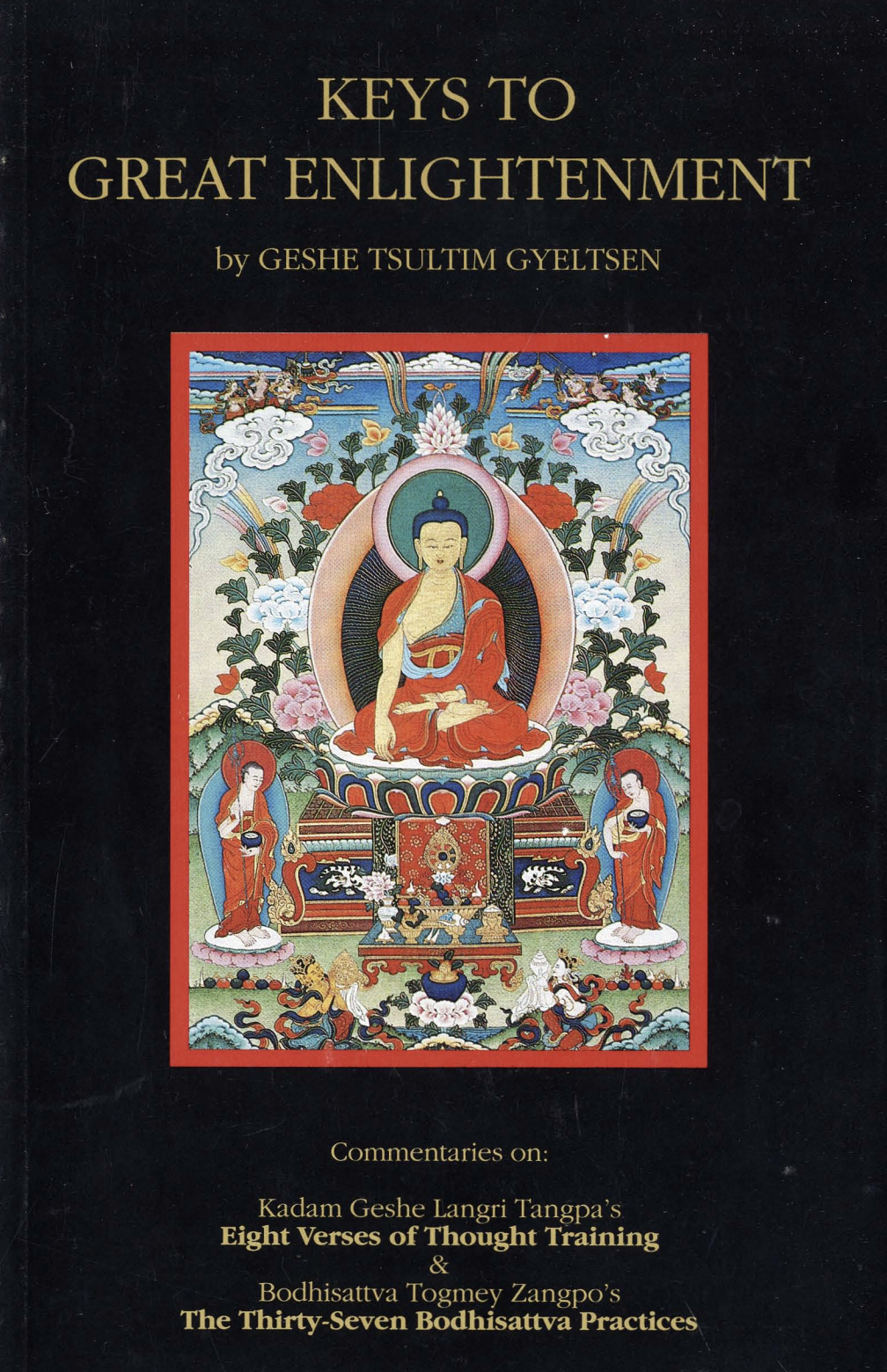
|TmlnDescription=Commentaries on "Eight Verses of Thought Training" and "The Thirty-Seven Bodhisattva Practices." Los Angeles: Thubten Dhargye Ling Publications | |||
}} | |||
[[Category:Translation Timeline]] | |||
Latest revision as of 16:12, 10 December 2025
| 🤓 Admin Zone 🛠️ hidden to non-admins | |

Description
The commentaries were transcribed and revised by Gary Schlageter and Karen Gudmundsson. Under the supervision of Robert Stone, these working texts were then proofread and edited with the help of Pat Aiello, Paul McClelland, Nancy Nason, and others.
- Acknowledgements9
- Technical Note11
- Preface13
- Introduction15
- Part One
- The Preliminaries17
- Preparation for Practice19
- Graduated Path to Enlightenment & Levels of Attainment25
- Part Two
- Eight Verses of Thought Training43
- The Root Test45
- The Commentary47
- Questions & Answers61
- Part Three
- The Thirty-Seven Bodhisattva Practices67
- The Root Test69
- The Commentary85
- Questions & Answers147
- Appendices
- Tong-Len Practice153
- Outline of the Root Text Verses161
- Glossary163
- Bibliography173


cultivating the awakening mind of compassion, wisdom, and love. This eight-verse lojong enshrines the very heart of Dharma, revealing the true essence of the Mahayana path to liberation. Even a single line of this practice can be seen as encapsulating the entire teaching of the Buddha. For even a single statement of this mind training practice has the incredible power to help us subdue our self-oriented behavior and mental afflictions. The fundamental theme of mind training practice is the profound reorientation of our basic attitude, both toward our own self and toward our fellow human beings, as well as toward the events around us. The goal of mind training practice is the radical transformation of our thoughts, attitudes, and habits. Presently, we tend to cherish the welfare of our own self at the expense of all others. However, the mind training teaching challenges us to reverse this process. This involves a deep understanding of others as true friends, and the recognition that our
true enemy lies inside of ourselves, not outside. Source Accessed Jan 30, 2025)cultivating the awakening mind of compassion, wisdom, and love. This eight-verse lojong enshrines the very heart of Dharma, revealing the true essence of the Mahayana path to liberation. Even a single line of this practice can be seen as encapsulating the entire teaching of the Buddha. For even a single statement of this mind training practice has the incredible power to help us subdue our self-oriented behavior and mental afflictions. The fundamental theme of mind training practice is the profound reorientation of our basic attitude, both toward our own self and toward our fellow human beings, as well as toward the events around us. The goal of mind training practice is the radical transformation of our thoughts, attitudes, and habits. Presently, we tend to cherish the welfare of our own self at the expense of all others. However, the mind training teaching challenges us to reverse this process. This involves a deep understanding of others as true friends, and the recognition that our
true enemy lies inside of ourselves, not outside. Source Accessed Jan 30, 2025)