| 🤓 Admin Zone 🛠️ hidden to non-admins | |
योगाचारभूमौश्रावकभूमिः
Yogācārabhūmauśrāvakabhūmiḥ
རྣལ་འབྱོར་སྤྱོད་པའི་ས་ལས་ཉན་ཐོས་ཀྱི་ས།
rnal 'byor spyod pa'i sa las nyan thos kyi sa
From The Levels of Spiritual Practice: The Level of a Śrāvaka (84000)
Text
Please note that many items in our library are simply pages that represent a detailed library catalog entry and citation of someone else's work, presentation, or performance. Read our General Disclaimer for more information.


Description
The Śrāvakabhūmi, "The Level of the Śrāvaka," is the thirteenth of the seventeen levels (bhūmi) that make up the first and longest part of the Yogācārabhūmiśāstra, the encyclopedic treatise of the Yogācāra tradition traditionally ascribed to Asaṅga. It sets out the path of the śrāvaka, the "hearer" or disciple, as a complete course of training. It begins with the spiritual disposition (gotra) that makes liberation possible and moves through ethical discipline, guarding the senses, and the other preparations for meditation. Its core is a detailed manual of meditative practice: the objects of meditation suited to different temperaments, the cultivation of calm abiding (śamatha) and insight (vipaśyanā), and the nine stages of settling the mind (navākārā cittasthiti). Though framed as the path of the śrāvaka, these instructions became a common foundation for Mahāyāna meditation, and Tibetan authors such as Tsongkhapa drew on them extensively in their presentations of calm abiding.
The work survives in Sanskrit, in a manuscript photographed by Rāhula Sāṅkṛtyāyana at Zhalu Monastery in the 1930s, which has since been edited by Karunesha Shukla and by the Śrāvakabhūmi Study Group of Taishō University. It was translated into Chinese by Xuanzang as part of his complete translation of the Yogācārabhūmi, and into Tibetan by Yeshe De and Jinamitra. The Tibetan translation is preserved in the Derge Tengyur (Toh 4036), in the sems tsam section, vol. dzi, F.1b–195a.
Reference
Asaṅga. yogācārabhūmauśrāvakabhūmiḥ [योगाचारभूमौश्रावकभूमिः]. rnal 'byor spyod pa'i sa las nyan thos kyi sa [རྣལ་འབྱོར་སྤྱོད་པའི་ས་ལས་ཉན་ཐོས་ཀྱི་ས།]. [From The Levels of Spiritual Practice: The Level of a Śrāvaka (84000)]. Tengyur, RKTST 3375 http://www.rkts.org/cat.php?id=3375&typ=2.
Interconnections
2 Partial translations

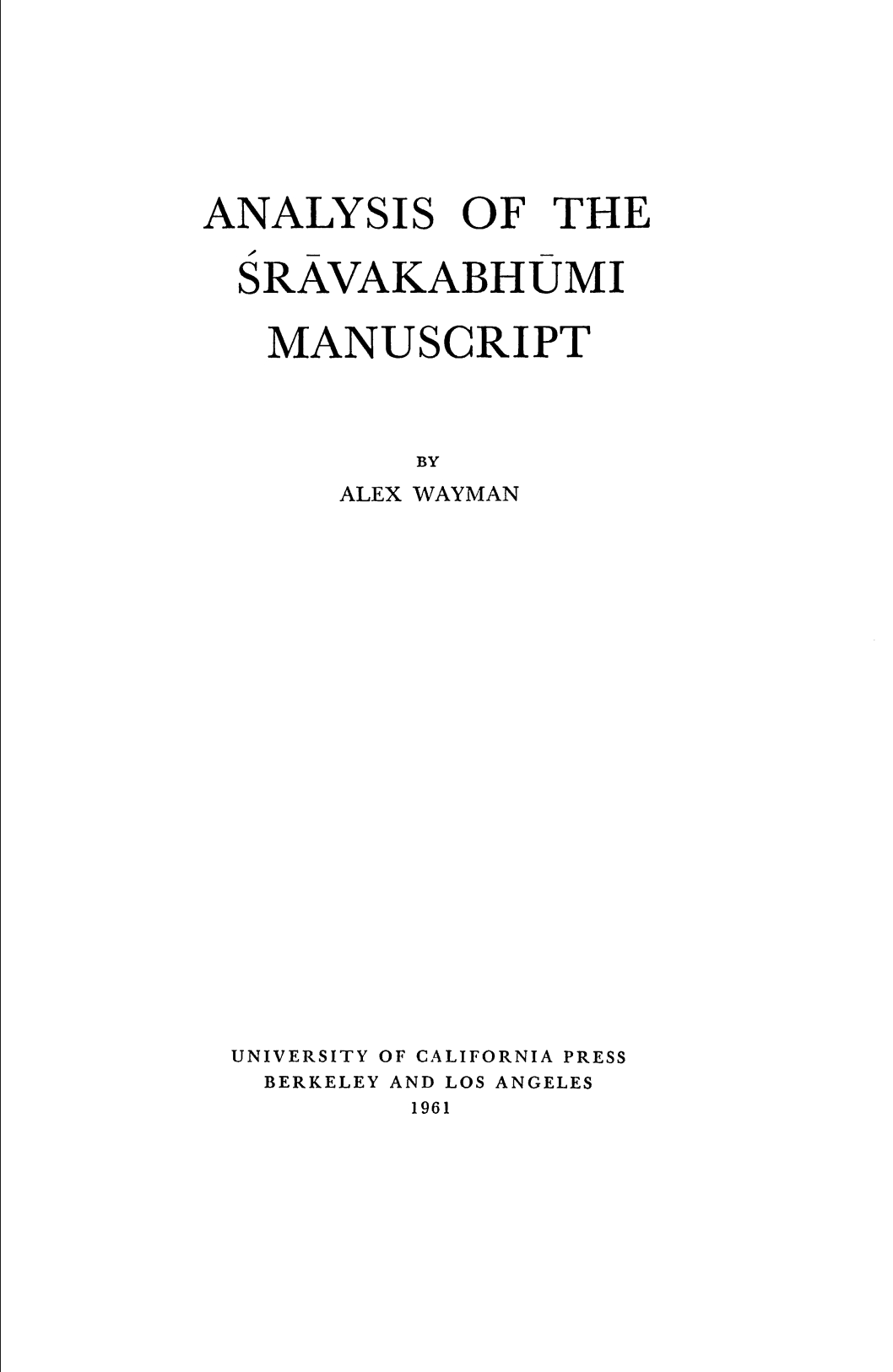
This work is substantially the same as that submitted in partial satisfaction of the requirements for the degree of Doctor of Philosophy in Sanskrit at the University of California in June, 1959. It is an attempt
to describe the photographically reproduced manuscript of a Buddhist text called the Śrāvakabhūmi devoted to Buddhist meditation; to set forth the literary history and the known facts about its author, Asaṅga; to discuss the Buddhist Hybrid Sanskrit language of the text; to analyze the work to show the leading ideas; and finally to exhibit continuous sections in edition and translation so as to indicate Asaṅga's way of writing as well as his religious and philosophical position. (Wayman, preface, v)

The introductory study touches in detail upon the textual history of the Bodhisattvabhūmi (pp. 162-167) and Dharmakṣema's translation of the text (pp. 183-186) in the larger context of the formation of the Yogācārabhūmi. Its examination of the philological and historical background of the translations of the Yogācārabhūmi into Tibetan (pp. 73-105) Chinese (106-146), which are naturally are relevant to the Bodhisattvabhūmi. (Source Accessed Aug 19, 2025)
2 Scholarship
This work is substantially the same as that submitted in partial satisfaction of the requirements for the degree of Doctor of Philosophy in Sanskrit at the University of California in June, 1959. It is an attempt
to describe the photographically reproduced manuscript of a Buddhist text called the Śrāvakabhūmi devoted to Buddhist meditation; to set forth the literary history and the known facts about its author, Asaṅga; to discuss the Buddhist Hybrid Sanskrit language of the text; to analyze the work to show the leading ideas; and finally to exhibit continuous sections in edition and translation so as to indicate Asaṅga's way of writing as well as his religious and philosophical position. (Wayman, preface, v)
The introductory study touches in detail upon the textual history of the Bodhisattvabhūmi (pp. 162-167) and Dharmakṣema's translation of the text (pp. 183-186) in the larger context of the formation of the Yogācārabhūmi. Its examination of the philological and historical background of the translations of the Yogācārabhūmi into Tibetan (pp. 73-105) Chinese (106-146), which are naturally are relevant to the Bodhisattvabhūmi. (Source Accessed Aug 19, 2025)
1 A topic of
This work is substantially the same as that submitted in partial satisfaction of the requirements for the degree of Doctor of Philosophy in Sanskrit at the University of California in June, 1959. It is an attempt
to describe the photographically reproduced manuscript of a Buddhist text called the Śrāvakabhūmi devoted to Buddhist meditation; to set forth the literary history and the known facts about its author, Asaṅga; to discuss the Buddhist Hybrid Sanskrit language of the text; to analyze the work to show the leading ideas; and finally to exhibit continuous sections in edition and translation so as to indicate Asaṅga's way of writing as well as his religious and philosophical position. (Wayman, preface, v)