Later Editions and Translations of the BCA
Articles/Later Editions and Translations of the BCA
| 🤓 Admin Zone 🛠️ hidden to non-admins | |
Description
This comprehensive overview serves as a key resource for understanding the Bodhicaryāvatāra's impact and evolution. It offers historical context, tracing the text's journey across cultures and languages, and demonstrating its enduring relevance in a variety of contexts. It offers insights into both the scholarly significance and the spiritual importance of Śāntideva's work. By highlighting key translations, commentaries, and modern interpretations, the article guides readers toward important sources for further study and illustrates the Bodhicaryāvatāra's continued relevance in contemporary discourse.
Featured on
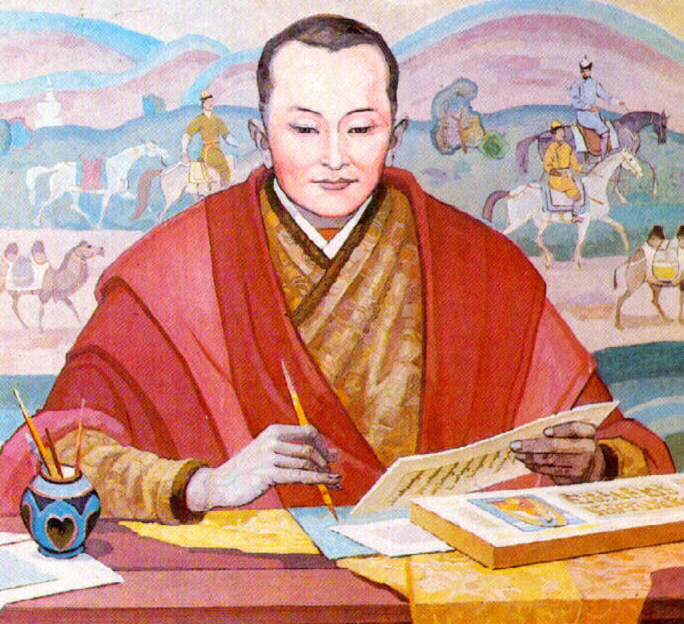
The Oirat scholar Zaya Pandita (1599-1662) according to his biography made a new translation of the BCA.[1] Zaya Pandita was influential in spreading the Buddhist faith also among the Kalmyks, a Mongolian people who migrated to the shore of the Caspian Sea in the 17th Century. He is said to have translated a large number of texts into the Oirat/Kalmyk language, so it is quite likely that the BCA was among these. The translation of Zaya Pandita has however not been found.[2] After a period of harsh repression under Soviet rule Buddhism is today again thriving in Kalmykia, being strongly influenced by the exiled Tibetan Buddhist community in India. As it is a central text in Tibetan Buddhism, it is likely that the BCA is having a renewed influence among the Kalmyks.
The most significant development took place in the beginning of the 18th Century. The Manchu empire conquered Mongolia in 1691, and to retain power they understood that they had to keep good relations with the Buddhist faith of the country.[3] Under the Qīng Dynasty (1644-1911) Mongolian Buddhism was allowed to proliferate, and the Mongolian canon was printed in Beijing. Among the works printed was the BCAMon. It was redacted by the Oirat Güüsi Bilig-un Dalai who flourished in the first half of the 18th Century. The changes affected mainly "the orthography and some, by then, obsolete grammatical and lexical elements."[4] In spite of the changes the work is, as Rachewiltz (1996: xi) says, still basically Čosgi Odser's work. It is based on this, together with the work already done by Vladimirtsov (1929) and Ligeti,[5] that Rachewiltz published his revised edition of the BCAMon in 1996. According to the colophon[6] Bilig-un Dalai performed his revision at the Sōngzhù Temple 嵩祝寺 in Beijing, guided by lCang skya Rol pa'i rdo rje (1717-1786), the chief administrative religious leader of Tibetan Buddhism in China.[7] The work was begun in 1741, and the canon was finally printed in 1748. The revision was based on three Mongolian and three Tibetan editions of the text, as well as three Tibetan commentaries.
Another translation was also done in the 19th Century by the Buriat writer and translator Radna Nomtoev (1821-1907).[8] This translation can be found at the end of the Kowalewski ms., and contains only the 10th chapter. It is a curious translation, and it seems that it was done without basing himself on Čosgi Odser's translation as it has very little in common with this. Radna Nomtoev must have known of the former translation however, for in the colophon translated in Cleaves (1954: 25-26) he mentions it specifically. He also mentions that he has based himself on the commentary by a "Boγda Darm-a Rinčin", which I suspect must be rGyal tshab Dar ma rin chen's (1364-1432) Byang chub sems dpa'i spyod pa la 'jug pa'i 'grel pa.[9] In 1976 A. Luvsanbalden published an edition of chapter ten in Mongolian.[10] I have not, however, so far been able to acquire a copy of this book, and a positive identification of which edition it is taken from, or whether it is an independent translation, will have to wait.
Since the start of the rule of the Dalai Lamas in Tibet in the 17th Century the dGe lugs sect of Tibetan Buddhism became the most influential also in Mongolia. Monasteries and education programs were based on the Tibetan model, and the Tibetan language almost superseded the Mongolian in importance within the religious sphere. As was the case in Tibet, the BCA was probably a central text within monastic education also in Mongolia. From the 1920s to the early 1990s there was severe religious repression in Mongolia due to Soviet communist influence. Today Buddhism is again flourishing. There is renewed interest for the ancient Mongolian Buddhist tradition, and Tibetan teachers are again influential in the renewal. As it has played such an important part in the history of Mongolian Buddhism, and as Tibetan teachers usually put great emphasis on it, the BCA will probably still play an important part in Mongolian Buddhism in the future.
Recent Developments

Portrait by Louisa Starr-Canziani
Over the last 100+ years the BCA has moved beyond its traditional areas of South and Northeast Asia. This process was first started with the birth of religious and oriental studies in the academic environments of Europe, and gained momentum through the 19th Century. The British rule of India enabled scholars to get long-term access to previously unknown material, both through personal accounts and through archaeological excavations and manuscripts. Initially the interest was fuelled by the colonial powers need to understand their subjects in order to rule more efficiently. Several of the earliest Indologists were officials employed by the British rulers, such as the previously mentioned Brian Houghton Hodgson (1800-1894). Through his work as a civil servant in Nepal Hodgson were among those who gave the academic community access to a literal treasure throve of previously unknown manuscript material that had been stored in the Kathmandu Valley for up to a millennium. Several of these manuscripts contained the BCA, and due to them the wider scholarly world were introduced to Śāntideva and his BCA in 1889 when the Russian Indologist Ivan P. Minayev published the first edition based on three of these newly discovered manuscripts.[11]
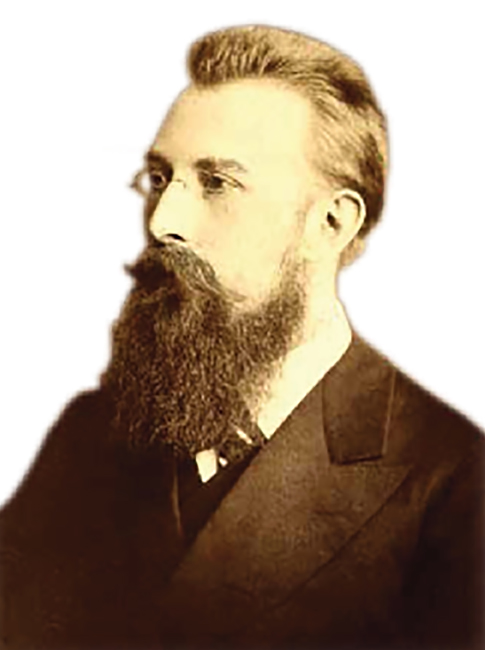
The text was received with enthusiasm, and was quickly regarded as one of the central texts of Mahāyāna Buddhism, a branch of Buddhism that had not yet received as much interest as its older sibling, the more sombre Theravāda tradition of Sri Lanka that the West had first been introduced to. Minayev was the first to set the text in context, as together with his 1889 edition he also gave a short account of the life of its author Śāntideva based on that given by the Tibetan historian Tāranātha (1575-1634).[12] Minayev's work launched what would prove to be a long-lasting interest in the BCA within academic circles, an interest that would inspire not only Indologists, but also scholars of other regions of Asia such as China and Mongolia, as ancient translations of the text were also found elsewhere. It would also inspire philosophers to attempt to tackle the to some extent revolutionary ethical aspects, seen from a Western perspective, that characterizes the practice of the bodhisattva, as well as the complicated Mādhyamika style logical arguments put forth to disprove the ontology of other Indian philosophical schools, including the "lesser" Buddhist schools of thought, such as for instance the idealist Vijñānavādins.
Minayev also launched what would prove to be a sustained interest in the production of ever more accurate translations of the text. Early on this interest can be said to have been mostly academic in orientation, for the most part executed by scholars of Sanskrit connected with academic institutions in Europe. Later on however, as the interest in Buddhism gained hold in Europe, translations executed by individuals with a more personal interest in Buddhism appeared. This wave of translations may well be regarded as a genuine "religious" continuation of the tradition of the BCA, as many of these translators do indeed consider themselves as upholders of the Buddhist religion, and, in some sense of the word, as missionaries of the Buddhist religion as it travels to, it is tempting to say, the West. It must be noted, however, that this use of the term "West" is indeed somewhat problematic. As a survival of the old colonial distinction between the "modern" West, as represented by Europe, and the "backward" East, as represented by the newly conquered lands of Asia, the term does not really apply anymore. "Modernity" has also reached Asia, and so when we in this chapter consider the recent developments of the BCA we will not only look at its travels to the "West" as represented by the European cultures of the World, but at its travels into modernity, whether it be France, Japan, or, indeed, India.[13]
The BCA has by now been translated so many times and into so many languages that it will be impossible, and probably not helpful, to give a comprehensive account of it all here. Translations can be found in Bengali,[14] Danish,[15] Dutch,[16] English,[17] Estonian,[18] French,[19] German,[20] Hindi,[21] Italian,[22] Japanese,[23] Norwegian,[24] Polish,[25] and Spanish,[26] to mention those that I have so far been able to locate. As already mentioned these translations can be divided roughly into academic and religious translations, although this division can not be considered strict. Some translators with an obvious personal interest in Buddhism, who consider themselves practicing Buddhists, hold academic positions and follow academic criteria when translating.[27] Still, the division will be of help as it highlights the intention of the translator. Roughly speaking, one type of translator follows the ideal of a distanced academic considering the history of human thought and a religious tradition, while the other considers himself a contributor to that tradition and a member of a movement wishing to spread the thoughts of Śāntideva. A key term in this context is perhaps "lineage", which is something of central importance when claiming authenticity within Buddhism, especially Tibetan Buddhism. The translators working from within the Tibetan Buddhist tradition put great emphasis on which teachers they have received the text from, and on which teacher or which commentary they have gone for guidance. We will also look into more general discussions, academic and religious, of the contents of the BCA. In this context we will concentrate on one example, among the many available, from each. As an academic contribution we will look at Williams (2000) and some of the responses that it generated. As a religious contribution we will look at the 14th Dalai Lama’s many books on the BCA.
Academic Translations

Photographer unknown.
Source: Ghent University
The first attempt at a translation of the BCA was by the Belgian scholar Louis de La Vallée Poussin (1869-1938) in 1892. La Vallée Poussin published his French translation in stages in the academic journal Le Muséon, beginning with chapters 1-4 and 10, which must have been the ones he considered the easiest. He introduced his work with a discussion of the philosophical contents of the BCA, its broader place in Mahāyāna Buddhism, and expanded on the biography of Śāntideva previously presented by Minayev. Chapter 5 followed in 1896, also with an introduction which, in addition to a discussion of the contents of the chapter, also contained corrections proposed for the Sanskrit edition by Minayev. La Vallée Poussin had two other manuscripts of the BCA kept at the Bibliothéque Nationale in Paris at his disposal, and improved on Minayev's edition with these. Through his work on the manuscripts of the BCAṬ and BCAP (commentaries to the BCA important particularly for an understanding of the complicated chapter 9) and their publication by him in 1898 and 1901-14, he was able to complete his translation of the BCA in a series of articles in the journal Revue d'histoire et de litterature religieuses in 1906-1907.[28] La Vallée Poussin's work on the BCA has been of incomparable importance for most, if not all, later academic work on the BCA, and his edition of the BCAP has superseded Minayev's edition as the primary source for an accurate account of the verses of the BCA.[29]
After the work of Minayev and La Vallée Poussin no further studies of significance on the Sanskrit edition of the BCA have appeared.[30] The translations that have been done have been based on these editions and the canonical Tibetan translation. No modern translations have, as far as I am aware, been based on the Newari, Chinese, or Mongolian translations. The next translation, and the first into English, was published by L.D. Barnett, Professor of Sanskrit at the University College of London, in 1909. Barnett's is the only translation done in prose, without attempting to transmit some of the poetic beauty of the original. Furthermore it is not a complete translation. Barnett has only translated selected parts where the text "seemed needlessly prolix,"[31] and he has also left out practically the whole of chapter 9. He seems to have considered this chapter overly scholastic, and has instead focused on the sections that exhibit "fervent devotion and brotherly love".[32] After these initial translations many more translations have appeared, with the frequency of new translations rising sharply during the 1990s. The perhaps most accurate translation into English, and the one that will remain the standard reference work in the coming years, is the one by Kate Crosby and Andrew Skilton published in 1996. This translation also contains a considerable amount of reference material and discussions of the details of the work. It is a translation that is standing on the shoulders of a long line of previous work, among which the doctoral thesis by Michael J. Sweet (1977) is perhaps the most important work for the understanding of the 9th chapter, Prajñāpāramita.
Religious Translations
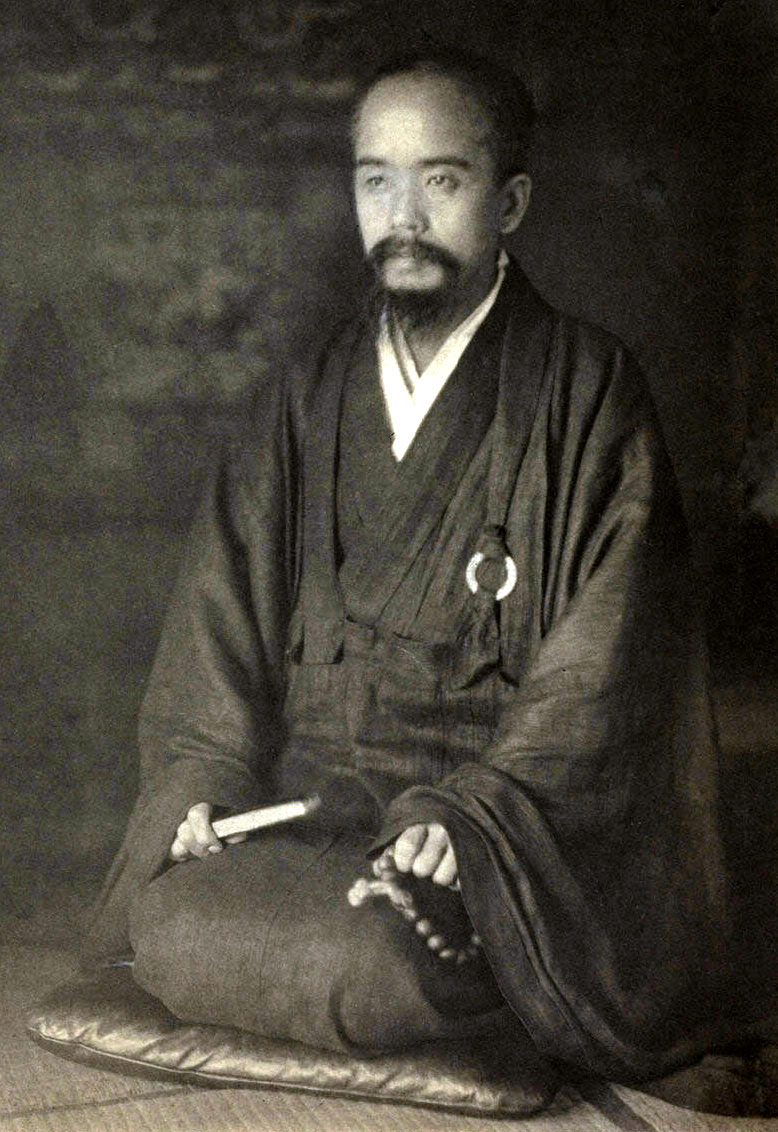
Photo by Zaida Ben-Yusufat
The earliest, and perhaps surprising, example of a religious translation into a language that can be labelled "modern" is the translation into Japanese by Ekai Kawaguchi (1866-1945) published in 1921. Until 1891 Kawaguchi was the head of the Zen Gohyaku rakan Monastery in Tokyo. He had a sincere interest in understanding Buddhist scriptures, and spent several years as a hermit studying Chinese Buddhist texts. The famed accuracy of the Tibetan Buddhist canon had reached him, and he had also heard of the recent discoveries of Sanskrit manuscripts in Nepal. Considering these as more direct sources for the Buddha's teachings he decided to travel to Tibet and India in order to get access to them. He first travelled to Tibet between 1897 and 1903, studying Tibetan and English with a newly acquainted friend Sarat Chandra Das, himself a famous Tibetologist.[33] He later made a second trip to India and Nepal to study Sanskrit. Kawaguchi published an account of his travels in the book Three Years in Tibet in 1909 with the help of the Theosophical society. As the first Japanese to travel to Tibet, Kawaguchi has been seen as a pioneer of the Japanese branch of Tibetology and studies of Buddhism. His interests seem, however, to have been fuelled primarily by a religious motivation, a personal interest for understanding the Buddhist teachings. Likewise with his translation of the BCA, a text which he must have become well acquainted with through his studies at monasteries in Tibet, and through the recent publications of the Sanskrit edition in India. It is probably safe to say that his motivation in translating it was that he thought it was an important text not readily available in Japan, and one that the Japanese Buddhist community could learn from.

The single most important event responsible for the world-wide spreading of the BCA in the second half of the 20th Century was the involuntary exile of a large group of Tibetans, including the religious and temporal leader of Tibet, the 14th Dalai Lama Tenzin Gyatso (bsTan 'dzin rgya mtsho; 1935-), in 1959. Most of the refugees settled in India, setting up Tibetan communities and Buddhist monasteries aimed at preserving Tibetan identity and culture. Throughout the 1960s and 1970s the interest in Tibetan Buddhism spread to new countries as Tibetan religious teachers, previously inaccessible to foreigners in the, at times, quite isolated Tibet, travelled abroad. Foreigners also came to India in search for religious guidance, and the presence of the Dalai Lama attracted many. As will be dealt with extensively in a later chapter, where a teaching by the Dalai Lama on the BCA will be presented, the Dalai Lama has a personal preference for the BCA, and has said that it is one of his main inspirations in life.[34] He teaches it often. The first translation from the Tibetan edition was published by the American, and at that time Tibetan Buddhist monk, Stephen Batchelor in 1979. Batchelor had been asked by the Dalai Lama himself to prepare a translation of the BCA, and was also appointed a tutor, Geshe Ngawang Dargyey, to instruct him through the process. He was told to base himself on the commentary by the Tibetan bKa' gdams pa master dNgul chu rGyal sras thogs med bzang po (12th Century). The translation has remained influential in the Buddhist community, and was also used as the main translation during the teachings by the Dalai Lama in January of 2009 (as presented below). Recently translations have appeared in many languages, mostly by individuals with a personal interest in Buddhism, and usually through the guidance of a Tibetan Buddhist teacher.[35]
Academic Work

The BCA has also given rise to several works that are not translations, but that deal with specific philosophical or ethical issues raised by the text. One of these that have stirred the most debate lately, is a book containing articles by Paul Williams, Studies in the Philosophy of the Bodhicaryāvatāra: Altruism and Reality, published in 1998. Williams, Reader in Indo-Tibetan Studies and Codirector of the Centre for Buddhist Studies at the University of Bristol, presents his interest in the BCA as a way to "take seriously Śāntideva's invitation to us to engage with him in the meditation."[36] His interests are mainly with doctrinal interpretations and critical philosophical analysis. The article that has caused most of the ensuing debate is found in chapter 5, entitled "The Absence of Self and the Removal of Pain", containing the provocative subtitle "How Śāntideva Destroyed the Bodhisattva Path." Two opponents, Mark Siderits and Jon Wetlesen, both skilled philosophers and clearly both enthusiastic and perhaps somewhat offended on account of this attack on Śāntideva, have taken up the lead left by Williams and present two detailed answers.[37]
The thrust of Williams' argument is based on verses 8.101-103 in which Śāntideva makes an argument for altruism. Śāntideva says that since the continuant (saṃtāna) and the collective (samudāya), a reference to the self (ātman), are like a row of people, or an army, they do not exist (as a single unit), and therefore there exists no one who owns suffering. Ownerless suffering does not have the distinctions "mine" and "other." All will agree that suffering should be avoided, and since there can be no distinction between one's own suffering and that of others, all suffering should therefore be avoided, also that of other people. The logical response to the existence of suffering in the world is therefore that one develops an altruistic attitude, wishing to remove all suffering, no matter who experiences it. Williams then makes the point that this argument is based on denying the existence of the person not only ultimately, but also the conventional me-construction that is a useful conceptual fiction when relating to other people. If we are to give up this conceptual distinction we will be left paralyzed, since our interventions in the world require conceptualizations in terms of the conventional truth in order to be able to distinguish who is experiencing suffering. By denying the conventional existence of the person Śāntideva has then, Williams claims, destroyed the Bodhisattva path. I will not go into detail concerning the responses given by Siderits and Wetlesen, but suffice it to say that they point out that Williams' analysis sees Śāntideva's argument as strictly reductive, and that he has not paid heed to other alternative interpretations of the verses. They are therefore not persuaded by Williams' arguments, but they still gladly welcome the debate, and Siderits praises Williams' article as "a masterful blend of two elements seldom successfully combined: a scholarly investigation of the tradition and a critical philosophical interrogation of some of the tradition’s more important theories and arguments."[38]
Religious Commentaries and Self-Help Books
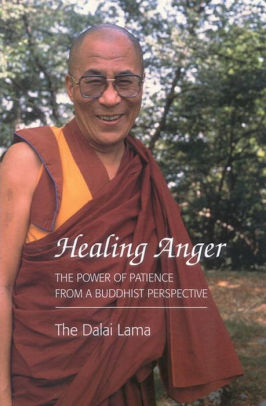
In the field of modern religious commentaries I wish to highlight, again, the Dalai Lama's contribution, which has been particularly rich and varied. As he often teaches on the BCA he has been a continuous inspiration to the many that have ended up translating the work, and many of his talks have also ended up in book form. These are mostly in the form of self-help books so popular to the modern mind, being sold also outside of the traditional Buddhist milieus, in bookstores and at airports across the world. One such book is Healing Anger, where the Dalai Lama comments freely on the 6th chapter of the BCA, that on patience. He writes loosely on the verses of the BCA on the importance of developing love, compassion, and tolerance in order to overcome difficulties. Another book, where he follows the verses more strictly while commenting, is A Flash of Lighning in the Dark of Night, basically a transcript of a teaching he gave in Dordogne, France, in 1991. This work contains a selection of verses from the BCA and Dalai Lama's short comments on how they relate to daily life and Buddhist practice. As one of the main proponents of the text, and an influential religious character and Nobel Peace Price laureate who often meets with world leaders, the BCA owes much of its wider popularity today to the Dalai Lama.
Notes
- ↑ Cleaves (1954: 5).
- ↑ Cleaves (1954: 9); Vladimirtsov reports that "in spite of intense searches both among the Volga Kalmuks as well as among the Oirat of North-West Mongolia, there has been no success in discovering this translation."
- ↑ The Manchus were a Tungusic people, in fact related historically and linguistically with the Mongols, but had taken on Hàn customs and traditions in order to rule China.
- ↑ Rachewiltz (1996: xi).
- ↑ L. Ligeti (1966), Śāntideva. A megvilágosodás útja. Bodhicaryāvatāra, Čhos-kyi ’od-zer fordítása, Mongol Nyelvemléktár VII, Budapest.
- ↑ Cleaves (1954: 24).
- ↑ For the life and works of lCang skya Hu thog thu, Ye shes bstan pa’i gron me, alias Rol pa'i rdo rje, see Smith (2001: 133-146); Rol pa'i rdo rje was influential in the translation and revision of the Mongolian canon, compiling a Tibetan-Mongolian bilingual glossary, and working on the translations and revisions under imperial patronage from 1741-42 with what must have been an enormous group of scholars.
- ↑ Also known as Sumatiratna Blo-bzan-rin-chen.
- ↑ rGyal tshab was the disciple of the founder of the dGe lugs school Tsong kha pa Blo bzang grags pa (1357-1419). Another student of Tsong kha pa was dGe 'dun grub (1391-1474), whose line of reincarnations would later be awarded the title Dalai Lama by the Mongol ruler Altan Qaan (1507-1582). The dGe lugs in time became the most influential sect in Mongolian Buddhism.
- ↑ A. Luvsanbalden (1976), Bodhicaryāvatāra, Ulan Bator.
- ↑ This and other manuscript work on the BCA will be discussed in a later chapter.
- ↑ Minayev (1889: 226-228); see the section on India for more on Tāranātha's account; I would like to thank Valeria Gazizova (MA student at UiO) for preparing an English translation of this account, originally written in Russian.
- ↑ Melis (2005) presents a survey of some of the recent developments in the translation of the BCA.
- ↑ Mukhopādhyāya (1962).
- ↑ Lindtner (1981).
- ↑ Ensink (1955) and Kloppenborg (1980)
- ↑ Barnett (1947), Chöpel (1940s), Matics (1970), Sweet (1976), Batchelor (1979), Gyatso (1988, 1991, 1994a, 1994b, and 2005), Gyatso (1989 and 2002), Parmananda (1990), Sonam (1990), Padmakara (1993, 1997, 1999, and 2008), Oldmeadow (1994), Crosby (1996), Wallace (1997), Cooper (1998), Thrangu (1999), Brunhölzl (2004), and Chodron (2005).
- ↑ Mäll (1982).
- ↑ Finot (1920), Ansermet (1985), Tri Lai, Thich (2001), and Padmakara (1993).
- ↑ Schmidt (1923), Winternitz (1930), Steinkellner (1981), Koss (2004), Scmidt (2005), and Driessens (1993).
- ↑ Shastri (1955), Tripathi (1989), Sharma (1990), and Siṃha (1993).
- ↑ Tucci (1925), Pezzali (1975 and 1982), and Gnoli (1983).
- ↑ Kanakura (1958) and Kawaguchi (1921).
- ↑ Lie (2003).
- ↑ Unknown (1980).
- ↑ Villalba (1993).
- ↑ Such as is the case with Wallace (1997).
- ↑ In this later translation he did not include the 10th chapter, as he considered in apocryphal.
- ↑ In a later chapter, "Manuscripts of the BCA", we will discuss the accuracy of La Vallée Poussin's edition, and present at least one example of what appears to be an inaccuracy that has crept into La Vallée Pousin's work which was not there in Minayev's.
- ↑ Those that have appeared, for instance the works of Vaidya (1960) and Bhaṭṭācārya (1960), are based solely on Minayev and La Vallée Poussin's previous editions, and have not considered any other manuscript witnesses; Lindtner has done some work on one ms., Pat. 196, but this has not lead to the publication of a new edition.
- ↑ Barnett (1947: 36).
- ↑ Ibid.
- ↑ Das published a Tibetan-English dictionary in 1903 which is still popular today.
- ↑ Crosby (1996: ix).
- ↑ One example is the Padmakara Translation Group which has published translations in English and French under the guidance of Jigme Khyentse Rinpoche (b. 1963).
- ↑ Williams (2000: x).
- ↑ Siderits' (2000) article is entitled "The Reality of Altruism: Reconstructing Śāntideva", while Wetlesen's (2002) is entitled "Did Śāntideva Destroy the Bodhisattva Path?"
- ↑ Another philosophical work that deals specifically with the ethical aspects of Śāntideva's philosophy is Brassard (2000).



