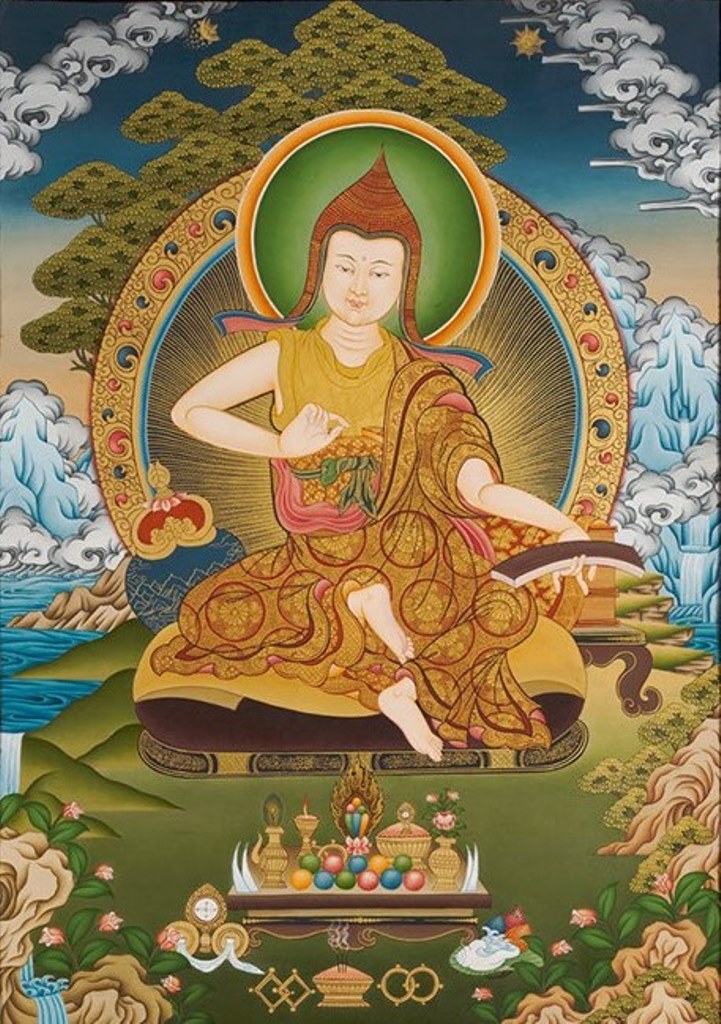
Candrakīrti's Middle Way

From Bodhicitta
< Books(Redirected from Candrakīrti's Middle Way)
Books/Candrakīrti's Middle Way

🤓 Admin Zone 🛠️ hidden to non-admins
Candrakīrti's Middle Way: Madhyamakāvatāra Chapter 6
Book


Please note that many items in our library are simply pages that represent a detailed library catalog entry and citation of someone else's work, presentation, or performance. Read our General Disclaimer for more information. You can find more information about this item on the publisher website.
Candrakirtis Middle Way-front.jpg

Description

A classic Indian work on the Mahayana Buddhist philosophy of emptiness by one of its greatest exponents is unlocked for contemporary readers in this new translation with lucid verse-by-verse explanations.

The Middle Way, or Madhyamaka, school of Indian Buddhist philosophy is known for its explication of emptiness (śūnyatā), and after Nāgārjuna—the second-century founder of the school—its most well-known defender is Candrakīrti (seventh century). Until recently, the Madhyamakāvatāra, one of Candrakīrti’s major works, was known primarily through its Tibetan translation, but with the publication of the Sanskrit verses from a manuscript discovered at the Potala Palace in Lhasa, we can now access Candrakīrti’s words in their original language.

Chapter 6 of the Madhyamakāvatāra, “Turned Toward” (abhimukhī), is roughly two thirds of the entire work, and it explicates the perfection of wisdom. As such, it contains Candrakīrti’s most detailed discussions of distinctively Madhyamaka teachings, defending Madhyamaka against accusations of nihilism and maintaining it has no thesis of its own. Answering objections from other Indian schools, both within and outside the Buddhist fold, he denies the ultimate reality of any and all existents, whether external or internal, and even of emptiness itself. While denying ultimates, he leaves conventionalities, arising dependently free of any absolute, to the world to confirm or deny.

The three main sections of chapter 6 are on the selflessness of phenomena, the selflessness of persons, and the varieties of emptiness. The first section is organized around the fourfold refutation of origination—from self, other, both, and neither—that begins Nāgārjuna’s root treatise of the Madhyamaka school. Candrakīrti takes up, in turn, Abhidharma realism, assertions of God or of Ātman, and Cārvāka materialism, but his main opponent is the Yogācāra school, which he calls Vijñānavāda. In his second section, he addresses Buddhist personalists (pudgalavāda) of the Saṃmatīya school, deploying his distinctive sevenfold analysis of a chariot and its parts.

All 226 verses of Candrakīrti’s chapter appear here in Sanskrit and in translation, accompanied by the authors’ clear distillation of Candrakīrti’s own commentary. (Source: Wisdom Publications)


Citation
Siderits, Mark, and Shoryu Katsura, trans. Candrakīrti's Middle Way: Madhyamakāvatāra Chapter 6. Classics of Indian Buddhism. New York: Wisdom Publications, 2026.
Publisher Link
Interconnections
1 Partial translation of
Chandrakirti.jpeg
Classical WorksAbout this item
Madhyamakāvatāra. (T. Dbu ma la 'jug pa). In Sanskrit, "Entrance to the Middle Way" (translated also as "Supplement to the Middle Way"); the major independent (as opposed to commentarial) work of the seventh-century Indian master Candrakīrti, who states that it is intended as an avatāra (variously rendered as "primer," "entrance," and "supplement") to Nāgārjuna's Mūlamadhyamakakārikā. The work is written in verse, to which the author provides an extensive prose commentary (bhāṣya). The work is organized around ten "productions of the aspiration to enlightenment" (bodhicittotpāda), which correspond to the ten stages (bhūmi) of the bodhisattva path (drawn largely from the Daśabhūmikasūtra) and their respective perfections (pāramitā), describing the salient practices and attainments of each. These are followed by chapters on the qualities of the bodhisattva, on the stage of buddhahood, and a conclusion. The lengthiest (comprising approximately half of the work) and most important chapter of the text is the sixth, dealing with the perfection of wisdom (prajñāpāramitā). This is one of the most extensive and influential expositions in Indian literature of Madhyamaka philosophical positions. In it, Candrakīrti provides a detailed discussion of the two truths—ultimate truth (paramārthasatya) and conventional truth (saṃvṛtisatya)—arguing that all things that have these two natures and that conventional truths (which he glosses as "concealing truths") are not in fact true because they appear falsely to the ignorant consciousness. He also discusses the crucial question of valid knowledge (pramāṇa) among the unenlightened, relating it to worldly consensus (lokaprasiddha). The sixth chapter also contains one of the most detailed refutations of Yogācāra in Madhyamaka literature, treating such topics as the three natures (trisvabhāva), the foundational consciousness (ālayavijñāna), and the statements in the sūtras that the three realms of existence are "mind-only" (cittamātra). This chapter also contains Candrakīrti's most famous contribution to Madhyamaka reasoning, the sevenfold reasoning designed to demonstrate the absence of a personal self (pudgalanairātmya). Adding to and elaborating upon a fivefold reasoning found in Nāgārjuna's Mūlamadhyamakakārikā, Candrakīrti argues that the person does not intrinsically exist because of it: (1) not being the aggregates (skandha), (2) not being other than the aggregates, (3) not being the basis of the aggregates, (4) not depending on the aggregates, (5) not possessing the aggregates, (6) not being the shape of the aggregates, and (7) not being the composite of the aggregates. He illustrates this reasoning by applying it to the example of a chariot, which, he argues, is not to be found among its constituent parts. The sixth chapter concludes with a discussion of the sixteen and the twenty forms of emptiness (śūnyatā), which include the emptiness of emptiness (śūnyatāśūnyatā). The work was the most widely studied and commented upon Madhyamaka text in Tibet among all sects, serving, for example, as one of the "five texts" (zhung lnga) that formed the Dge lugs scholastic curriculum. The work is preserved only in Tibetan, although a Sanskrit manuscript of verses has been discovered in Tibet. (Source: "Madhyamakāvatāra." In The Princeton Dictionary of Buddhism, 489. Princeton University Press, 2014. http://www.jstor.org/stable/j.ctt46n41q.27.)