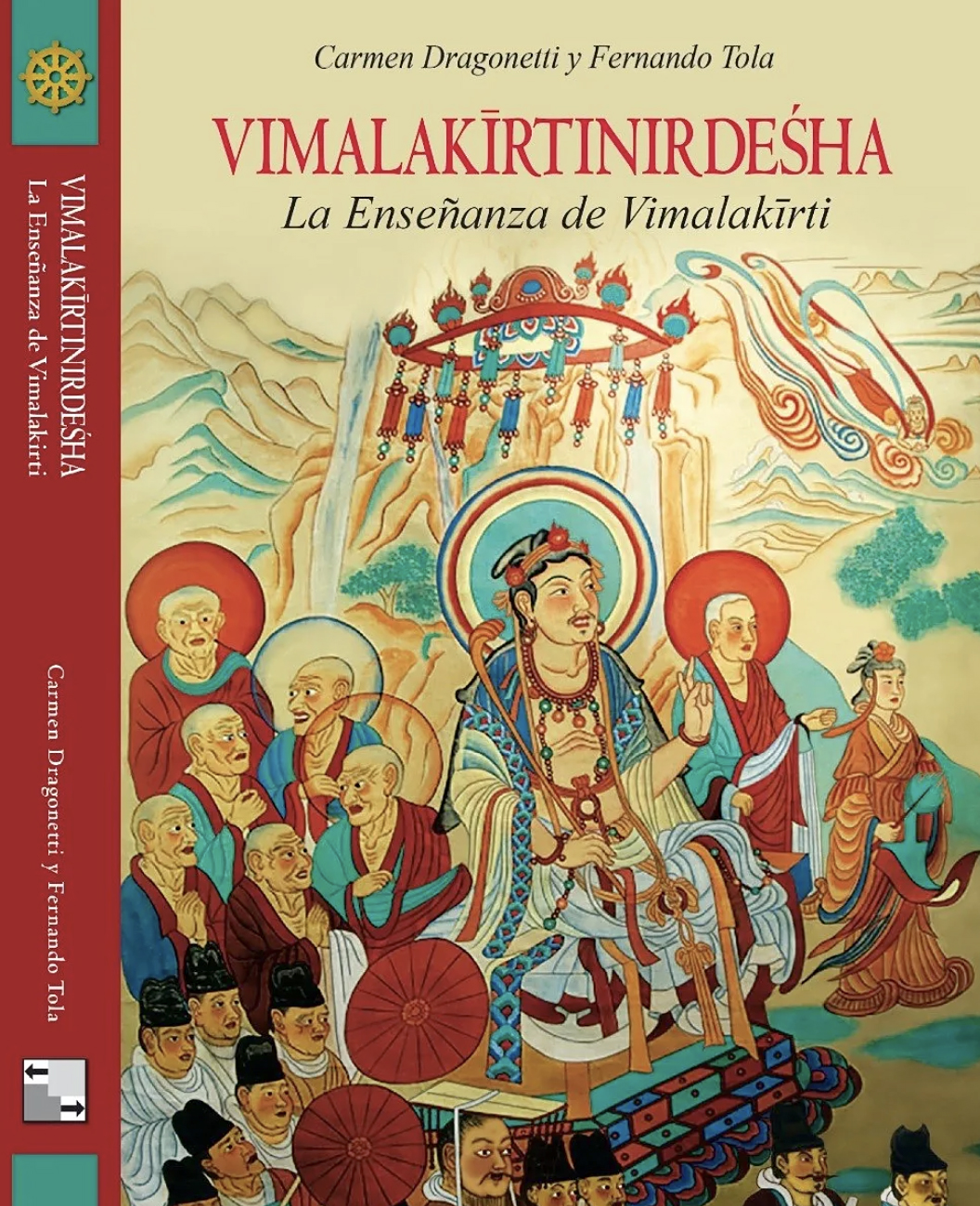
Vimalakīrtinirdeśha: La Enseñanza De Vimalakīrti

From Bodhicitta
Books/Vimalakīrtinirdeśha: La Enseñanza De Vimalakīrti

🤓 Admin Zone 🛠️ hidden to non-admins
Vimalakīrtinirdeśha: La Enseñanza De Vimalakīrti
Book


Please note that many items in our library are simply pages that represent a detailed library catalog entry and citation of someone else's work, presentation, or performance. Read our General Disclaimer for more information. You can find more information about this item on the publisher website.

Description

Obra póstuma de Carmen Dragonetti y Fernando Tola, este volumen contiene la primera traducción a lengua moderna occidental, el español, a partir del original sánscrito, del Vimalakirtinirdesha. Sus traducciones chinas tuvieron enorme influencia en todo el mundo buddhista, ya que es uno de los textos que contribuyeron a la creación del Buddhismo Ch´an en China, que se difundió luego en Vietnam, Korea y Japón, donde recibe el nombre de Zen. Además, que el personaje central sea un Bodhisattva laico lo convierte en un texto muy apreciado por la parte laica de la Comunidad Buddhista en todos los ámbitos buddhistas, antiguos y modernos.

El Vimalakirtinirdesha no es un Sutra del Mahayana en sentido tradicional, no tiene como centro a Buddha Shakyamuni, y su Palabra, sino la enseñanza personal de un laico buddhista ejemplar, Vimalakirti, que ha captado la evolución sufrida filosóficamente por la doctrina buddhista en virtud de la cual los dharmas, insustanciales, dependientes de causas, transitorios e impermanentes, dan lugar a la Vaciedad de ser propio (svabhavashunyata) de toda la realidad. Los nuevos enfoques de la antigua Enseñanza desde todas las perspectivas posibles aparecen en él: el cuerpo, la enfermedad, la Carrera del Bodhisattva, la moral buddhista de las Perfecciones, las antiguas nociones, las nuevas percepciones y valores como la Habilidad en el Uso de los Medios, la Paciencia en su novedosa perspectiva intelectual que hace posible comprender la Vaciedad, la Elocuencia del que predica, la Receptividad del que lo escucha, el puente entre ellos constituido por la Habilidad en el Uso de los Medios, la Tierra de Buddha en su concepción moralizante, etc.

El Vimalakirtinirdesha, ni Sutra ni Tratado, es un texto extraordinario escrito desde la perspectiva de un laico buddhista que pone en práctica buddhista la filosofía teórica de la Vaciedad Universal y expone su visión amplia y abarcante de la misma en un sánscrito de inigualable belleza. Toda la enseñanza está enfocada desde la Vaciedad Universal: las ideas, los valores, las cualidades morales, las prácticas del Bodhisattva en su Carrera, en forma exhaustiva y detallada, con explicaciones ingeniosas y profundas, no siempre fáciles de captar y/o seguir, una riqueza argumentativa coherente y hermosa. (Source Accessed Apr 20, 2022)


Citation
Dragonetti, Carmen, and Fernando Tola, trans. Vimalakīrtinirdeśha: La Enseñanza De Vimalakīrti. Buenos Aires: Fundación Bodhiyāna, 2018.
Publisher Link
Interconnections
1 Full translation of
Classical WorksAbout this item
Vimalakīrtinirdeśa (T. Dri med grags pas bstan pa'i mdo; C. Weimo jing; J. Yuimagyō; K. Yuma kyǒng 維摩經). In Sanskrit, "Vimalakīrti's Instructions"; one of the most beloved Indian Mahāyāna sūtras, renowned especially for having a layman, the eponymous Vimalakīrti, as its protagonist. The text probably dates from around the second century CE. Among the seven translations of the sūtra into Chinese, the most famous is that made by Kumārajīva in 406. His translation seems to have been adapted to appeal to Chinese mores, emphasizing the worldly elements of Vimalakīrti's teachings and introducing the term "filial piety" into the text. The sūtra was also translated by Xuanzang in 650. The sūtra was translated into Tibetan twice, the more famous being that of Chos nyid tshul khrims in the ninth Century. It has also been rendered into Sogdian, Khotanese, and Uighur. The original Sanskrit of the text was lost for over a millennia until a Sanskrit manuscript was discovered in the Po ta la palace in Tibet in 2001. The narrative of the sūtra begins with the Buddha requesting that his leading Śrāvaka disciples visit his lay disciple Vimalakīrti, who is ill. Each demurs, recounting a previous meeting with Vimalakīrti in which the layman had chastised the monk for his limited understanding of the dharma. The Buddha then instructs his leading bodhisattva disciples to visit Vimalakīrti. Each again demurs until MañjuśrI reluctantly agrees. Vimalakīrti explains that his sickness is the sickness of all sentient beings, and goes on to describe how a sick bodhisattva should understand his sickness, emphasizing the necessity of both wisdom (prajñā) and method (upāya). A large audience of monks and bodhisattvas then comes to Vimalakīrti's house, where he delivers a sermon on "inconceivable liberation" (acintyavimokṣa). Among the audience is Śariputra, the wisest of the Buddha's śrāvaka disciples. As in other Mahāyāna sūtras, the eminent śrāvaka is made to play the fool, repeatedly failing to understand how all dichotomies are overcome in emptiness (śūnyatā), most famously when a goddess momentarily transforms him into a female. Later, a series of bodhisattvas take turns describing various forms of duality and how they are overcome in nonduality. Vimalakīrti is the last to be invited to speak. He remains silent and is praised for this teaching of the entrance into nonduality. The sūtra is widely quoted in later literature, especially on the topics of emptiness, method, and nonduality. It became particularly famous in East Asia because the protagonist is a layman, who repeatedly demonstrates that his wisdom is superior to that of monks. Scenes from the sūtra are often depicted in East Asian Buddhist art. (Source: "Vimalakīrtinirdeśa." In The Princeton Dictionary of Buddhism, 971. Princeton University Press, 2014. http://www.jstor.org/stable/j.ctt46n41q.27.)