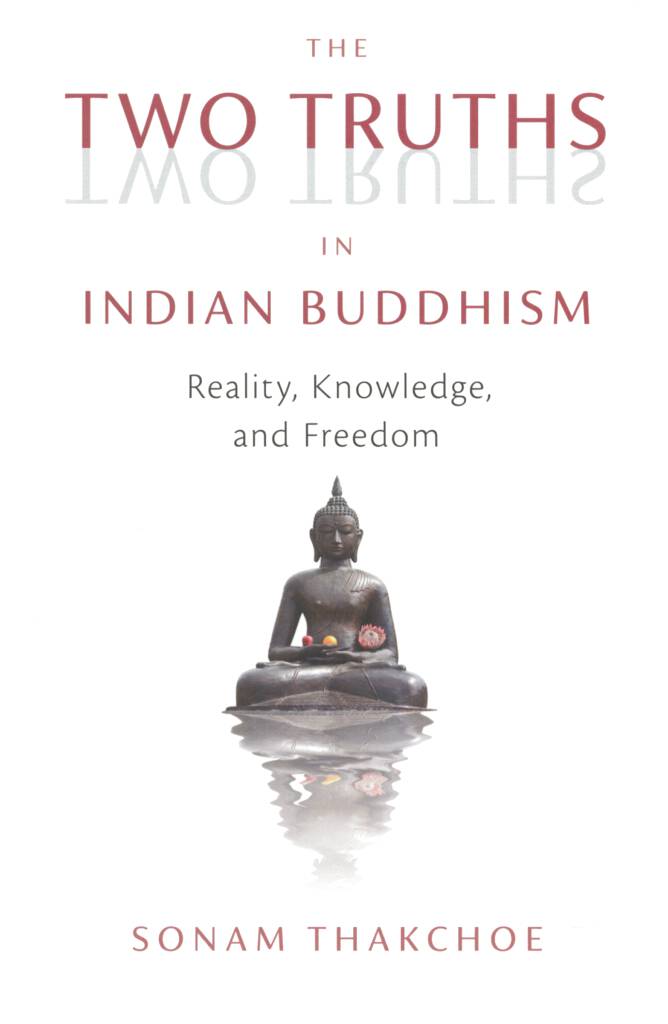
The Two Truths in Indian Buddhism (Thakchoe 2023)
From Bodhicitta
< BooksBooks/The Two Truths in Indian Buddhism (Thakchoe 2023)
| 🤓 Admin Zone 🛠️ hidden to non-admins | |
The Two Truths in Indian Buddhism: Reality, Knowledge, and Freedom
Book
Please note that many items in our library are simply pages that represent a detailed library catalog entry and citation of someone else's work, presentation, or performance. Read our General Disclaimer for more information. You can find more information about this item on the publisher website.
-front.jpg)
Description
In this clear and exemplary approach to one of the core philosophical subjects of the Buddhist tradition, Sonam Thakchoe guides readers through the range of Indian Buddhist philosophical schools and how each approaches the two truths: ultimate truth and conventional truth. In this presentation of philosophical systems, the detailed argumentations and analyses of each school’s approach to the two truths are presented to weave together the unique contributions each school brings to supporting and strengthening a Buddhist practitioner’s understanding of reality. The insights of the great scholars of Indian Buddhist history—such as Vasubandhu, Bhāvaviveka, Kamalaśīla, Dharmakīrti, Nāgārjuna, and Candrakīrti—are illuminated in this volume, with profound implications to the practice and views of modern practitioners and scholars.
The Vaibhāṣika, Saūtrāntika, Yogācāra, and Madhyamaka schools provide a framework for a continuum of philosophical debate that is far more interrelated, and internally complex, than one may presume. Yet we see how the schools build upon the findings of one another, leading from a belief in the realism of external phenomena to the relinquishment of any commitment to realism of either external or internal realities. This fascinating movement through philosophical approaches leads us to see how the conventional and ultimate—dependent arising and emptiness—are twin aspects of a single reality. (Source: Wisdom Publications)
Citation
Thakchoe, Sonam. The Two Truths in Indian Buddhism: Reality, Knowledge, and Freedom. Somerville, MA: Wisdom Publications, 2023.
Publisher Link
Table of contents
- Acknowledgmentsix
- Introduction: Mahāyāna and the Two Truths1
- 1. Vaibhāsika: Vasubandhu25
- Conventional Truth29
- Ultimate Truth32
- Conclusion35
- 2. Sautrāntika: Vasubandhu and Dharmakīrti39
- Scripturalists40
- Logicians43
- Ultimate Truth43
- Conventional Truth48
- Conclusion51
- 3. Yogācāra: Vasubandhu53
- Conventional Truth56
- Ultimate Truth60
- The Theory of the Three Naturelessnesses63
- Arguments Rejecting the Reality of External Objects65
- Conclusion72
- 4. Madhyamaka: Nāgārjuna75
- Nāgārjuna’s Theory of the Two Truths76
- The Svātantrika/Prāsaṅgika Splinter79
- Conclusion93
- 5. Sautrāntika-Svātantrika Madhyamaka: Bhāviveka and Jñānagarbha95
- Bhāviveka98
- Jñānagarbha114
- Conclusion124
- 6. Yogācāra-Svātantrika Madhyamaka: Śāntaraksita and Kamalaśīla127
- Ultimate Truth129
- Conventional Truth150
- The Relationship of the Two Truths154
- Conclusion157
- 7. Prāsañgika Madhyamaka: Candrakīrti161
- Conventional Truth162
- Ultimate Truth177
- Conclusion195
- 8. Implications on Contemporary Studies199
- Notes209
- References and Bibliography265
- Index295
- About the Author311
Interconnections