The Precious Garland: An Epistle to a King
From Bodhicitta
< BooksBooks/The Precious Garland: An Epistle to a King
| 🤓 Admin Zone 🛠️ hidden to non-admins | |
The Precious Garland: An Epistle to a King
Book
Please note that many items in our library are simply pages that represent a detailed library catalog entry and citation of someone else's work, presentation, or performance. Read our General Disclaimer for more information.

Description
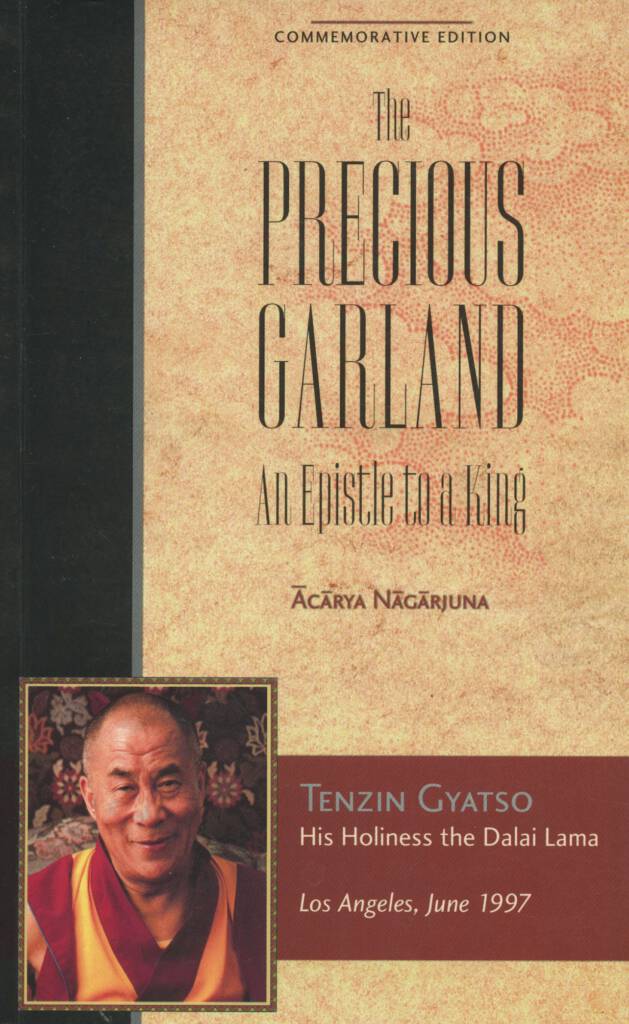
This book is a commemorative edition that was produced especially for the occasion of H.H. the Dalai Lama's teachings in Los Angeles in June 1997.
Citation
Nāgārjuna. The Precious Garland: An Epistle to a King. Translated by John Dunne and Sarah McClintock. Boston, MA: Wisdom Publications, 1997.
Table of contents
- Note to the Readerii
- Translators' Preface1
- The Precious Garland: An Epistle to a King by Ācārya Nāgārjuna
- Chapter One Elevation and the Highest Good9
- Chapter Two Combination (of Elevation and the Highest Good)25
- Chapter Three The Collections for Awakening41
- Chapter Four Royal Policy57
- Chapter Five The Practices of a Bodhisattva73
- Appendix
- The Light of Centrism: In Praise of the Glorious Protector Nāgārjuna by Könchog Tenpey Drönmey91
- Tibetan text of Precious Garland verses105
- Notes111
- Brief Remarks on the Śākyamuni Empowerment129
- About His Holiness the Dalai Lama131
- About Thubten Dhargye Ling and Venerable Geshe Gyeltsen133
- Contributors and Sponsors135
- About Wisdom Publications137
Interconnections
1 Full translation of

Ratnāvalī. (T. Rin chen phreng ba; C. Baoxingwang zheng lun; J. Hōgyō ō shöron; K. Pohaengwang chöng non 寶行王正論). In Sanskrit, "Garland of Jewels," a Sanskrit work by the Madhyamaka philosopher Nāgārjuna. The work consists of five hundred verses arranged in five chapters. While the Ratnāvalī contains many of Nāgārjuna's fundamental philosophical ideas, grounded primarily in the notion of emptiness (śūnyatā), the work is more focused on issues of ethics. The Ratnāvalī is addressed to King Gautamīputra of Āndhra, a friend and patron of Nāgārjuna, and much of the text discusses the proper conduct of the laity, particularly those in administrative positions such as ministers and kings. In particular, the fourth chapter is devoted to an exploration of kingship and the proper management of a kingdom. The work also contains a defense of the Mahāyāna as the word of the Buddha (buddhavacana), an exposition of the collection of merit (puṇyasaṃbhāra) and the collection of wisdom (jñānasaṃbhāra), a description of the ten bodhisattva stages (bhūmi) based on the Daśabhūmikasūtra, and a correlation of the practice of specific virtues with the achievement of the thirty-two marks of a superman (mahāpuruṣalakṣaṇa). There are complete versions of the work extant in Tibetan and Chinese translations, but only parts survive in the original Sanskrit. (Source: "Ratnāvalī." In The Princeton Dictionary of Buddhism, 704. Princeton University Press, 2014. http://www.jstor.org/stable/j.ctt46n41q.27.)
1 Other editions
-front.jpg)
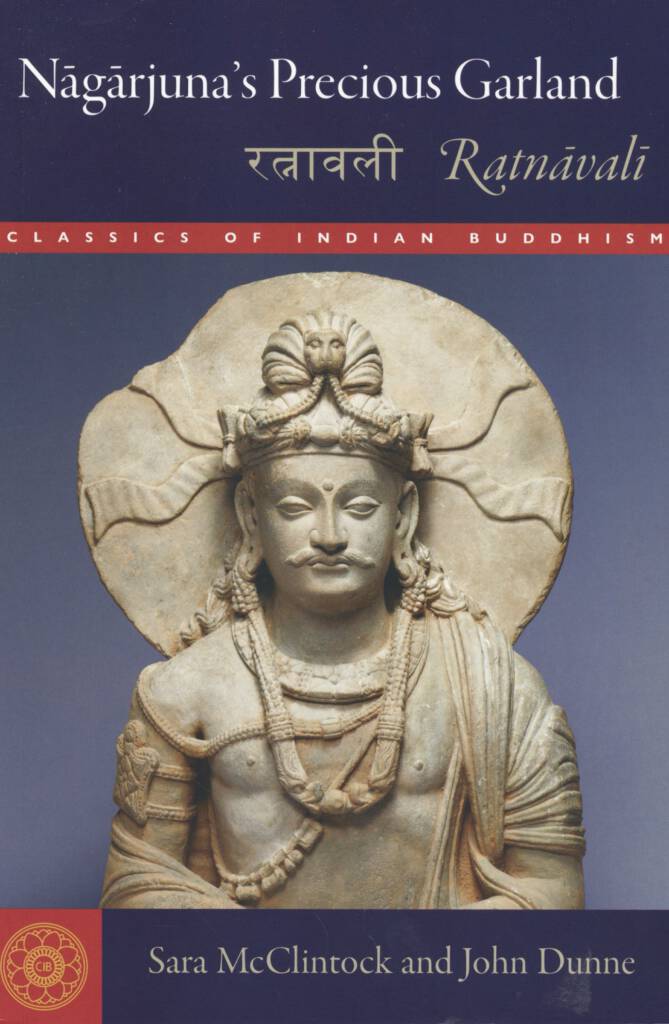
In this profound work of five hundred verses, we encounter a presentation of Buddhism that integrates both the worldly and the transcendent. The clear and sagacious advice laid out on every page serves as a road map to one’s highest goal—whether that goal is a better life, here called the Dharma of ascendance, or the ultimate one of spiritual freedom, the Dharma of the highest good. The verses, written for an unnamed ruler, touch on questions of statecraft, but their broader themes speak to us today because they tackle the difficulty of integrating one’s spiritual journey with the social and political demands of daily life.
Nāgārjuna was an Indian Buddhist teacher, probably of the second century CE, who was renowned for his astute articulation of the philosophy of the Middle Way (Madhyamaka). His thoroughgoing critique of all forms of essentialism became a touchstone for Mahāyāna Buddhism in India, Tibet, and throughout East Asia, and his importance for the development of the Mahāyāna tradition can scarcely be exaggerated.
The translators here first rendered Nāgārjuna’s letter for the Dalai Lama’s teachings on the work in Los Angeles in 1997. While that commemorative edition was translated from the Tibetan, the present volume prioritizes the surviving Sanskrit verses along with the only known Indian commentary, by the eleventh-century scholar Ajitamitra. This is the first complete translation in English of the Precious Garland that takes the Indian text and commentary as its primary authorities. In addition, they provide rigorous working editions of the Sanskrit and Tibetan verses they translate. (Source: Wisdom Publications)