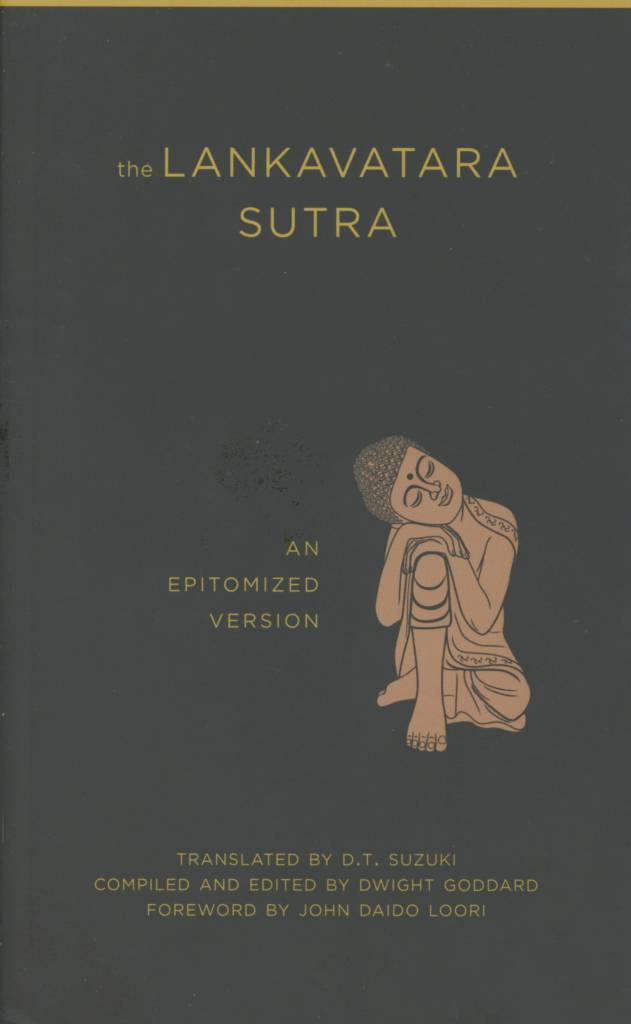
The Lankavatara Sutra: An Epitomized Version
From Bodhicitta
< BooksBooks/The Lankavatara Sutra: An Epitomized Version
| 🤓 Admin Zone 🛠️ hidden to non-admins | |
The Lankavatara Sutra: An Epitomized Version
Book
Please note that many items in our library are simply pages that represent a detailed library catalog entry and citation of someone else's work, presentation, or performance. Read our General Disclaimer for more information. You can find more information about this item on the publisher website.

Description
The Lankavatara Sutra, according to tradition, contains the actual words of the Buddha spoken in Sri Lanka (Ceylon). Nothing is known about its author, the time of its composition, or its original form. Scholars have tended to date the original compilation to early in the first century, and the written work to the fourth century of the Common Era. The sutra was foundational in establishing the central tenets of Mahayana Buddhism, and especially Zen. The Lankavatara was virtually unknown in the West until D. T Suzuki’s Studies in the Lanakavata Sutra was published in 1929. Suzuki’s subsequent translation and publication of the The Lankavatara Sutra in 1932 earned him the respect and gratitude of scholars and Buddhists worldwide. Professor Suzuki felt that an editing of the Lankavatara, for the sake of easier reading, would make the sutra more widely accessible. He encouraged the editor Dwight Goddard to take on the challenge, and the publication of the ‘epitomised’ version appeared in print also in 1932, under the title, Self-Realization of Noble Wisdom: The Lankavatara Sutra.
(Source: Monkfish Book Publishing)
Citation
Goddard, Dwight, ed. The Lankavatara Sutra: An Epitomized Version. Translated by D.T. Suzuki. Rhinebeck, NY: Monkfish Book Publishing, 2003.
Publisher Link
Interconnections
1 Partial translation of

An important Mahāyāna sūtra that was highly influential in East Asia as well as in Nepal, where a manuscript was discovered that remains the only extant Sanskrit recension of this text. It is notable for its inclusion of many doctrinal features that would come to be associated with the Yogācāra philosophy of Mind-Only (Cittamātra), such as the ālayavijñāna, or store-house consciousness, that acts as a repository for the seeds of karmic actions. It also includes several lengthy discussions of tathāgatagarbha and, though it is never actually referenced in the Uttaratantra, it is often listed among the so-called tathāgatagarbha sūtras. While its lack of mention in the Uttaratantra has been interpreted by scholars as evidence that the sūtra postdates the treatise, it should be noted that the ways in which the tathāgatagarbha is discussed in the sūtra is often at odds with its presentation in the Uttaratantra.