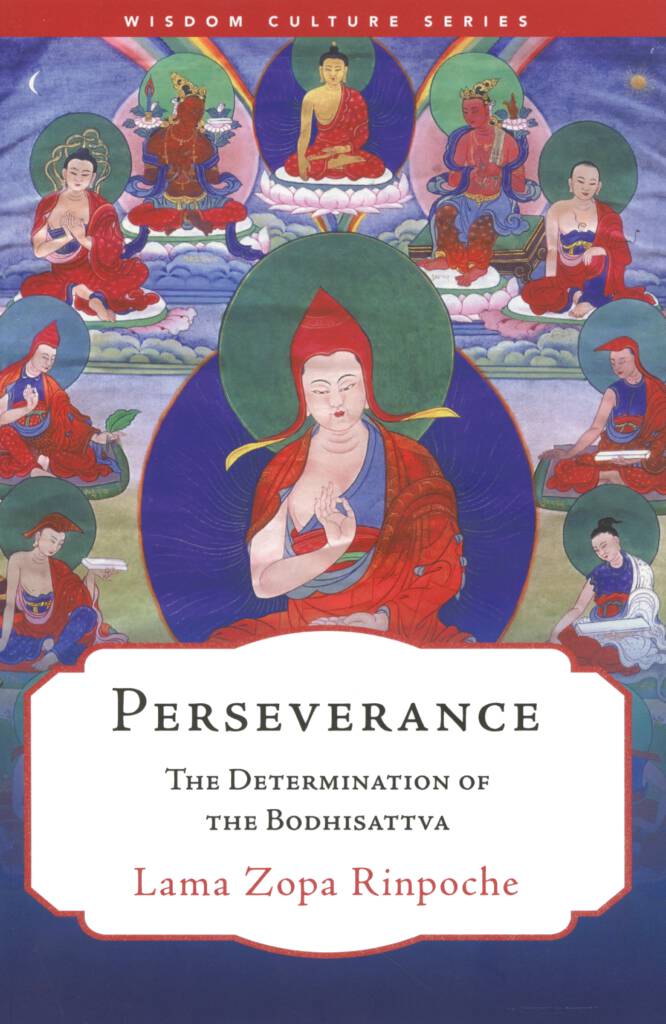
Perseverance (Zopa 2024)

From Bodhicitta
LibraryBooksPerseverance (Zopa 2024)
< Books
Books/Perseverance (Zopa 2024)

Perseverance (Zopa 2024)
Book


Please note that many items in our library are simply pages that represent a detailed library catalog entry and citation of someone else's work, presentation, or performance. Read our General Disclaimer for more information.
Perseverance (Zopa 2024)-front.jpg

Description

Dive deep into perseverance, one of the core practices of the bodhisattvas, with beloved teacher Lama Zopa Rinpoche as a guide.

Perseverance, or virya, is also translated as “energy,” “fortitude,” or “vigor.” One of the six perfections, or paramitas, it is one of the trainings of the bodhisattvas and a deeply necessary quality for the Buddhist path. But it’s far from the kind of head-down, stubborn determination the name could imply; instead, it’s joyful energy that enables us to practice.

Rinpoche’s commentary is structured around the fifth and seventh chapters of the beloved Guide to the Bodhisattva’s Way of Life by the eighth-century philosopher-poet Shantideva. Interweaving his teaching with Shantideva’s verses, Rinpoche elucidates this prerequisite for enlightenment, explaining what it is and how to cultivate it: guard your mind, gather virtue, work for others—and find incredible joy in these things. (Source: Wisdom Publications)

Citation
Zopa, Thubten. Perseverance: The Determination of the Bodhisattva. Compiled and edited by Gordon McDougall. Wisdom Culture Series. New York: Wisdom Publications, 2024.


Partial translation of

 
An "Introduction to Bodhisattva Practice," the Bodhisattvacaryāvatāra is a poem about the path of a bodhisattva, in ten chapters, written by the Indian Buddhist Śāntideva (fl. c. 685–763). One of the masterpieces of world literature, it is a core text of Mahāyāna Buddhism and continues to be taught, studied, and commented upon in many languages and by many traditions around the world. The main subject of the text is bodhicitta, the altruistic aspiration for enlightenment, and the path and practices of the bodhisattva, the six perfections (pāramitās). The text forms the basis of many contemporary discussions of Buddhist ethics and philosophy.
Text

Teaching based on

 
Bodhicaryāvatāra
An "Introduction to Bodhisattva Practice," the Bodhisattvacaryāvatāra is a poem about the path of a bodhisattva, in ten chapters, written by the Indian Buddhist Śāntideva (fl. c. 685–763). One of the masterpieces of world literature, it is a core text of Mahāyāna Buddhism and continues to be taught, studied, and commented upon in many languages and by many traditions around the world. The main subject of the text is bodhicitta, the altruistic aspiration for enlightenment, and the path and practices of the bodhisattva, the six perfections (pāramitās). The text forms the basis of many contemporary discussions of Buddhist ethics and philosophy.
Text

  • Editor's Prefacevii
  • Introduction: Chapter 7, Verses 1-2a1
    • Perseverance Aids All the Other Perfections1
    • We Need Perseverance on the Whole Path5
    • Compassion Gives Life Meaning13
  • 1. Guarding the Mind: Chapter 5, Verses 1-3317
    • Armor-like Perseverance18
    • The Dangers of an Uncontrolled Mind23
    • The Mind Is the Basis of All Six Perfections31
    • The Need for Awareness34
  • 2. The Energy of Working for Others51
    • The Perseverance of Gathering Virtue51
    • The Perseverance of Acting for the Welfare of Others62
  • 3. Overcoming Laziness: Chapter 7, Verses 2b-1565
    • The Three Types of Laziness65
    • The Laziness of Procrastination66
    • The Laziness of Attachment to Samsaric Activities85
    • The Laziness of Discouragement88
  • 4. Developing Perseverance: Chapter 7, Verses 16-3093
    • The Minds Needed for Perseverance93
    • The Ability to Endure Difficulties97
    • Bodhisattvas Happily Take On Suffering for Others104
  • 5. The Four Supports: Chapter 7, Verses 31-75109
    • The Armies of Effort109
    • Zeal110
    • Resolve122
    • Rejoicing141
    • Relinquishment148
  • Afterword: Saving the Child from the Fire159
  • Glossary161
  • Notes179
  • Bibliography185
  • Index189
  • About the Author201