Peacock in the Poison Grove

From Bodhicitta
LibraryBooksPeacock in the Poison Grove
< Books
Books/Peacock in the Poison Grove

Peacock in the Poison Grove
Book


Please note that many items in our library are simply pages that represent a detailed library catalog entry and citation of someone else's work, presentation, or performance. Read our General Disclaimer for more information. You can find more information about this item on the publisher website.
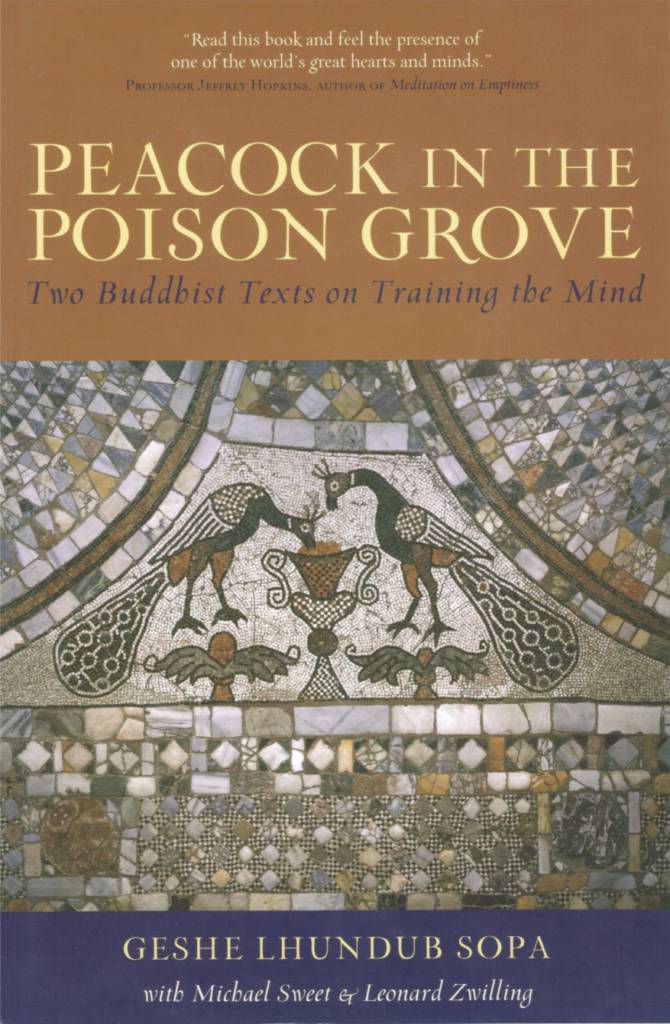
Peacock in the Poison Grove-front.jpg

Description

Geshe Sopa offers insightful commentary on two of the earliest Tibetan texts that focus on mental training. Peacock in the Poison Grove presents powerful yogic methods of dispelling the selfish delusions of the ego and maintaining purity in our motives. Geshe Sopa's lucid explanations teach how we can fight the egocentric enemy within by realizing the truth of emptiness and by developing a compassionate, loving attitude toward others. (Source: Wisdom Publications)
Citation
Sopa, Geshe Lhundub, trans. Peacock in the Poison Grove: Two Buddhist Texts on Training the Mind; The Wheel-Weapon (mTshon cha ’khor lo) and The Poison-Destroying Peacock (rMa bya dug ’joms). Attributed to Dharmarakṣita. Edited and cotranslated by Michael J. Sweet and Leonard Zwilling. Boston: Wisdom Publications, 2001.
Publisher Link
Texts Translated
  1. Dharmarakṣita (དྷརྨ་རཀྴི་ཏ་): blo sbyong mtshon cha 'khor lo (བློ་སྦྱོང་མཚོན་ཆ་འཁོར་ལོ་ / The Wheel-Weapon Mind Training). In gdams ngag mdzod, Vol. 4: 53 - 66. Paro: Lama Ngodrup and Sherab Drimey, 1979-1981. Buda by BDRC Logo.jpg Tsadra Foundation Treasury of Precious Instructions
  2. Dharmarakṣita (དྷརྨ་རཀྴི་ཏ་): blo sbyong rma bya dug 'joms (བློ་སྦྱོང་རྨ་བྱ་དུག་འཇོམས་ / The Poison-Destroying Peacock Mind Training). In gdams ngag mdzod Vol. 4: 67 - 78. Paro: Lama Ngodrup and Sherab Drimey, 1979-1981. Buda by BDRC Logo.jpg Tsadra Foundation Treasury of Precious Instructions


Translation of

 
Blo sbyong rma bya dug 'joms
One of the earliest Tibetan texts that focuses on mind training. This text presents powerful yogic methods of dispelling the selfish delusions of the ego and maintaining purity in our motives. Teaches how we can fight the egocentric enemy within by realizing the truth of emptiness and by developing a compassionate, loving attitude toward others.
Text
 
Blo sbyong mtshon cha 'khor lo
Wheel of Sharp Weapons is an abbreviated title for The Wheel of Sharp Weapons Effectively Striking the Heart of the Foe. This text is often referenced as a detailed source for how the laws of karma play out in our lives; it reveals many specific effects and their causes. A poetic presentation, the wheel of sharp weapons can be visualized as something we throw out or propel, which then comes back to cut us, like a boomerang. In the same way, Dharmarakṣita explains, the nonvirtuous causes we create through our self-interested behavior come back to "cut us" in future lives as the ripening of the negative karma such actions create. This, he explains, is the source of all our pain and suffering. He admonishes that it is our own selfishness or self-cherishing that leads us to harm others, which in turn creates the negative karma or potential for future suffering. Our suffering is not a punishment, merely a self-created karmic result. In most verses, Dharmarakṣita also offers a suggested alternative virtuous or positive action to substitute for our previous nonvirtuous behavior, actions that will create positive karma and future pleasant conditions and happiness.

According to the Wheel of Sharp Weapons, the way to make an end of this cycle is to understand how this process comes about and how it is rooted in the grasping at a self or "I". When we contemplate how our actions, rooted in the sense of self and other, cause suffering, then we use these very negative actions we have done in the past as a contemplative "weapon" to attack self grasping, the real "foe" in our lives. Thus, the weapon which harms us is turned against the heart or source of our suffering, our "true enemy".

Despite the fact that Wheel of Sharp Weapons has come to be considered a Mahayana text, Dharmarakṣita is said to have subscribed to the Vaibhāṣika view. His authorship of the text is considered questionable by scholars for various reasons. (Adapted from Source April 25, 2025)

Text

Teaching based on

 
Blo sbyong rma bya dug 'joms
One of the earliest Tibetan texts that focuses on mind training. This text presents powerful yogic methods of dispelling the selfish delusions of the ego and maintaining purity in our motives. Teaches how we can fight the egocentric enemy within by realizing the truth of emptiness and by developing a compassionate, loving attitude toward others.
Text
 
Blo sbyong mtshon cha 'khor lo
Wheel of Sharp Weapons is an abbreviated title for The Wheel of Sharp Weapons Effectively Striking the Heart of the Foe. This text is often referenced as a detailed source for how the laws of karma play out in our lives; it reveals many specific effects and their causes. A poetic presentation, the wheel of sharp weapons can be visualized as something we throw out or propel, which then comes back to cut us, like a boomerang. In the same way, Dharmarakṣita explains, the nonvirtuous causes we create through our self-interested behavior come back to "cut us" in future lives as the ripening of the negative karma such actions create. This, he explains, is the source of all our pain and suffering. He admonishes that it is our own selfishness or self-cherishing that leads us to harm others, which in turn creates the negative karma or potential for future suffering. Our suffering is not a punishment, merely a self-created karmic result. In most verses, Dharmarakṣita also offers a suggested alternative virtuous or positive action to substitute for our previous nonvirtuous behavior, actions that will create positive karma and future pleasant conditions and happiness.

According to the Wheel of Sharp Weapons, the way to make an end of this cycle is to understand how this process comes about and how it is rooted in the grasping at a self or "I". When we contemplate how our actions, rooted in the sense of self and other, cause suffering, then we use these very negative actions we have done in the past as a contemplative "weapon" to attack self grasping, the real "foe" in our lives. Thus, the weapon which harms us is turned against the heart or source of our suffering, our "true enemy".

Despite the fact that Wheel of Sharp Weapons has come to be considered a Mahayana text, Dharmarakṣita is said to have subscribed to the Vaibhāṣika view. His authorship of the text is considered questionable by scholars for various reasons. (Adapted from Source April 25, 2025)
Text

  • Prefacevii
  • Historical and Thematic Introduction
  • Michael J. Sweet and Leonard Zwilling1
  • Notes to Historical Introduction24
  • Introduction to Mind-Training Practice
  • Geshe Lhundub Sopa35
  • Part 1
  • The Wheel-Weapon Mind Training57
  • Commentary by Geshe Lhundub Sopa123
  • Part 2
  • The Poison-Destroying Peacock Mind Training187
  • Commentary by Geshe Lhundub Sopa237
  • Index305