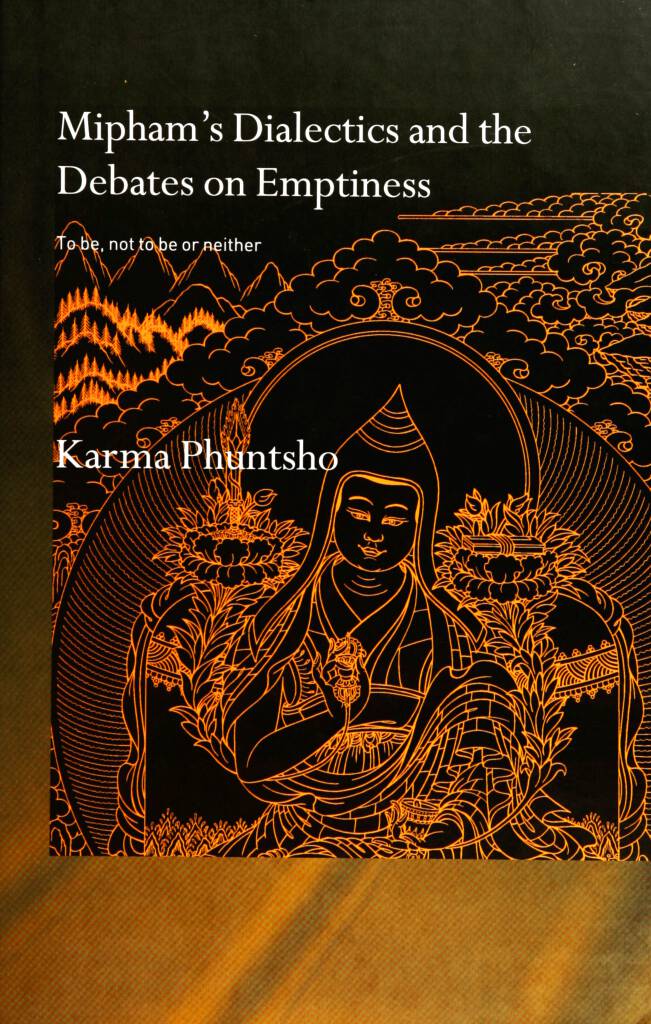
Mipham's Dialectics and the Debates on Emptiness
From Bodhicitta
< BooksBooks/Mipham's Dialectics and the Debates on Emptiness
| 🤓 Admin Zone 🛠️ hidden to non-admins | |
Mipham's Dialectics and the Debates on Emptiness: To Be, Not to Be or Neither
Book
- A Commentary on Shantideva's Engaging in the Conduct of the Bodhisattvas
- A Flash of Lightning in the Dark of Night
- A Great Commentary on Shantideva's Guide to the Bodhisattva's Way of Life, Vol. 1
- A Study of the Wisdom Chapter (Prajñāpāramitā Pariccheda) of the Bodhicaryāvatārapañjikā of Prajñākaramati
- Altruism and Reality (1998)
- An Intoxication of Mouse Venom: Reading the Guide, Chapter 9
- Appendix B: Excerpt from A Lamp Completely Illuminating the Profound Reality of Interdependence
- Bodhicaryāvatāra 9:2 as a Focus for Tibetan Interpretations of the Two Truths in the Prāsangika Mādhyamika
- Bodhicaryāvatāra with Commentary (O'Sullivan)
- Bodhicitta: Cultivating the Compassionate Mind of Enlightenment
- Bodhisattva e Prajñāpāramitā nel Bodhicaryāvatāra di Śāntideva
- Can We Kill Illusory People? Some Philosophical Reflections on Bodhi(sattva)caryāvatāra 9:11-13ab
- Comprendre la vacuité
- Courageous Compassion
- Drops of Nectar: Khenpo Kunpal's Commentary on Shantideva's Entering the Conduct of the Bodhisattvas
- Engaging in the Conduct of the Bodhisattvas
- Epitome of the Bodhicaryāvatāra with Its Pañjikā, Chap. IX
- Following in the Buddha's Footsteps
- For the Benefit of All Beings
- In Praise of Great Compassion
- Indian Madhyamaka Buddhist Philosophy after Nagarjuna, Vol. 2
- Introduction to Gzhan gyis brtsad pa'i lan mdor bsdus pa rigs lam rab gsal de nyid snang byed: An Answer to Blo-bzang-rab-gsal's Refutation of the Author's 'Sher le nor bu ke ta ka' and Its Defence, the Brgal lan nyin byed snang ba
- L'opalescent joyau
- Le commentaire de Mi-pham au chapitre IX du Bodhicaryāvatāra de Śāntideva: Échos modernes d'une controverse du XVème siècle
- Mi pham and the Philosophical Controversies of the Nineteenth Century
- Mipham's Dialectics and the Debates on Emptiness
- No Time to Lose
- Perfecting Wisdom
- Polemics in Indo-Tibetan Scholasticism - A Late 19th-Century Debate Between 'Ju Mi pham and Dpa' ris Rab gsal
- Practicing Wisdom
- Readings of Śāntideva's Guide to Bodhisattva Practice
- Seeing from All Sides
- Shantideva's Bodhicaryavatara: An Internal Pilgrimage to Universal Peace and Compassion
- Tant que durera l'espace
- The Bodhisattva Guide
- The Buddhist Roots of Secular Compassion Training: A Comparative Study of Compassion Cultivation in Indian and Tibetan Mahāyāna Sources with the Contemporary Secular Program of Compassion Cultivation Training (CCT)
- The Case of 'Ju Mi pham (1846–1912) and Dpa' ris Rab gsal (1840–1912): A Study in Dgag lan Debate
- The Center of the Sunlit Sky
- The Entrance for the Children of the Conquerors
- The Middle Way of the Bodhisattva
- The Nectar of Manjushri's Speech
- The Profound Reality of Interdependence
- The Profound Reality of Interdependence-Review by Bouthillette
- The Reflexive Nature of Awareness (1998)
- The Way of Awakening
- The Way of the Bodhisattva (2006)
- The Wisdom Chapter
- Transcendent Wisdom (1988)
- Uncommon Happiness
- Vimalakīrtinirdeśa: The Teaching of Vimalakīrti (Gómez, L. and Harrison, P.)
- Wisdom: Two Buddhist Commentaries
- Śāntideva (Internet Encyclopedia of Philosophy)
- Śāntideva and the Mādhyamika: The Prajñāpāramitā-Pariccheda of the Bodhicaryāvatāra
Please note that many items in our library are simply pages that represent a detailed library catalog entry and citation of someone else's work, presentation, or performance. Read our General Disclaimer for more information. You can find more information about this item on the publisher website.

Description
This is an introduction to the Buddhist philosophy of Emptiness which explores a number of themes in connection with the concept of Emptiness, a highly technical but very central notion in Indo-Tibetan Buddhism. It examines the critique by the leading Nyingma school philosopher Mipham (1846-1912) formulated in his diverse writings. The book focuses on related issues such as what is negated by the doctrine of emptiness, the nature of ultimate reality, and the difference between 'extrinsic' and 'intrinsic' emptiness. Karma Phuntsho's book aptly undertakes a thematic and selective discussion of these debates and Mipham's qualms about the Gelukpa understanding of Emptiness in a mixture of narrative and analytic style. (Source: RoutlegeCurzon)
Citation
Phuntsho, Karma. Mipham's Dialectics and the Debates on Emptiness: To Be, Not to Be or Neither. RoutledgeCurzon Critical Studies in Buddhism. London: Routledge Curzon, 2005.
Publisher Link
People Mentioned
Table of contents
- Acknowledgementsxii
- List of abbreviationsxiv
- Introduction3
- Emptiness and what there is3
- Emptiness, to be and not to be6
- Emptiness: a religious issue and the nature of the debates10
- Mipham: a polymath and his works on Emptiness13
- Sources and methodological considerations19
- 1 Emptiness: its soteriological, doctrinal, ontological and historical significance in Buddhism23
- Emptiness qua Non-self: the heart of Buddhist soteriology24
- Emptiness qua Prajñāpāramitā: the primary path28
- Emptiness qua Pratītyasamutpāda: the central doctrine31
- Emptiness qua nitārtha: the ultimate topic32
- Emptiness qua the ultimate: the ontological truth33
- Emptiness qua nirvāṇa: the religious goal34
- Emptiness qua Mādhyamika philosophy: a historical milestone37
- 2 The big fuss about Emptiness: an outline of the history of debates on Emptiness40
- Controversies in India before Nāgārjuna40
- Nāgārjuna's critiques and subsequent controversies42
- Controversies during Early Propagation in Tibet44
- Early debates in the Later Propagation44
- Debates after Tsongkhapa47
- Mipham and the later debates51
- 3 What is negated by ultimate analysis? Debates on the delimitation of the Mādhyamika negandum55
- The delimitation of the negandum56
- BA, IX/140 and negandum60
- Some Gelukpa criticisms of the Ngarabpa position66
- What is 'hypostatically existent' and when does one negate?70
- On insertion of the qualifiers75
- Mipham's main criticisms79
- On the tetralemma methodology91
- The Gelukpa interpretation of 'neither existent nor non-existent' 95
- The nuances of inferential arguments98
- The verification of contexts101
- An analysis of the cognitive negandum (lam gyi dgag bya)103
- On BA, IX/26107
- Resemblances and reciprocal comparisons109
- 4 The fully empty: Mipham's theory of the ultimate reality113
- The ultimate and two truth theories114
- The ultimate and the nature of negation120
- On BA, IX/33-5132
- The two ultimates136
- The two ultimates and the two schools142
- The ultimate and the coalescence148
- The ultimate middle way and elimination of extremes153
- On MK, Xlll/8159
- 5 Is Emptiness knowable and effable?162
- On whether Emptiness is knowable (jñeya, shes bya)163
- On BA, IX/2166
- Rebuffing his refuters170
- Verifying subjective thoughts175
- Apprehension, grasping and the ultimate178
- Conceptuality, non-conceptuality and Emptiness185
- Mipham's theory of non-conceptuality189
- On Hwashang and meditation on Emptiness193
- Is Emptiness effable?198
- Some concluding remarks208
- Appendix I213
- Appendix II215
- Appendix III217
- Appendix IV219
- Notes226
- Bibliography283
- Name and place index297
- Subject index300
Interconnections
2 Scholarship on

An "Introduction to Bodhisattva Practice," the Bodhisattvacaryāvatāra is a poem about the path of a bodhisattva, in ten chapters, written by the Indian Buddhist Śāntideva (fl. c. 685–763). One of the masterpieces of world literature, it is a core text of Mahāyāna Buddhism and continues to be taught, studied, and commented upon in many languages and by many traditions around the world. The main subject of the text is bodhicitta, the altruistic aspiration for enlightenment, and the path and practices of the bodhisattva, the six perfections (pāramitās). The text forms the basis of many contemporary discussions of Buddhist ethics and philosophy.

Nyingma master Mipham Gyatso's (1846-1912) famous word and meaning commentary (tshig don gyi 'grel pa) on the ninth chapter of the Bodhicaryāvatāra.