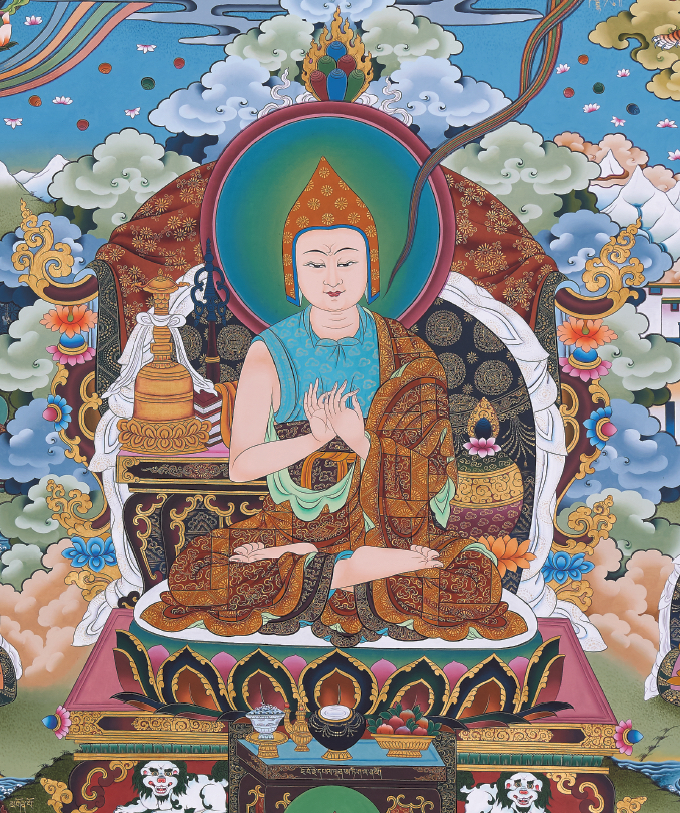
Atisha's Lamp for the Path to Enlightenment
From Bodhicitta
< Books
Books/Atisha's Lamp for the Path to Enlightenment| 🤓 Admin Zone 🛠️ hidden to non-admins | |
Atisha's Lamp for the Path to Enlightenment: An Oral Teaching by Geshe Sonam Rinchen
Book
Please note that many items in our library are simply pages that represent a detailed library catalog entry and citation of someone else's work, presentation, or performance. Read our General Disclaimer for more information. You can find more information about this item on the publisher website.

Description
Atisha, the eleventh-century Indian Buddhist scholar and saint, came to Tibet at the invitation of the king of Western Tibet, Lha Lama Yeshe Wo, and his nephew, Jangchub Wo. His coming initiated the period of the second transmission of Buddhism to Tibet, formative for the Sakya Kagyu and Gelug traditions of Tibetan Buddhism. Atisha's most celebrated text, Lamp for the Path to Enlightenment, sets forth the entire Buddhist path within the framework of three levels of motivation on the part of the practitioner. Atisha's text thus became the source of the lamrim tradition, or graduated stages of the path to enlightenment, an approach to spiritual practice incorporated within all schools of Tibetan Buddhism. (Source: Shambhala Publications)
Citation
Sonam, Ruth, trans. and ed. Atisha's Lamp for the Path to Enlightenment: An Oral Teaching by Geshe Sonam Rinchen. Ithaca, NY: Snow Lion Publications, 1997.
Publisher Link
Table of contents
- Introduction 7
- Prologue 23
- 1. The Three Perspectives 27
- 2. Arousing and Nurturing the Aspiration 57
- 3. The Vow 75
- 4. Higher Perception 89
- 5. Reality and Wisdom 107
- 6. The Vajra Vehicle 129
- The Seven-part Practice, from The King of Prayers 149
- The Root Text - English 151
- The Root Text - Tibetan 161
- Notes 181
- Source Readings 217
Interconnections
1 Full translation of

Bodhipathapradīpa. (T. Byang chub lam gyi sgron ma). In Sanskrit, "Lamp for the Path to Enlightenment"; a work composed by the Indian scholar Atiśa Dīpamkaraśrījñāna at Tho ling gtsug lag khang shortly after he arrived in Tibet in 1042. Tibetan histories often note that Atiśa wrote this text in order to clarify problematic points of Buddhist practice, especially tantra, which were thought to have degenerated and become distorted, and to show that tantra did not render basic Buddhist practice irrelevant. The Bodhipathapradīpa emphasizes a gradual training in the practices of the Mahāyāna and vajrayāna and became a prototype and textual basis first for the bstan rim, or "stages of the teaching" genre, and then for the genre of Tibetan
religious literature known as lam rim, or "stages of the path." It is also an early source for the instructions and practice of blo sbyong, or "mind training." Atiśa wrote his own commentary (pańjikā) (Commentary on the Difficult Points of the Lamp for the Path to Enlightenment) to the text. The text says bodhisattvas must first follow one of the sets of prātimokṣa disciplinary rules; based on those precepts, they practice the six perfections (pāramitā); with those perfections as a solid foundation, they finally practice Buddhist tantra. (Source: "Bodhipathapradīpa." In The Princeton Dictionary of Buddhism, 133. Princeton University Press, 2014. http://www.jstor.org/stable/j.ctt46n41q.27.)
1 Teaching based on
Bodhipathapradīpa. (T. Byang chub lam gyi sgron ma). In Sanskrit, "Lamp for the Path to Enlightenment"; a work composed by the Indian scholar Atiśa Dīpamkaraśrījñāna at Tho ling gtsug lag khang shortly after he arrived in Tibet in 1042. Tibetan histories often note that Atiśa wrote this text in order to clarify problematic points of Buddhist practice, especially tantra, which were thought to have degenerated and become distorted, and to show that tantra did not render basic Buddhist practice irrelevant. The Bodhipathapradīpa emphasizes a gradual training in the practices of the Mahāyāna and vajrayāna and became a prototype and textual basis first for the bstan rim, or "stages of the teaching" genre, and then for the genre of Tibetan
religious literature known as lam rim, or "stages of the path." It is also an early source for the instructions and practice of blo sbyong, or "mind training." Atiśa wrote his own commentary (pańjikā) (Commentary on the Difficult Points of the Lamp for the Path to Enlightenment) to the text. The text says bodhisattvas must first follow one of the sets of prātimokṣa disciplinary rules; based on those precepts, they practice the six perfections (pāramitā); with those perfections as a solid foundation, they finally practice Buddhist tantra. (Source: "Bodhipathapradīpa." In The Princeton Dictionary of Buddhism, 133. Princeton University Press, 2014. http://www.jstor.org/stable/j.ctt46n41q.27.)