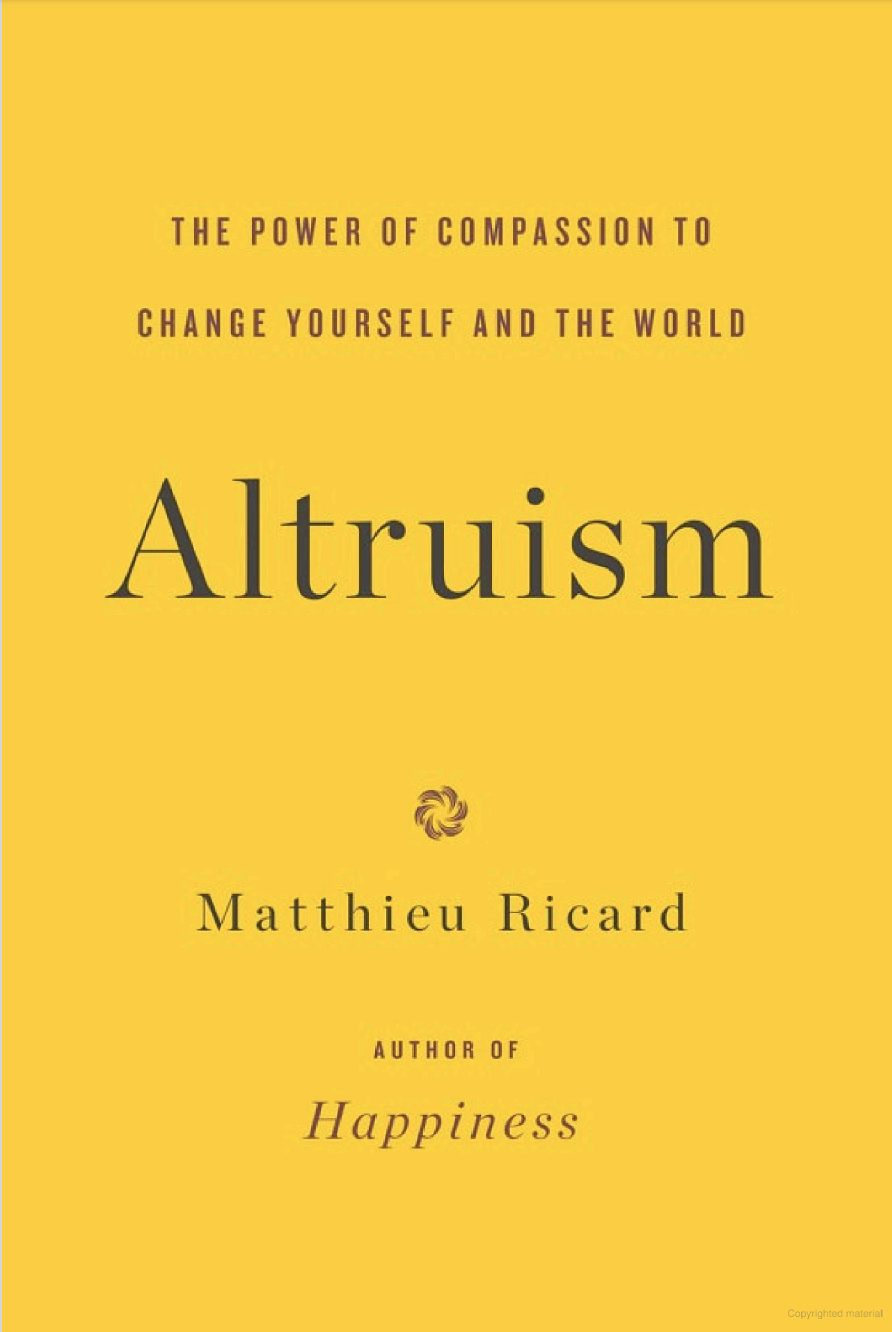
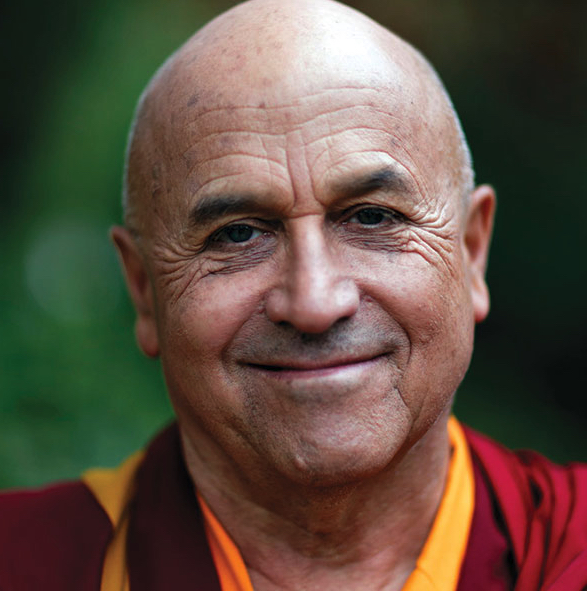
Altruism: The Power of Compassion to Change Yourself and the World
| 🤓 Admin Zone 🛠️ hidden to non-admins | |

Description
Ricard’s message has been taken up by major economists and thinkers, including Dennis Snower, Amartya Sen, Joseph Stiglitz, and George Soros. Matthieu Ricard makes a robust and passionate case for cultivating altruistic love and compassion as the best means for simultaneously benefitting ourselves and our society. It’s a fresh outlook on an ardent struggle — and one that just might make the world a better place.
- Introduction3
- I What is Altruism ?
- 1. The Nature of Altruism 15
- 2. Extending Altruism 24
- 3 What is Empathy?39
- 4. From Empathy to Compassion in a Neuroscience Laboratory 56
- 5. Love, Supreme Emotion 65
- 6. The Accomplishment of aTwofold Benefit, Our Own and Others'76
- 7. Self-Interested Altruism and Generalized Reciprocity83
- 8. Selfless Altruism 89
- 9. The Banality of Good 94
- 10. Altruistic Heroism 103
- 11. Unconditional Altruism 110
- 12. Beyond Imitations, True Altruism: An Experimental Investigation 120
- 13. The Philosophical Arguments Against Universal Selfishness 137
- II The Emergence of Altruism
- 14. Altruism in Theories of Evolution 151
- 15. Maternal Love, Foundation for Extended Altruism? 171
- 16. The Evolution of Cultures 177
- 17. Altruistic Behavior Among Animals 183
- 18. Altruism Among Children 208
- 19. Prosocial Behavior 225
- III Cultivating Altruism
- 20. Can We Change?239
- 21. Training the Mind: What the Cognitive Sciences Have to Say 247
- 22. How to Cultivate Altruism: Meditations on Altruistic Love, Compassion, Joy, and Impartiality 260
- IV Contrary Forces
- 23. Egocentrism and Crystallization of the Ego 271
- 24. The Spread of Individualism and Narcissism 281
- 25. The Champions of Selfishness 299
- 26. Having Hatred or Compassion for Yourself 314
- 27. The Shortfall of Empathy 322
- 28. At the Origin of Violence: Devaluing the Other 339
- 29. The Natural Repugnance to Kill 374
- 30. Dehumanizing the Other: Massacres and Genocides 388
- 31. Has War Always Existed? 412
- 32. The Decline of Violence 426
- 33. The Instrumentalization of Animals: A Moral Aberration 455
- 34. Backfire: Effects of the Meat Industry on Poverty, Environment, and Health 470
- 35. Institutionalized Selfishness 480
- V Building a More Altruistic Society
- 36. The Virtues of Cooperation 515
- 37. An Enlightened Education 532
- 38. Fighting Inequality 552
- 39. Toward a Caring Economy 563
- 40. Voluntary, Joyous Simplicity 604
- 41. Altruism for the Sake of Future Generations 616
- 42. Sustainable Harmony 657
- 43. Local Commitment, Global Responsibility 675
- Conclusion: Daring Altruism 690
- Acknowledgments 695
- Karuna-Shechen: Altruism in Action 699
- Notes701
- Sources for Figures 833
- Select Bibliography 837

amuses or fascinates the crowds. We knowingly ignore their nature as sentient beings and rank them among objects. This ruthless point of view was expressed by Émile Baudement, holder of the first chair of animal husbandry at the Agronomical Institute at Versailles in the mid-nineteenth century:
- Animals are living machines, not in the accepted sense of the word, but in its most rigorous sense as used in mechanics and industry.…They give milk, meat, strength: they are machines producing a return for a given expense.[1]
In the same line of thinking, a century later, the commentator in a televised report devoted to the establishment of industrial breeding in France announced with a certain pride in his voice: “Every action of their biological lives should correspond to our needs and our schedule.… The bovine becomes what we had hoped: an industrial product.”[2] Even more cynical, a manager of the American company Wall’s Meat recently declared:
- The breeding sow should be thought of, and treated as, a valuable piece of machinery whose function is to pump out baby pigs like a sausage machine.[3]
The vision of the system is summarized by the president of an American poultry company with 225,000 laying hens, Fred C. Haley: “The object of producing eggs is to make money. When we forget this objective, we have forgotten what it is all about.”[4]
Is it conceivable to desire the advent of a more altruistic society while closing our eyes to the fate we inflict on the billions of animals killed every year for our consumption?
In the system of industrial production, the lifespan of animals is only a fraction of their natural expectancy, 1/60th for poultry. It is as if a human’s life expectancy were only a year and four months.5 Animals are confined to cubicles where they can’t even turn around; castrated; separated at birth from their mothers; made to suffer for our amusement (bull fights, dogfights, cockfights); caught in traps that crush their limbs in steel jaws; skinned alive,6 crushed alive in giant screws (the fate reserved for hundreds of millions of male chicks every year).
In short, we decide when, where and how they are to die, without the slightest concern for what they feel.