The Instrumentalization of Animals: A Moral Aberration
| 🤓 Admin Zone 🛠️ hidden to non-admins | |
Description
amuses or fascinates the crowds. We knowingly ignore their nature as sentient beings and rank them among objects. This ruthless point of view was expressed by Émile Baudement, holder of the first chair of animal husbandry at the Agronomical Institute at Versailles in the mid-nineteenth century:
- Animals are living machines, not in the accepted sense of the word, but in its most rigorous sense as used in mechanics and industry.…They give milk, meat, strength: they are machines producing a return for a given expense.[1]
In the same line of thinking, a century later, the commentator in a televised report devoted to the establishment of industrial breeding in France announced with a certain pride in his voice: “Every action of their biological lives should correspond to our needs and our schedule.… The bovine becomes what we had hoped: an industrial product.”[2] Even more cynical, a manager of the American company Wall’s Meat recently declared:
- The breeding sow should be thought of, and treated as, a valuable piece of machinery whose function is to pump out baby pigs like a sausage machine.[3]
The vision of the system is summarized by the president of an American poultry company with 225,000 laying hens, Fred C. Haley: “The object of producing eggs is to make money. When we forget this objective, we have forgotten what it is all about.”[4]
Is it conceivable to desire the advent of a more altruistic society while closing our eyes to the fate we inflict on the billions of animals killed every year for our consumption?
In the system of industrial production, the lifespan of animals is only a fraction of their natural expectancy, 1/60th for poultry. It is as if a human’s life expectancy were only a year and four months.5 Animals are confined to cubicles where they can’t even turn around; castrated; separated at birth from their mothers; made to suffer for our amusement (bull fights, dogfights, cockfights); caught in traps that crush their limbs in steel jaws; skinned alive,6 crushed alive in giant screws (the fate reserved for hundreds of millions of male chicks every year).
In short, we decide when, where and how they are to die, without the slightest concern for what they feel.

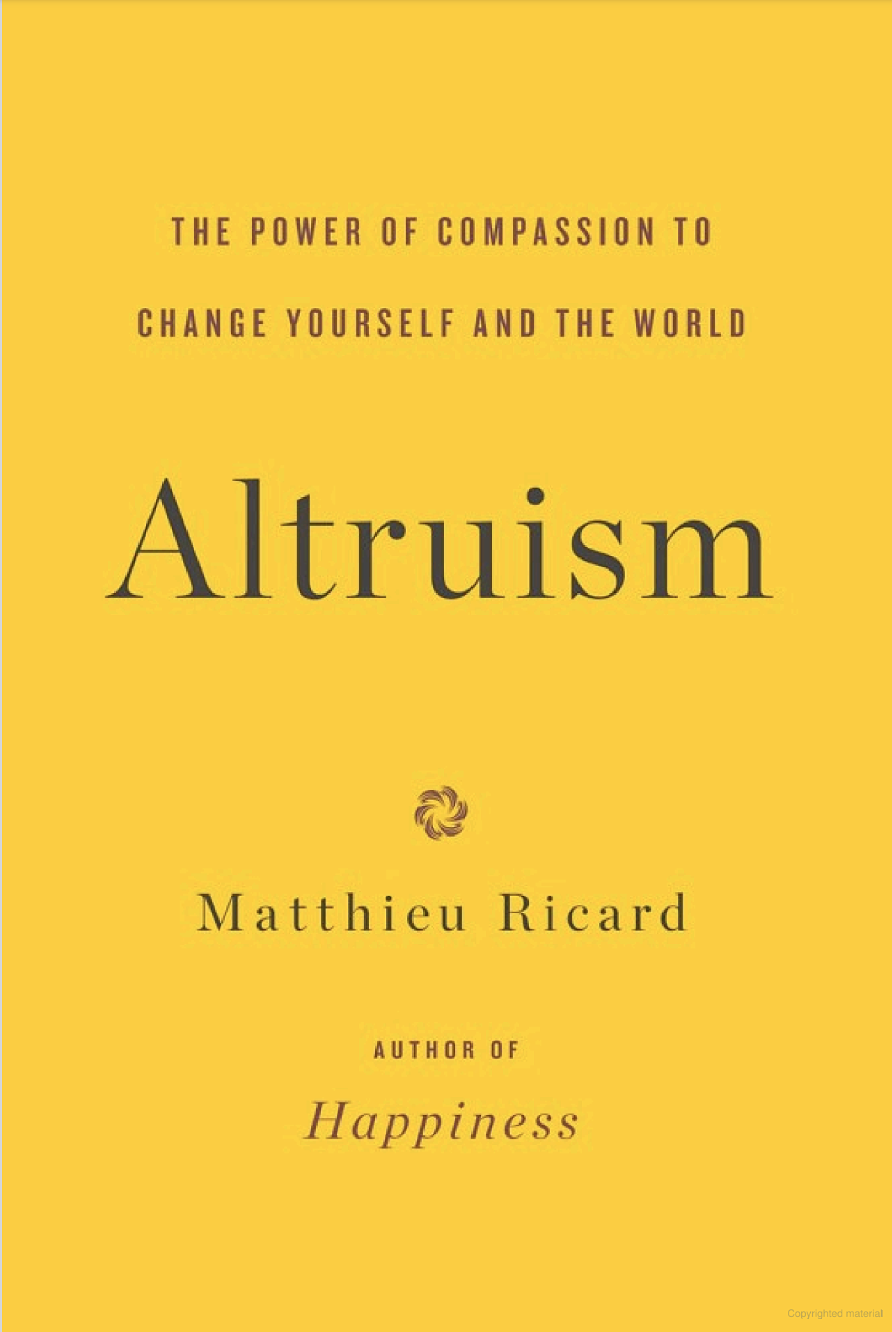
Ricard’s message has been taken up by major economists and thinkers, including Dennis Snower, Amartya Sen, Joseph Stiglitz, and George Soros. Matthieu Ricard makes a robust and passionate case for cultivating altruistic love and compassion as the best means for simultaneously benefitting ourselves and our society. It’s a fresh outlook on an ardent struggle — and one that just might make the world a better place.
(Source: Little, Brown and Company)