Bold Judgments on Eating Meat

From Bodhicitta
< Articles(Redirected from Bold Judgments on Eating Meat)
Articles/Bold Judgments on Eating Meat

🤓 Admin Zone 🛠️ hidden to non-admins
Bold Judgments on Eating Meat
Chapter in a Book


Please note that many items in our library are simply pages that represent a detailed library catalog entry and citation of someone else's work, presentation, or performance. Read our General Disclaimer for more information.

Description

The Faults of Eating Meat is a Tibetan-language text by Shardza Tashi Gyaltsen (1859–1935), the preeminent Bon scholar and practitioner of his era. Written in a colloquial style for a broad but literate audience, the text navigates the tension between the Buddhist and Bon ethical imperative of compassion toward all beings and the practical reality of the high-altitude Tibetan diet. Shardza opens with a forceful condemnation of meat eating, equating it with karmic consequences and a lack of compassion, before conceding that meat may be a medical necessity in the Tibetan context—a position rooted in the indigenous medical tradition's view that abstaining from meat weakens the body and compromises one's ability to practice the Dharma. His resolution invokes the Vinaya rule of threefold purity, permitting only meat not seen, heard, or suspected to have been killed for the consumer, and proposes the consumption of meat from animals that died naturally or accidentally as the only ethically defensible option for those unable to maintain a vegetarian diet. The text reflects the broader vegetarian movement that flourished in late nineteenth- and early twentieth-century Kham, particularly among non-Geluk practitioners associated with the rime (nonsectarian) movement, of which Shardza was an active participant. As a Bon contribution to an overwhelmingly Buddhist discourse on vegetarianism, The Faults of Eating Meat occupies a distinctive place in the corpus of Tibetan ethical literature on diet and animal welfare.
Citation
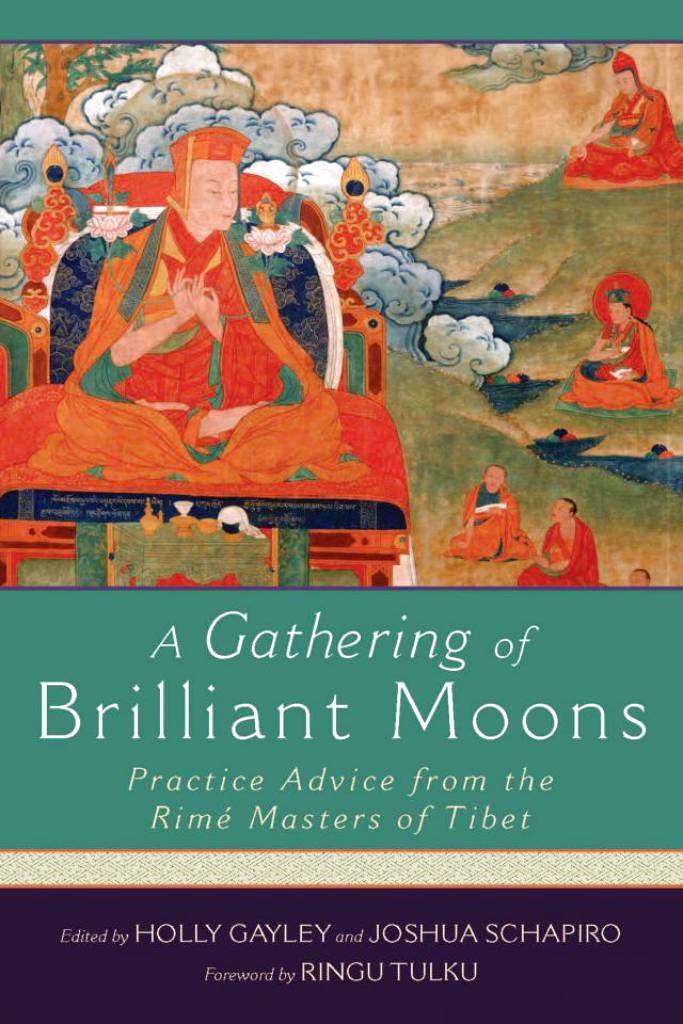
Barstow, Geoffrey, trans. "Bold Judgments on Eating Meat." Chapter 4 in A Gathering of Brilliant Moons: Practice Advice from the Rimé Masters of Tibet, edited by Holly Gayley and Joshua Schapiro, 97–108. Somerville, MA: Wisdom Publications, 2017.
Interconnections
1 Chapter or part of
A Gathering of Brilliant Moons-front.jpg
Books2017About this item
This collection focuses on an influential and inspiring generation of Buddhist teachers: the nineteenth-century ecumenical, or rimé, tradition of eastern Tibet. A Gathering of Brilliant Moons provides lively translations of nineteen pithy and profound works by these great masters, along with essays by their translators which explore the aesthetic qualities of their chosen works, highlight their ecumenical features, and comment on the journey of translation.

Includes works from Jamgon Kongtrul, Dza Patrul Rinpoché, Ju Mipham Rinpoché, Dudjom Lingpa, The Third Dodrupchen, Do Khyentsé, Tokden Sakya Sri, Jikmé Lingpa, Shardza Tashi Gyaltsen, Getsé Mahapandita, Shangton Tenpa Gyatso, and Bamda Thupten Gelek Gyatso.

This book arose from a unique conference on Tibetan translation, where the fourteen translators shared their process with each other and received feedback from their peers with a special focus on the literary aspects of the source texts. As a reflection of this genesis, the accompanying essays in this volume by the translators explore the aesthetic qualities of their chosen works, highlight ecumenical features in them, and comment on the journey of translation. This unique book will be welcomed by religious scholars, Buddhist practitioners, and meditators. (Source: Wisdom Experience)

On the topic of buddha-nature, see especially Tina Draszczyk's translation of Jamgön Kongtrul's Immaculate Vajra Moonrays: An Instruction for the View of Shentong, the Great Madhyamaka in chapter 12, Putting Buddha Nature into Practice.