Demandingness, Well-Being and the Bodhisattva Path
From Bodhicitta
< ArticlesArticles/Demandingness, Well-Being and the Bodhisattva Path
| 🤓 Admin Zone 🛠️ hidden to non-admins | |
Demandingness, Well-Being and the Bodhisattva Path
Journal Article
Please note that many items in our library are simply pages that represent a detailed library catalog entry and citation of someone else's work, presentation, or performance. Read our General Disclaimer for more information.
Description
This paper reconstructs an Indian Buddhist response to the overdemandingness objection, the claim that a moral theory asks too much of its adherents. In the first section, I explain the objection and argue that some Mahāyāna Buddhists, including Śāntideva, face it. In the second section, I survey some possible ways of responding to the objection as a way of situating the Buddhist response alongside contemporary work. In the final section, I draw upon writing by Vasubandhu and Śāntideva in reconstructing a Mahāyāna response to the objection. An essential component of this response is the psychological transformation that the bodhisattva achieves as a result of realizing the nonexistence of the self. This allows him to radically identify his well-being with the well-being of others, thereby lessening the tension between self and others upon which the overdemandingness objection usually depends. Emphasizing the attention Mahāyāna authors pay to lessening moral demandingness in this way increases our appreciation of the philosophical sophistication of their moral thought and highlights an important strategy for responding to the overdemandingness objection that has been underdeveloped in contemporary work.
Citation
Harris, Stephen E. "Demandingness, Well-Being and the Bodhisattva Path." Sophia 54 (2015): 201–16. https://link.springer.com/article/10.1007/s11841-015-0474-0.
Interconnections
1 Based on dissertation
-front.jpg)
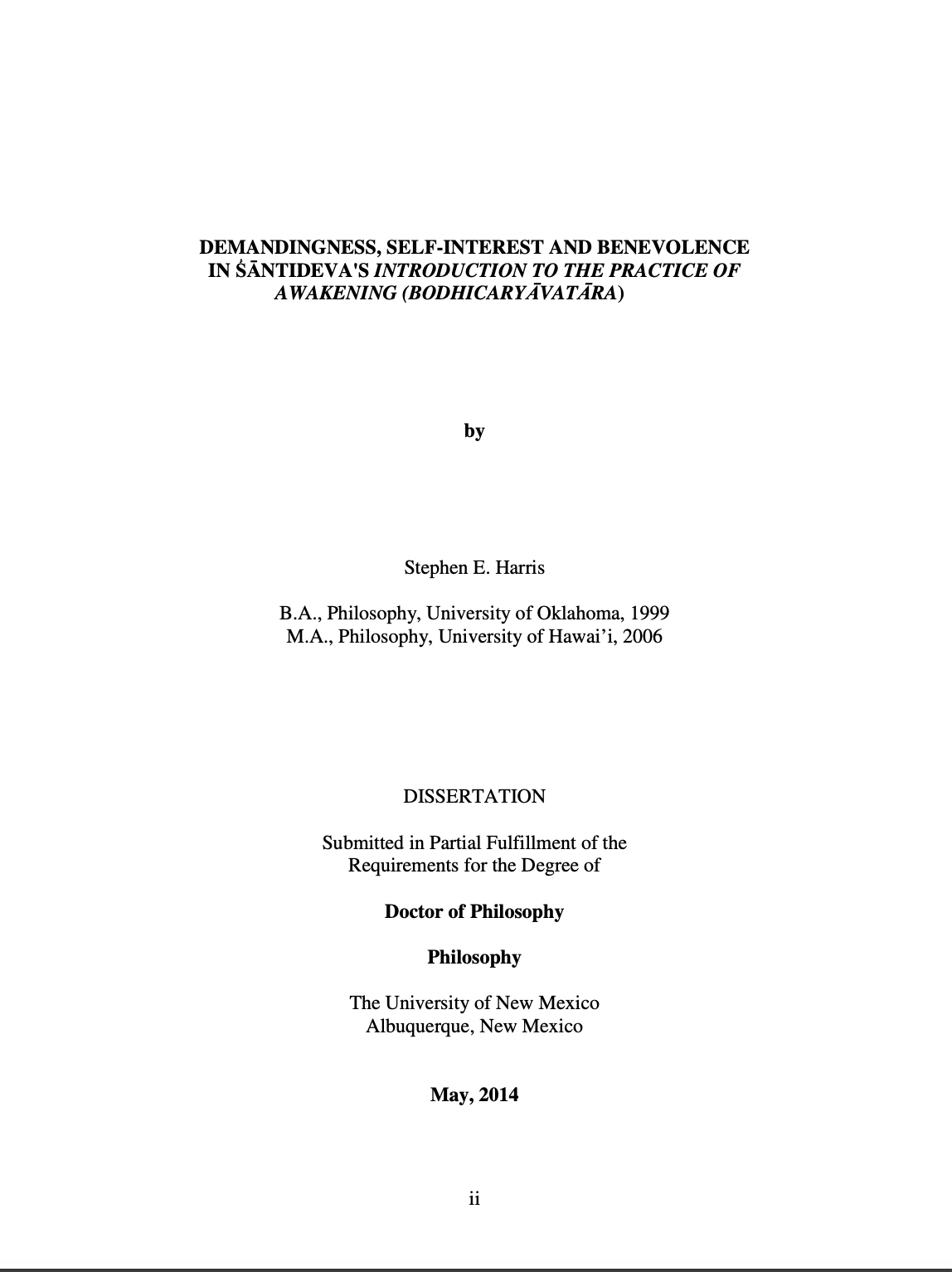
This dissertation by Stephen Harris explores how benevolence and self-interest converge, thereby lessening moral demandingness, in the writing of Śāntideva.
1 Scholarship on

An "Introduction to Bodhisattva Practice," the Bodhisattvacaryāvatāra is a poem about the path of a bodhisattva, in ten chapters, written by the Indian Buddhist Śāntideva (fl. c. 685–763). One of the masterpieces of world literature, it is a core text of Mahāyāna Buddhism and continues to be taught, studied, and commented upon in many languages and by many traditions around the world. The main subject of the text is bodhicitta, the altruistic aspiration for enlightenment, and the path and practices of the bodhisattva, the six perfections (pāramitās). The text forms the basis of many contemporary discussions of Buddhist ethics and philosophy.