Bruchstück des Ārya Rājāvavādaka genannten Mahāyāna Sūtra
From Bodhicitta
< Articles
Articles/Bruchstück des Ārya Rājāvavādaka genannten Mahāyāna Sūtra| 🤓 Admin Zone 🛠️ hidden to non-admins | |
Bruchstück des Ārya Rājāvavādaka genannten Mahāyāna Sūtra
Chapter in a Book
Please note that many items in our library are simply pages that represent a detailed library catalog entry and citation of someone else's work, presentation, or performance. Read our General Disclaimer for more information.
Citation
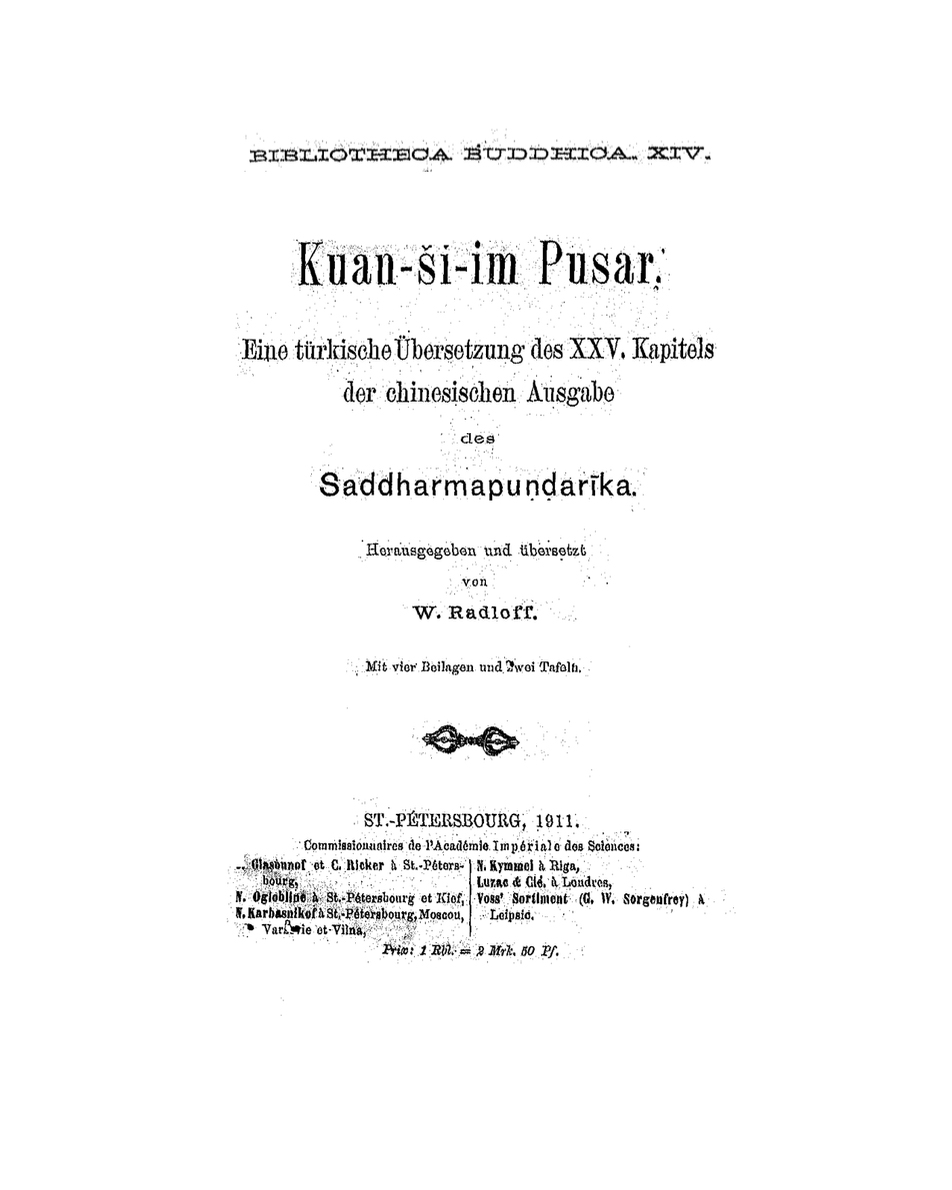
Radlov, Vasily, ed. and trans. "Bruchstück des Ārya Rājāvavādaka genannten Mahāyāna Sūtra." In Kuan-ši-im Pusar: Eine türkische Übersetzung des XXV. Kapitels der chinesischen Ausgabe des Saddharmapuṇḍarīka, 69–90. Bibliotheca Buddhica 14. St. Pétersbourg: Commissionnaires de l'Académie impériale des sciences, 1911. https://archive.org/details/dli.ministry.03566/page/68/mode/2up.
Interconnections
1 Partial translation of

Rājāvavādakasūtra (The Sūtra of Advice to the King; Tib. 'Phags pa rgyal po la gdams pa zhes bya ba theg pa chen po'i mdo; Toh 221, Derge Kangyur, vol. 63, ff. 78a–84b) is a Mahāyāna sūtra set in Jetavana, Anāthapiṇḍada’s park near Śrāvastī, where King Prasenajit of Kosala comes with his royal retinue to see the Buddha and hear the Dharma. The Buddha urges the king to rule by Dharma and not against it, and devotes most of the teaching to impermanence and death. Four great mountains, old age, sickness, death, and decline, are bearing down from every direction, and no speed, strength, wealth, mantra, or medicine can turn them back. Like a deer seized by a lion, a person in the grip of the Lord of Death is helpless; at that time only the Dharma can be a refuge, as fire is for the cold or food for the hungry. The comforts of royal life, fine food, clothing, and beds, cannot keep the body from death and the charnel ground. The sūtra was translated by the Indian preceptors Jinamitra and Śīlendrabodhi and the chief editor-translator Yeshé Dé, and revised according to the new terminology. It should be distinguished from two other Kangyur texts that share its Tibetan title, Rgyal po la gdams pa (Toh 214 and 215), whose Sanskrit title is Rājadeśa.
With respect to the text's citation in the Śikṣāsamuccaya, Śāntideva’s chapter 12 quotations from the Rājāvavādaka (on impermanence, death, and Dharma as the only refuge) correspond to the Derge Kangyur translation (ff. 80a–82b). His chapter 1 quotations, on rejoicing in and dedicating merit and on the fruits of the mind of awakening, have not been located in the Derge text; the version Śāntideva knew may have differed from, or been longer than, the one preserved in Tibetan translation.
1 Chapter or part of

Kuan-ši-im Pusar: A Turkish (or Uighur?) Translation of the 25th chapter of the Chinese edition of the Saddharmapuṇḍarīkasūtra. Translated into German with the original Old Uighur text.
1 Scholarship on
Rājāvavādakasūtra (The Sūtra of Advice to the King; Tib. 'Phags pa rgyal po la gdams pa zhes bya ba theg pa chen po'i mdo; Toh 221, Derge Kangyur, vol. 63, ff. 78a–84b) is a Mahāyāna sūtra set in Jetavana, Anāthapiṇḍada’s park near Śrāvastī, where King Prasenajit of Kosala comes with his royal retinue to see the Buddha and hear the Dharma. The Buddha urges the king to rule by Dharma and not against it, and devotes most of the teaching to impermanence and death. Four great mountains, old age, sickness, death, and decline, are bearing down from every direction, and no speed, strength, wealth, mantra, or medicine can turn them back. Like a deer seized by a lion, a person in the grip of the Lord of Death is helpless; at that time only the Dharma can be a refuge, as fire is for the cold or food for the hungry. The comforts of royal life, fine food, clothing, and beds, cannot keep the body from death and the charnel ground. The sūtra was translated by the Indian preceptors Jinamitra and Śīlendrabodhi and the chief editor-translator Yeshé Dé, and revised according to the new terminology. It should be distinguished from two other Kangyur texts that share its Tibetan title, Rgyal po la gdams pa (Toh 214 and 215), whose Sanskrit title is Rājadeśa.
With respect to the text's citation in the Śikṣāsamuccaya, Śāntideva’s chapter 12 quotations from the Rājāvavādaka (on impermanence, death, and Dharma as the only refuge) correspond to the Derge Kangyur translation (ff. 80a–82b). His chapter 1 quotations, on rejoicing in and dedicating merit and on the fruits of the mind of awakening, have not been located in the Derge text; the version Śāntideva knew may have differed from, or been longer than, the one preserved in Tibetan translation.