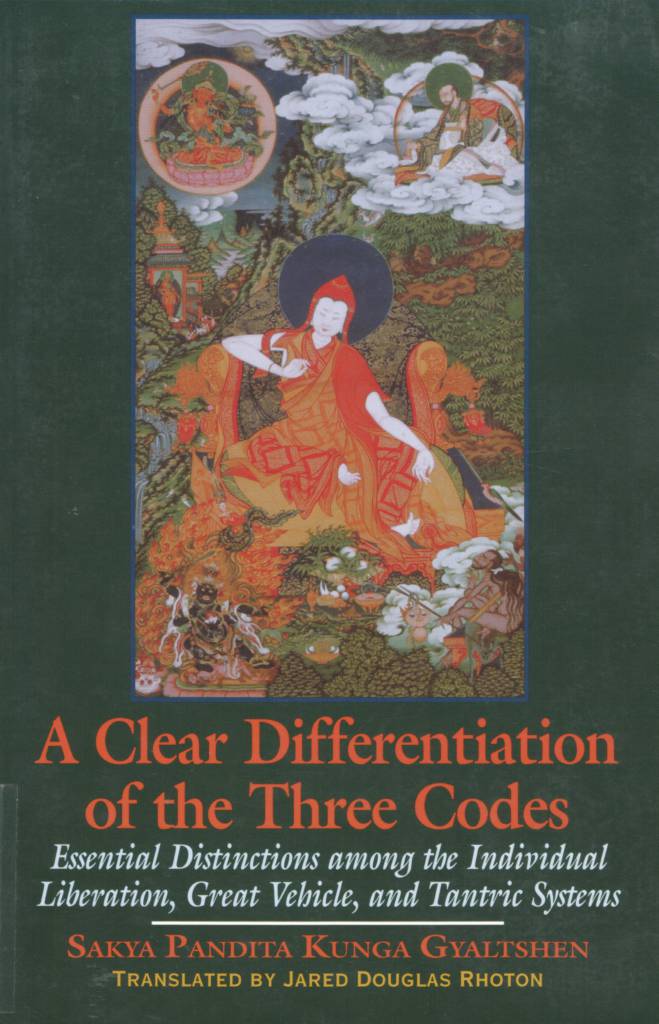
A Clear Differentiation of the Three Codes
From Bodhicitta
< Books(Redirected from A Clear Differentiation of the Three Codes)
Books/A Clear Differentiation of the Three Codes
Books/A Clear Differentiation of the Three Codes
| 🤓 Admin Zone 🛠️ hidden to non-admins | |
A Clear Differentiation of the Three Codes: Essential Distinctions among the Individual Liberation, Great Vehicle, and Tantric Systems
Book
Please note that many items in our library are simply pages that represent a detailed library catalog entry and citation of someone else's work, presentation, or performance. Read our General Disclaimer for more information. You can find more information about this item on the publisher website.

Description
A Clear Differentiation of the Three Codes presents the first English translation of the sDom gsum rab dbye, one of the most famous and controversial doctrinal treatises of Tibetan Buddhism. Written by Sakya Pandita Kunga Gyaltshen (1182–1251), a founder of the Sakya school and one of Tibet’s most learned sages, The Three Codes strongly influenced subsequent religious and intellectual traditions in Tibet—and sparked a number of long-lasting doctrinal and philosophical disputes, some of which persist today.
In The Three Codes, Sakya Pandita discusses the Hinayana, Mahayana, and Tantric vows of Buddhist conduct, which often diverge and contradict each other. He criticizes, on at least one point or another, later practitioners of almost every lineage, including the Kadampa, Kagyupa, and Nyingmapa, for contradicting the original teachings of their own traditions. (Source: SUNY Press)
Citation
Rhoton, Jared Douglas, trans. A Clear Differentiation of the Three Codes: Essential Distinctions among the Individual Liberation, Great Vehicle, and Tantric Systems. Edited by Victoria R. M. Scott. SUNY Series in Buddhist Studies. Albany: State University of New York Press, 2002.
Publisher Link
Interconnections
1 Full translation of

Written circa 1232 when the author was about fifty years old, it is an expansive treatise on the three vows pertaining to the three vehicles of Buddhism that is one of Sakya Paṇḍita's most important and influential works. Nevertheless, it was controversial in its time for the criticism the author levels against the philosophical positions of various scholars and schools of thought.