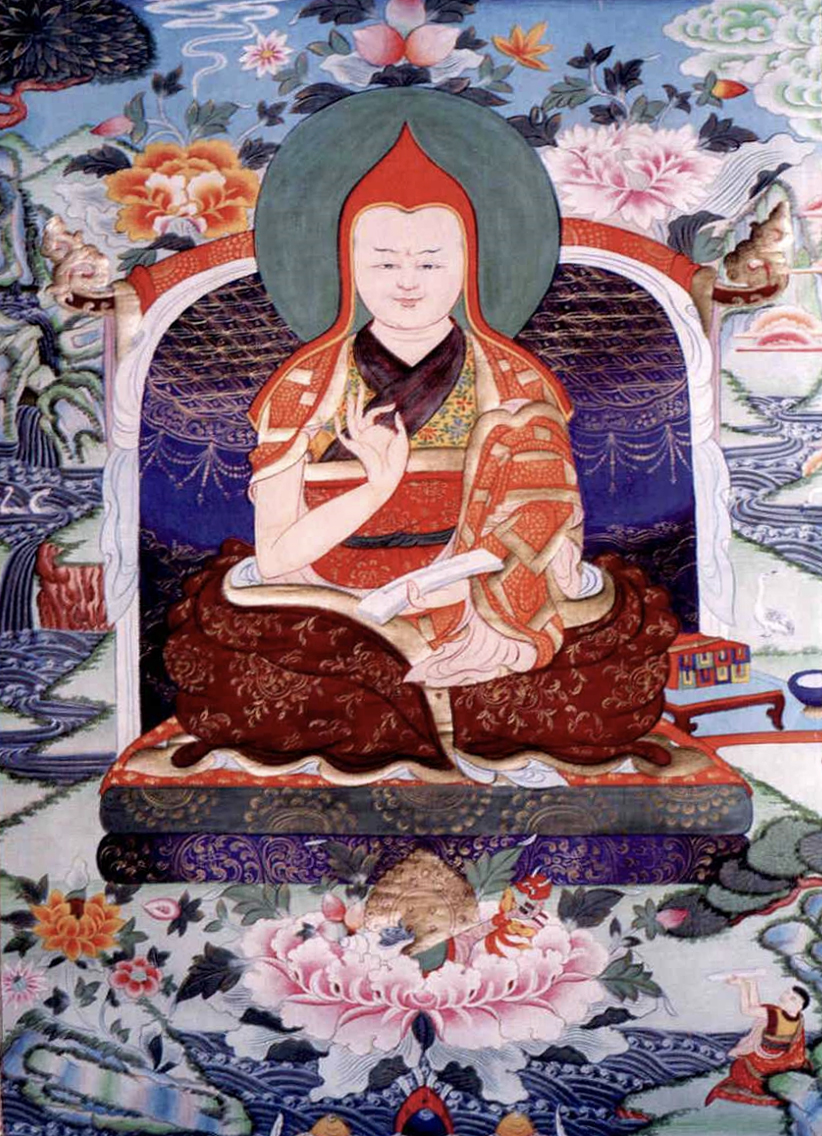
Breathing Life into Śāntideva's Words: Rago Choktrul's Integration of Tonglen and Dedication
Articles/Breathing Life into Śāntideva's Words: Rago Choktrul's Integration of Tonglen and Dedication
| 🤓 Admin Zone 🛠️ hidden to non-admins | |
Rago Choktrul Thubten Shedrup Gyatso (1879–1972) was a prominent Tibetan Buddhist master of the Palyul tradition whose extensive four-volume collected works demonstrate his mastery of multiple Buddhist traditions and genres of religious literature. Among his notable contributions to Bodhicaryāvatāra studies are Vines of Amṛta: A Prayer to the Lineage of the Bodhicaryāvatāra, which elaborates on Patrul Rinpoche's shorter lineage prayer, and Drops of Nectar (Bdud rtsi'i thigs pa), a practical meditation guide focused on the dedication chapter.
Drops of Nectar transforms Śāntideva's dedication verses into living practice by combining dedication (bsngo ba) with breath meditation (dbugs sbyor) and tonglen techniques. The text provides flexible instruction for practitioners of different capacities, from brief three-to-seven-breath sessions to extended practice periods, emphasizing the visualization of light rays to take in others' suffering and send out happiness and merit. Drawing on inspiring examples from masters like Tokme Zangpo and Karma Chakme, Rago Choktrul's approach makes the profound philosophical understanding of dedication accessible through practical meditation techniques that can transform ordinary breath awareness into bodhisattva practice.Rago Choktrul Thubten Shedrup Gyatso (Rag mgo mchog sprul thub bstan bshad sgrub rgya mtsho, 1879–1972) was a prominent Tibetan Buddhist master associated with the Palyul tradition. He was a prolific author, making significant contributions to Tibetan Buddhist literature. One of his notable works, Vines of Amṛta: A Prayer to the Lineage of the Bodhicaryāvatāra, elaborates on Patrul Rinpoche's shorter prayer to the lineage holders of Śāntideva's classic work.
He also served as a teacher to several esteemed figures, including Adzom Drukpa Thupten Padma Trinlé (A 'dzom 'Brug pa Thub bstan Pad+ma 'phrin las, 1926–2001). To Adzom Drukpa, he imparted various teachings on common sūtras as well as empowerments and oral transmissions of the sūtra, illusion, and mind sections of Dzogchen.
Rago Choktrul Thubten Shedrup Gyatso's collected works have been compiled and published, showcasing his extensive contributions to Tibetan Buddhist scholarship.
Main Writings
The collected works (gsung 'bum) of Rago Tulku were published in 1985 by the Nyingmapa Monastery in Bylakuppe. The collection comprises four volumes that were reproduced from recently calligraphed manuscripts from Rago Monastery (Rag mgo dgon) in Tibet. The texts are written in Tibetan Ume script, indicating their preservation of traditional manuscript formatting.
Volume 1 consists primarily of devotional literature, including praises and supplications (bstod pa gsol 'debs skor) to various Buddhist figures like Buddha Śākyamuni, Mañjuśrī, and Guru Padmasambhava. The texts range from praises of the Buddha's qualities to prayers to various masters like Śākya Jungne (Zur chen sha kya 'byung gnas, 1002–1062) and Mipham ('Ju mi pham rin po che, 1846–1912). The volume ends with detailed inventories (known in Tibetan as dkar chag) listing the temples and their contents at Thubten Kunzang Ling Monastery.[1]
Volume 2 focuses on historical and biographical works and contains histories of various institutions, including Palyul Monastery (Dpal yul chos 'byung), and Marpa Kagyu traditions. It includes biographies of masters like Pema Sherab Zangpo (Pad+ma shes rab bzang po) and Pema Dudul (Nyag bla pad+ma bdud 'dul, 1816–1872), and it contains institutional histories of places like Ngulra Ösel Ling and Thubten Kunzang Ling.[2]
Volume 3 (Pod ma pa) contains commentarial literature ('grel chung skor), including explanations of the three vows (sdom gsum), commentaries on various prayers and practices, and instruction manuals. Notable texts include practice notes on the Bodhicaryāvatāra's dedication chapter and commentaries on the Guhyagarbha Tantra, along with various meditation instructions.[3]
Volume 4 (Pod ya pa) is dedicated to liturgical and ritual texts ('don cha skor), containing practice manuals for cycles like Lama Gongpa Dupa and the Eight Herukas. It includes monastic guidelines (bca' yig) for several institutions, including Thubten Kunzang Ling and Ngulra Ösel Chöling, along with various ritual texts for protector practices and ceremonies.[4]
From these works, we can draw several conclusions about Rago Tulku's scholarship and religious orientation. He was clearly trained in multiple Buddhist traditions, showing particular expertise in both Nyingma and Kagyu lineages. His writings demonstrate mastery of various genres of Tibetan religious literature, from sophisticated philosophical commentaries to practical ritual manuals. The range of his works suggests he was not only a scholar but also an active teacher and monastery administrator.
The deities and practices he wrote about most extensively include Avalokiteśvara, Guru Padmasambhava, and various peaceful and wrathful manifestations, indicating his strong connection to the Nyingma tradition while maintaining a nonsectarian approach. His teaching style, as evidenced in his written works, combines scholarly precision with practical instruction, always emphasizing the importance of combining study with meditation practice.
A distinctive feature of Rago Tulku's writings is his systematic approach to presenting Buddhist teachings. This is particularly evident in his instructional manuals where he frequently provides step-by-step guidance, as seen in his commentary on the Bodhicaryāvatāra's dedication chapter. His explanations typically begin with foundational concepts before moving to more advanced topics, suggesting he was an experienced teacher who understood the importance of gradual training.
A significant portion of his corpus deals with practical aspects of Buddhist practice, particularly in the ritual and meditation instruction texts. His detailed exposition of various meditation practices (particularly in volume 3) suggests he was deeply committed to preserving and transmitting experiential aspects of the tradition. The extensive ritual manuals in volume 4 indicate his important role in systematizing and preserving liturgical traditions.
Rago Tulku's writings reflect the complex religious environment of early to mid-twentieth-century Eastern Tibet. His works show influence from the Rime (ris med), or nonsectarian tradition, as evidenced by his incorporation of teachings from various Buddhist schools and his explicit statements about the validity of different approaches to practice. This is particularly apparent in his historical works and devotional compositions, where he pays homage to masters from multiple lineages.
The collected works include several monastic guidelines, including texts for Thubten Kunzang Ling Monastery and Ngulra Ösel Chöling Monastery. Among these are Pure Aspiration Dharma Conch Melody (Lhag bsam rab dkar chos dung sgra dbyangs) and The Light That Makes the Buddha's Teachings Like Day (Rgyal bstan nyin mor byed pa'i snang ba). These texts contain regulations and guidelines for monastic communities, though without examining their content directly, we cannot make specific claims about their details or the author's particular approach to monastic administration.
One of his most significant contributions appears to be in the field of ritual studies and practice. His extensive ritual manuals and commentaries show a sophisticated understanding of both the theoretical foundations and practical applications of Buddhist ceremony. These works continue to serve as important references for contemporary practice.
Rago Tulku's Practice Instructions on Dedication
Introduction to the Text
Drops of Nectar (Bdud rtsi'i thigs pa) is a precious practice guide that shows us how to bring the dedication chapter of Śāntideva's Bodhicaryāvatāra to life in our meditation. Rather than just reciting the verses, it teaches us how to transform them into a living practice that combines dedication (bsngo ba) with breath meditation (dbugs sbyor).
The text comes in the form of very practical instructions: For our daily practice, it explains that we can practice tonglen with just three to seven breaths. If we have time for longer sessions, it recommends we do hundreds of repetitions. More importantly, Rago Rinpoche emphasizes that we don't apply all instructions at once—we can break the practice into smaller, manageable parts.
The heart of the practice involves visualizing bright white light rays and using our breath to take in others' suffering and send out our own happiness and merit (gtong len). As we practice, we can transform the challenging realms of existence into pure realms (zhing khams) where beings can practice the Dharma. We can also call upon the Three Family Protectors (rigs gsum mgon po)—Avalokiteśvara, Mañjuśrī, and Vajrapāṇi—and use their mantras to deepen our practice.
The text shares inspiring stories of great masters who used these practices. For example, Tokme Zangpo's (Thog med bzang po, 1295–1369) mastery of bodhicitta (byang chub sems) was so profound that even natural enemies like sheep and wolves would play together in his presence. Karma Chakme (Karma chags med, 1613–1678) and Drikung Kyopa ('Bri gung skyobs pa 'Jig rten mgon po, 1143–1217) used these practices to heal illnesses. The Fifth Dalai Lama, Ngawang Lobzang Gyatso (Ngag dbang blo bzang rgya mtsho, 1617–1682) had direct visions of the purification of suffering realms while practicing.
While rooted in profound philosophical understanding, the text is very practical. It teaches us that while the highest form of dedication is free from the three spheres ('khor gsum)—concepts of giver, giving, and receiver—we can also practice in simpler ways, following the example of the buddhas and bodhisattvas in how they dedicate merit.
Drops of Nectar: Notes on the Practice of the Dedication Chapter of the Bodhicaryāvatāra
I bow at the feet of the incomparable lord guru, sovereign of the precious bodhicitta. I pray for [your] compassionate blessing.
Here, regarding the method of mind training in the dedication chapter of the Bodhicaryāvatāra: Although [verses like]
By all the virtue I have now amassed By composition of this book, which speaks Of entry to the bodhisattva way, May every being tread the path to buddhahood. BCA 10.1
and so forth are the author's [Śāntideva's] own dedications, when practicing it as one's own daily recitations and so forth—as in general, whatever roots of virtue are created through the three doors [of body, speech, and mind], when embraced by method (upāya) as compassion and wisdom as emptiness (śūnyatā), these become Mahāyāna roots of virtue that are an entry into bodhisattva conduct—one must think: "I dedicate all virtuous actions I undertake throughout the three times to all space-pervading beings. As a result, may all of them engage in the bodhisattva conducts." Furthermore, Chekawa (Bya ’chad ka ba, 1101–1175) has said, "One should practice giving and taking (gtong len) in conjunction with the breath."
To make this arise easily in one's mindstream, one should strive in the following way: When breathing in through the nostrils, think that you are gathering all the karma and afflictions of however many sentient beings there are throughout the infinite world systems of the ten directions who have become our parents in samsara—those afflicted by the illness of suffering in their bodies and the illness of afflictions arising from ignorance in their minds—and these dissolve into oneself, whereby all [beings] become free from suffering. That is the thought of compassion.
When breathing out, think that the accumulated virtues of your three times, in the form of white light rays, dissolve into those beings, whereby they attain physical well-being and a mind filled with undefiled joy like an ocean. That is the thought of loving-kindness.
Likewise, think "By the compassion of the guru and the Three Jewels, may this practice of thoughts of compassion and loving-kindness definitely benefit sentient beings."
Do this visualization with three or seven breaths, or as many as one is able, and think: "Through the virtue resulting from dedicating my merit in this way, may all those beings, from the moment of generating bodhicitta until attaining enlightenment, never decline from happiness as long as they remain in samsara, and may they attain the uninterrupted happiness of bodhisattvas."
After making this general dedication, dedicate your merit specifically to the beings of the lower realms. However many beings there might be suffering in the hot and cold hells across the infinite world systems, when the breath comes in, take upon yourself the suffering [inflicted on] their bodies tormented by pain, along with their anger, hatred, and the causes and effects of their suffering.
When breathing out, imagine that your accumulated virtues dissolve into the hell beings in the form of white light, whereby they attain the joy and bliss of the pure land of great bliss (Sukhavatī) and generate love, compassion, and bodhicitta in their mindstreams.
For those suffering in the cold hells, such as Arbuda, Nirarbuda, Aṭaṭa, and so on, when breathing in, gather to yourself the causes and results of their negative actions, such as stealing others' clothing and cloth-making materials, which they performed extensively over long periods.
When breathing out, [imagine] that your virtue radiates like a thousand suns rising simultaneously, and through this warmth, those beings whose bodies are exhausted by cold from snow mountains, ice, and blizzards become endowed with the warmth and pleasure of bodhicitta.
Gather to yourself all the suffering of being burned in the eight hot hells, which results from karmic obscurations of long-term, serious misdeeds, such as hatred, malice, warfare, and killing.
When breathing out, [imagine] that great clouds of bodhicitta light rays pervade those hell realms, from which falls an endless torrent of cooling rain, instantly extinguishing the burning fires, whereby those tormented beings become endowed with cool, pleasant sensations and their minds filled with love, compassion, and bodhicitta.
Similarly, imagine that the Forest of Sword-Like Leaves instantly transforms into a pleasure grove adorned with beautiful flowers, becoming utterly delightful. Even the iron Śālmalī trees, which are the birth places [of those who committed] perverted desires, great attachment and craving, broken vows, and destruction of one's own continuum—gather their karmic obscurations to yourself and give them your roots of virtue. In doing so, imagine the [trees] transforming into excellent wish-fulfilling trees, and the vultures and iron-beaked ravens there [transforming into] beautiful birds—blue rollers, ruddy shelducks, geese, and water birds—making the place beautiful with their sweet sounds proclaiming the four summaries of the Dharma. Visualize that through giving virtue, those terrifying, repulsive hell realms become delightful, pleasant places with lakes full of very fragrant lotuses.
[Imagine that] in Avīci Hell, where beings are inseparably fused with the intensely burning fires of heaps of burning iron coals, [all this] is pacified by the waters of virtue and transforms into mounds of wish-fulfilling jewels that grant desires and bestow happiness. The burning iron ground is pacified and becomes a delightful crystal ground. Those being tormented between the Crushing Mountains purify their karmic causes and results of hell through the dharma sounds of the Three Baskets (Tripiṭaka) by Sugatas and Buddhas who fill immeasurable palaces with pedestals that emanate clouds of desirable offerings.
In the Reviving Hell, where beings strike each other with weapons out of hatred, [imagine] their hatred being pacified and [them] joyfully throwing flowers with love at each other with minds of love and affection.
It is taught that it is excellent to repeatedly visualize clearly in mind the Three Family Protectors (Avalokiteśvara, Mañjuśrī, and Vajrapāṇi) and other bodhisattvas as normally done, while mentally reciting their respective dhāraṇī mantras. In general, if one receives the empowerments of the Three Families and practices their meditation and recitation, and especially if one carefully practices this mind training, it is taught that through the compassion of the Victorious Ones and one's own devotion, they will meet and guide one at the time of death.
[For] pretas who have external obscurations of the four inverted perceptions regarding trees, water, food, sun and moon, and the seasons;[5] those with internal obscurations who have disproportionate bodies and whose food turns to fire in their stomachs; those who carry corpses, each of whose bodies is inhabited by many [parasites] that eat them; those who wander scattered in space with great malevolence; the short-lived ones; and those with mistaken perceptions—gather to yourself their causes [of suffering]: the obscurations of miserliness, attachment, and craving. Through giving them the accumulation of virtue such as the generosity practiced in past lives, [imagine that] a rain of whatever is desired falls from clouds of jewels, whereby they become like [the inhabitants of] Uttarakuru, spontaneously possessing enjoyments without effort, and develop minds free from attachment.
For animals dwelling in the depths of oceans and dark regions, and those scattered in human realms who bear karmic obscurations of ignorance, delusion, and rejection of Dharma—just as darkness is dispelled by the sun, [imagine] their mutual devouring being pacified. Through dedicating one's virtue to them, imagine that they attain exceptional wisdom, such as discriminating intelligence, faith, and definite emergence [from samsara].
As for dedications for [rebirth in] higher realms and for the Dharma to flourish and remain for a long time in the world, wholeheartedly think that beings are freed from their respective adversities and accomplish perfectly abundant excellent qualities. Make prayers with the four connections to the guru, victorious ones, and their heirs that this will definitely be accomplished.
Although one needs to train the mind in the entire Bodhicaryāvatāra, special emphasis should be placed on thoroughly training in bodhicitta, the methods of meditating on patience from the patience chapter, and the reversed meditations from the chapters on mindfulness and wisdom, along with their associated practices of giving and taking. It is crucial to practice these meditations until one feels satisfaction. As taught by the holy lamas of the past, one should mix together the three: hearing, contemplation, and meditation.
For example, just as a good horse simultaneously bites, chews, and swallows when it eats fodder, one should contemplate and meditate while listening. Even when hearing a single word, it is crucial to apply it to one's mindstream, thereby mixing the Dharma with one's own mental continuum. If one hears but does not apply it to the mind, there is a danger of becoming an uncultured person who knows about Dharma. Therefore, the teacher should instruct in this necessity, and it is important for students to meditate progressively:
Thus, through understanding all these teachings as explained, One should strive to accomplish the training. If one does not heed the doctor's words, How can medicine benefit the patient who needs treatment? [BCA. 4.48]
And [it is also said in the Bodhicaryāvatāra]: What can be accomplished by mere words? Will merely reading medical treatises Bring any benefit to the sick? [BCA. 5.109]
[It is said in Avataṃsakasūtra,] Just as one who knows how to swim, Though having the swimming knowledge in mind, Will not be saved if they don't swim when carried away by water, Similarly, not meditating on Dharma despite knowing it is the same.
[And it is stated in the Bodhicaryāvatāra] If I do not interchange My happiness for others’ pain, Enlightenment will never be attained, And even in saṃsāra, joy will fly from me. [BCA 8.131]
As thus, and so forth, said, and as taught in the Ratnāvalī and other texts, the benefits of even a single meditation session of giving and taking (gtong len) are immeasurable.
Through the power of Tokme Zangpo's mastery of bodhicitta, nearby animals such as sheep and wolves would play together, as would also dogs with beggars. He has said that when he actually took others' illnesses and evil influences on himself, he experienced only a slight discomfort for about a day.
Je [Karma] Chakme Rinpoche has said that when taking the illnesses of one or two people on himself, there was no harm at all. When taking the illnesses of a great city on himself, he would experience moderate discomfort for a day or two, but then it would clear up.
When Drikung Kyopa contracted a nāga-spirit illness, while practicing giving and taking, he saw a white snake leaving through his nostril, and when not meditating, he saw a black snake coming in. Through sustained practice, he was freed from the illness. When he instructed others with nāga illnesses to meditate, all their illnesses cleared up. Thus, it was said that Kyura[6] instantly drove away leprosy, and his instructions became renowned as Drikungpa's Great Instruction Eliminating Leprosy.
The Fifth Refuge Protector [namely, the Fifth Dalai Lama], when training his mind in the dedication chapter for worldly happiness during New Year, had visions of hell realms appearing exactly as meditated upon. There are many such examples in the biographies of the great masters.
This practice, being both easy to do and highly effective, is important. It is taught that when specifically meditating on the mind training of giving and taking, one should do many hundreds of repetitions. In regular daily practice, it is comfortable to meditate one after the other for three or seven breaths. If one cannot complete everything at once, it is acceptable to divide it into sections.
It is instructed that one should mentally contemplate the following four connections while reciting them verbally:
- "May all sentient beings practice the causal bodhisattva conduct that are virtuous at the beginning, middle, and end, and may they have happiness free from conflicts resulting from mutual attachment and aversion." That is connecting the specific visualization with prayers.
- "How wonderful it would be if they were to have [happiness]." That is connecting it with aspiration.
- "I shall ensure that they have [happiness]." That is connecting it with commitment.
Notes
- ↑ Volume 1 (Pod e pa) contains a section of praises and supplication prayers. It opens with a praise to the Buddha titled Waves of the Ocean of Devotion: A Praise to the Tathāgata, the Perfect Buddha (Bde bar gshegs pa rdzogs pa'i sangs rgyas la bsngags pa mos gus rgya mtsho'i rlabs phreng). The volume includes several works related to Mañjuśrī: The Mandala of Light That Makes a Thousand-Petaled Lotus Bloom: A Praise and Supplication to Lord Mañjuśrī (Rje btsun 'jam dbyangs la bstod cing gsol ba 'debs pa pad tshal 'dabs stong rgyas byed 'od kyi dkyil 'khor) and Light Rays of Speech: A Praise to Mañjuśrī (Rje btsun 'jam dbyangs la bstod pa ngag gi 'od zer). Other works include Verses on the Benefits of the Names of the Thirty-Five Buddhas (Bde gshegs so lnga'i mtshan gyi phan yon tshig bcad), a text on the Buddha's form (Ston pa'i sku yi sgyu 'khrul mdzad tshul), and a prayer to the Sixteen Arhats ('Phags pa gnas brtan bcu drug la gsol ba 'debs pa legs byas dpyid kyi dbyangs snyan). Several texts focus on Guru Padmasambhava, including Melody of Devotional Longing: A Praise and Supplication to Guru Rinpoche (Gu ru rin po cher bstod cing gsol ba 'debs pa mos gus gdung dbyangs) and a commentary on the Seven-Line Prayer (Gu ru'i gsol 'debs mos gus gdung dbyangs tshig bdun don 'grel). The volume includes praises to various masters: Śākya Jungne (Zur chen shAkya 'byung gnas, 1002–1062), Karma Chakmé (Mkhas grub kar+ma chags med, 1613–1678), and Mipham Jamyang Namgyal ('Jam mgon bla ma mi pham 'jam dbyangs rnam rgyal, 1846–1912). The latter section contains catalogues (dkar chag), including one catalogue of the Early Translation tantras (Rgyal bstan snga 'gyur bka' ma theg rim dgu'i phrin chog gzhung phyi mo rnams dang bcas pa'i dkar chag), and inventories of temples and their contents at Thubten Kunzang Ling Monastery (Thub bstan kun bzang gling). The volume also includes lineage prayers related to Avalokiteśvara practice (Thugs chen gsang 'dus brgyud 'debs) and Vajrakīlaya practice (Gsang bdag rdo rje gtum po'i gsol 'debs).
- ↑ Volume 2 contains historical works and biographies organized under "dkar chag rnam thar skor" (catalogues and biography section). The texts begin with a history of Palyul and its lineage holders titled The Wish-Fulfilling Jewel Garland: A History and Succession of Throne-Holders of Palyul (Dpal yul chos 'byung gdan rab rim byon gyi rnam thar yid bzhin nor bu'i phreng ba). This is followed by records of Muksang lineage holders (Rmugs sang bla rabs). The volume includes The Rosary of Purkhang: A History of the Glorious Marpa Kagyu (Dpal ldan smar pa bka' brgyud kyi rnam thar pu r+kha r+na'i phreng ba) and a brief nonsectarian religious history (Ris med chos 'byung nyung ngu). The collection continues with The Flower Garland: A History of the Successive Throne-Holders of Thubten Kunzang Ling (Thub bstan kun bzang gling bla rabs rim byon gyi rnam thar me tog phreng ba) and The Jewel Garland: History of Tsangpa Pema Gyaltsen and the Succession of Tagla Incarnations (Gtsang pa pad+ma rgyal mtshan dang stag bla sku rabs kyi rnam thar nor bu'i phreng ba). It also contains a catalogue of Ngulra Ösel Ling (Dngul ra 'od gsal gling gi chos 'byung mtshan tho). The volume features several individual biographies, including The Cloud of Faith: A Biography of the Holy Master Pema Sherab Zangpo (Bla ma dam pa pad+ma shes rab bzang po'i rnam thar dad pa'i mchod sprin), The Ocean of Wonders: Biography of the Great Rainbow Body Achiever Pema Dudul (Grub chen 'ja' lus pa chen po pad+ma bdud 'dul rnam thar ngo mtshar rgya mtsho), and The Seed of Faith: A Brief Biography of Orgyen Rinchen Lingpa (O rgyan rin chen gling pa'i rnam thar mdor bsdus dad pa'i sa bon). The biographical section concludes with The Thousand-Petaled Lotus of Wonders: Biography of the Omniscient Master Pema Do-ngag Tenzin Zangpo (Kun mkhyen bla ma pad+ma mdo sngags bstan 'dzin dpal bzang po'i rnam thar ngo mtshar pad+ma stong ldan).
- ↑ Volume 3 contains a section of brief commentaries ('grel chung skor), beginning with an explanation of the Three Jewels' recollection sūtra ('Phags pa dkon mchog gsum rjes su dran pa'i mdo'i 'grel chung legs lam dad pa'i snang ba). It includes a short explanatory commentary on supreme praise (Khyab par du 'phags pa'i bstod pa rnam par bshad pa mdor bsdus me tog mal+li ka'i ljon shing), followed by texts on the three vows (sdom gsum), including Branches of Explanation of the Three Vows (Sdom gsum bshad bya'i yan lag) and The Small White Lotus: A Brief Commentary on the Certainty of the Three Vows (Sdom gsum rnam nges 'grel chung pad dkar chun po). The volume contains texts on practical instructions, including summaries of the nine vehicles (theg pa rim pa dgu), foundational Vinaya topics ('dul ba gzhi bcu bdun sdom tshig), and a commentary on the Twenty-One Praises to Tārā (Sgrol ma phyag 'tshal nyer gcig rgyud kyi 'grel chung). It also includes explanatory notes on various supplication prayers and mantras. A significant portion contains practice instructions, including Notes on the Practice of the Dedication Chapter of the Bodhicaryāvatāra (Spyod 'jug bsngo le'i nyams len zin tho), The Luminous Circle of View, Meditation, Conduct and Result (Lta sgom spyod 'bras 'od gsal 'khor lo), and notes on the Seven Points of Mind Training (Blo sbyong don bdun ma). The volume also features a brief commentary on the Guhyagarbha Tantra (Rgyud gsang snying 'grel chung) and its general meaning (Gsang snying spyi don ngung ngu), as well as instructions on Dzogchen practice titled Clear Essential Notes on the Guidance for Buddha in the Palm (Rdzogs pa chen po sangs rgyas lag 'chang gi khrid kyi zin tho snying po gsal ba). The collection includes ritual texts and practice manuals for various deity practices, particularly focusing on Namchö (gnam chos) treasure teachings, including empowerment explanations for Vajrasattva practice (Gnam chos rdor sems khri rigs bsdus kyi dbang bshad) and instructions for pure land practices (Zhing chog zin bris).
- ↑ Volume 4 begins with a section of liturgical texts ('don cha skor), opening with ritual texts for the Lama Gongpa Dupa cycle (Bla ma dgongs pa 'dus pa'i las lam khyer snying por dril ba me tog phreng mdzes). It contains the condensed guardians practice for this cycle (Dgongs 'dus bka' srung bsdus pa), confession and fulfillment texts (bskang bshags), and condensed sādhana practices (Dgongs 'dus phyag bsdus). The volume includes ritual manuals for the Eight Herukas practice (Sgrub chen bka' brgyad bder 'dus), Namchö Vajrasattva practices (Gnam chos rdor sems dam pa rigs brgya'i cho ga), and guru yoga texts (Ri chos bla ma'i rnal 'byor). There are several ritual texts focused on Avalokiteśvara practice, including The Light Rays of Compassion (Thugs rje'i 'od zer) and various liturgies for the Secret Union of Great Compassion (Thugs rje chen po gsang 'dus). The collection contains monastic guidelines (bca' yig) for several institutions: Thubten Kunzang Ling's monastic rules titled The Pure Aspiration Dharma Conch Melody: A Source of Virtue (Thub bstan kun bzang gling gi bca' yig lhag bsam rab dkar chos dung sgra dbyangs dge ba'i 'byung gnas), guidelines for Ngulra Ösel Chöling (Dngul ra 'od gsal chos gling gi bca' yig), and general guidelines for Nyingma monasteries (Rgyal bstan snga 'gyur pa'i ring lugs rang phyogs dgon sde spyi'i bca' yig). The volume includes various ritual texts for protector deities (mgon po), particularly the practices of Legden (Dpal mgon legs ldan), offering rituals (mchod phreng), and consecration ceremonies. It concludes with a collection of miscellaneous shorter texts, including chronological calculations (bstan rtsis), Sanskrit synonyms (mngon brjod), ritual music notations ('cham gyi dbyangs yig), and various dedication prayers (bsngo ba).
- ↑ The four inverted perceptions of the pretas refer to their perception of trees, water, food, sun and moon, seasons. For instance, the inverted perception of the moon means that, while the moon is normally perceived as cooling, the pretas perceive it as burning hot. Likewise, the sun is perceived as hot, but, for the pretas, it is freezing cold.
- ↑ Kyura, Drikung Kyopa, and Drikungpa refer to 'Bri gung skyobs pa 'Jig rten mgon po, 1143–1217.