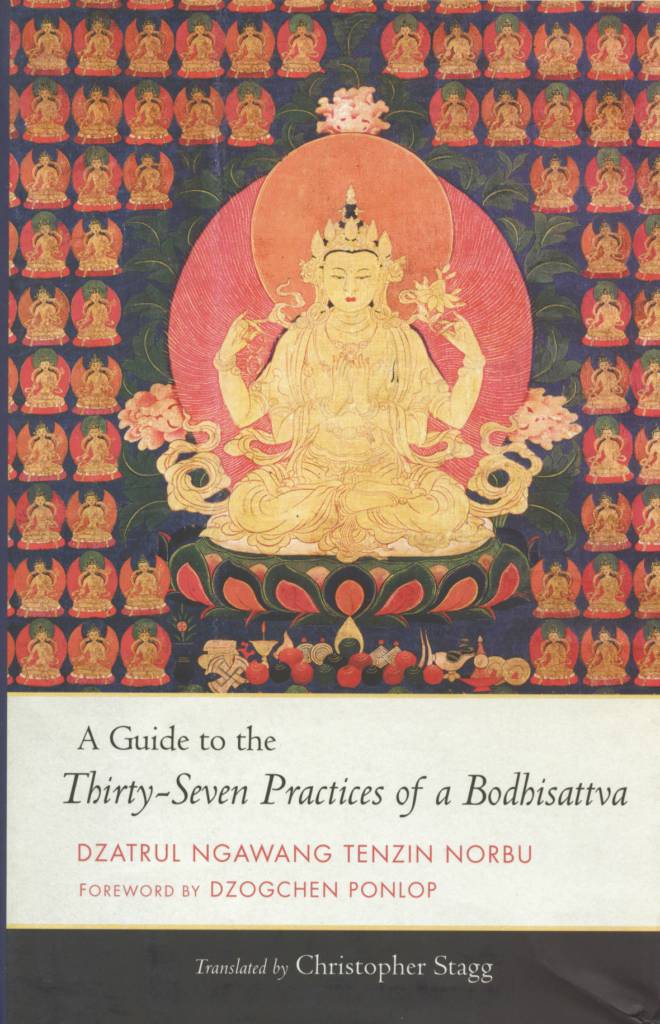
A Guide to the Thirty-Seven Practices of a Bodhisattva
| 🤓 Admin Zone 🛠️ hidden to non-admins | |

Description
Who is a bodhisattva and what do they practice? In the fourteenth century, the Tibetan Buddhist master Gyalse Tokme Zangpo answered these questions in a classic teaching on mind training (lojong) called the Thirty-Seven Practices of a Bodhisattva. This text consists of short slogans outlining the core of the Buddhist path of compassion that continues to inspire modern-day Buddhist masters, including the Dalai Lama and Dilgo Khyentse Rinpoche.
The most well-known commentary to the Thirty-Seven Practices is by the twentieth-century master Dzatrul Ngawang Tenzin, which is translated here along with a meditation instruction for the first time. Dzogchen Ponlop Rinpoche, who commissioned this translation, provides an informative overview to the history of the text and commentary, introducing the reader to the world of Tibet’s most widely studied text.
- Foreword by Dzogchen Ponlop Rinpocheix
- Editors' Prefacexiii
- Translator's Acknowledgmentsxv
- Translator's Introductionxvii
- Part One: The Root Text
- The Thirty-Seven Practices of a Bodhisattva1
- Part Two: The Commentary
- The Excellent Vase of Nectar: The Union of Scripture and Oral Instructions11
- Homage13
- Introduction15
- 1. Precious Human Birth19
- 2. Abandoning One's Homeland17
- 3. Relying on Solitary Places31
- 4. Remembering Impermanence33
- 5. Abandoning Bad Friends39
- 6. Relying on Good Friends43
- 7. Going for Refuge53
- 8. Lesser Beings59
- 9. Middling Beings73
- 10. Giving Rise to the Supreme Intention of Bodhichitta77
- 11. Meditation of Exchanging Self and Others85
- 12. Taking to the Path Not Getting What You Want89
- 13. Taking Suffering to the Path91
- 14. Taking Blame to the Path93
- 15. Taking Denigration to the Path95
- 16. Taking Ingratitude to the Path97
- 17. Taking Others' Contempt to the Path99
- 18. Taking Loss to the Path101
- 19. Taking Gain to the Path105
- 20. Taking Objects of Aggression to the Path109
- 21. Taking Objects of Attachment to the Path113
- 22. Meditative Equipoise Free from Clinging to Elaborations121
- 23. Abandoning Taking Objects of Attachment as Truly Existent125
- 24. Abandoning Taking Objects of Aversion as Truly Existent127
- 25. The Means of Generosity131
- 26. The Means of Discipline137
- 27. The Means of Patience143
- 28. The Means of Diligence149
- 29. The Means of Meditative Concentration155
- 30. The Wisdom of Prajna175
- 31. Examining and Abandoning One's Confusion189
- 32. Abandoning Speaking of the Faults of Bodhisattvas193
- 33. Abandoning Attachment to the Homes of Patrons197
- 34. Abandoning Harsh Speech199
- 35. The Trainings for Abandoning the Mental Afflictions203
- 36. Training in Accomplishing Others' Benefit through Mindfulness and Attentiveness207
- 37. Training in Dedicating Virtue to Perfect Enlightenment211
- Summary215
- Part Three: The Sadhana
- The Swift Path to Awakening: A Supplementary Practice That Breaks "The Thirty-Seven Practices of a Bodhisattva"
into Sessions221
- Appendix 1 : Outline of the Commentary243
- Appendix 2: Lineage Chart of the Kadampa Teachings247
- Notes249
- Selected Bibliography265
- Index267
- About the Translator275