No edit summary |
No edit summary |
||
| Line 3: | Line 3: | ||
|FullRead=No | |FullRead=No | ||
|DisableRedirects=No | |DisableRedirects=No | ||
|TableOfContents=*{{i|Preface|xi}} | |||
*{{i|Abbreviations|xv}} | |||
<center>'''Part One: Analysis'''</center> | |||
*{{i|1. INTRODUCTION|3}} | |||
*{{i|2. THE FORMATION OF THE INQUIRY OF UGRA|10}} | |||
**{{i|The ''Ugra'' as a Literary Document|11}} | |||
**{{i|Versions of the Sūtra|16}} | |||
**{{i|The Name "Ugradatta"|21}} | |||
**{{i|The Epithet Grhapati|22}} | |||
**{{i|Ugra as Literary Character: Precedents in Earlier Texts|25}} | |||
**{{i|The Title of the Sūtra|26}} | |||
**{{i|The ''Ugra'' as a ''Ratnakūta'' Text|31}} | |||
**{{i|The Evolution of the Text over Time|36}} | |||
**{{i|Structure and Genre|38}} | |||
**{{i|Date and Provenance|41}} | |||
*{{i|3. THE ''UGRA'' AS A HISTORICAL SOURCE: METHODOLOGICAL CONSIDERATIONS|48}} | |||
**{{i|The Problem of Textual Stratification|49}} | |||
**{{i|Types of Interpolations in the ''Ugra''|51}} | |||
***{{i|Multiplication of epithets|53}} | |||
***{{i|Completion of a standard list|53}} | |||
***{{i|Recall of a passage from elsewhere|54}} | |||
***{{i|Filling in the blanks|55}} | |||
***{{i|Reiteration with additional examples|56}} | |||
***{{i|Addition of genuinely new material|57}} | |||
**{{i|The Possibility of Omissions and Abbreviations|59}} | |||
**{{i|Moving Pieces: Alterations in the Sequence of the Text|61}} | |||
**{{i|Extracting Historical Data from a Normative Source|63}} | |||
***{{i|The principle of embarrassment|65}} | |||
***{{i|The principle of irrelevance|66}} | |||
***{{i|The principle of counterargument|67}} | |||
***{{i|The principle of corroborating evidence|68}} | |||
**{{i|''Ex Silentio'': The Interpretation of Absence|69}} | |||
**{{i|A Distant Mirror: Studying Indian Buddhism through Chinese and Tibetan Texts|70}} | |||
*{{i|4. THE INSTITUTIONAL SETTING|73}} | |||
**{{i|Defining Categories: Household vs. Renunciant Life|74}} | |||
**{{i|Lay Bodhisattvas|75}} | |||
**{{i|Monastic Bodhisattvas|79}} | |||
**{{i|Bodhisattvas and ''Śrāvakas'' in the Buddhist Sangha|84}} | |||
**{{i|The ''Vihāra'' and the Wilderness|89}} | |||
***{{i|Hirakawa's theory of the lay origins of the Mahāyāna|89}} | |||
***{{i|Ray's theory of the forest origins of the Mahāyāna|93}} | |||
**{{i|Gender Issues|96}} | |||
**{{i|Conclusions: Bodhisattvas in Their Nikāya Contexts|100}} | |||
*{{i|5. BODHISATTVA PRACTICES: GUIDELINES FOR THE PATH|103}} | |||
**{{i|THE LAY BODHISATTVA|106}} | |||
**{{i|Taking Refuge|106}} | |||
**{{i|The Eleven Precepts|107}} | |||
**{{i|The Practice of Giving|111}} | |||
**{{i|The Transformation of Merit|114}} | |||
**{{i|Detachment from People and Things|115}} | |||
**{{i|The ''Triskandhaka'' Ritual|117}} | |||
**{{i|The Necessity of Becoming a Monk|121}} | |||
**{{i|THE MONASTIC BODHISATTVA|127}} | |||
**{{i|The Four Noble Traditions|127}} | |||
**{{i|Wilderness-Dwelling|130}} | |||
**{{i|Avoiding Contact with Others|132}} | |||
**{{i|Maintaining Humility|135}} | |||
*{{i|6. THE STRUCTURE OF THE BODHISATTVA CAREER: IMPLICIT ASSUMPTIONS|137}} | |||
**{{i|The Three Vehicles: Separate Paths to Separate Goals|138}} | |||
**{{i|The Impossibility of Attaining Buddhahood in This Lifetime|142}} | |||
**{{i|Motivations for the Bodhisattva Path|144}} | |||
**{{i|Bodhisattva Vows|147}} | |||
**{{i|Stages of the Path|151}} | |||
**{{i|The Six ''Pāramitās''|153}} | |||
**{{i|Tactical Skill|154}} | |||
**{{i|The Buddha and the Practitioner|156}} | |||
***{{i|Paying homage|162}} | |||
***{{i|Making offerings|163}} | |||
***{{i|Service|166}} | |||
***{{i|Meditative remembrance|167}} | |||
**{{i|Conclusions: Imitative vs. Relational Cultivation|168}} | |||
*{{i|7. TELLING ABSENCES: WHAT IS NOT IN THE ''UGRA''|171}} | |||
**{{i|The Term "Hīnayāna"|172}} | |||
**{{i|Bodhisattva Universalism|174}} | |||
**{{i|The Supermundane Buddha|176}} | |||
**{{i|The Rhetoric of Emptiness|179}} | |||
**{{i|The Cult of the Stūpa|182}} | |||
**{{i|The Cult of the Book|184}} | |||
**{{i|Devotion to Celestial Buddhas|187}} | |||
**{{i|Devotion to Celestial Bodhisattvas|188}} | |||
**{{i|Conclusions: The Significance of Absence|190}} | |||
*{{i|8. THE MAHĀYĀNA IN THE MIRROR OF THE ''UGRA''|193}} | |||
<center>'''Part Two: Translation'''</center> | |||
*{{i|Translation Techniques and Conventions|201}} | |||
**{{i|Which Text?|202}} | |||
**{{i|Which Reading?|204}} | |||
**{{i|Symbols and Conventions|205}} | |||
*PRACTICES OF THE LAY BODHISATTVA | |||
**{{i|0. Opening Salutation|207}} | |||
**{{i|1. The Setting|207}} | |||
**{{i|2. Ugra's Inquiry|210}} | |||
**{{i|3. Going for Refuge|216}} | |||
**{{i|4. The Refuges, Repeated|219}} | |||
**{{i|5. Good Deeds|223}} | |||
**{{i|6. The Bodhisattva's Perspective|226}} | |||
**{{i|7. The Eleven Precepts|229}} | |||
**{{i|8. The Bodhisattva in Society|233}} | |||
**{{i|9. The Faults of the Household Life|237}} | |||
**{{i|10. The Benefits of Giving|240}} | |||
**{{i|11. Thoughts When Encountering Beggars|241}} | |||
**{{i|12. Detachment from People and Things|246}} | |||
**{{i|13. Cultivating Aversion for One's Wife|247}} | |||
**{{i|14. Cultivating Detachment from One's Son|255}} | |||
**{{i|15. How to Interact with Beggars|257}} | |||
**{{i|16. The ''Triskandhaka'' Ritual|259}} | |||
**{{i|17. When Monks Violate the Precepts|261}} | |||
**{{i|18. When Visiting a Monastery|264}} | |||
**{{i|19. Contrasts between Household and Renunciant Life|266}} | |||
**{{i|20. When Visiting a Monastery, Cont’d.|272}} | |||
**{{i|21. The Ordination of Ugra and His Friends (version 1)|278}} | |||
*PRACTICES OF THE MONASTIC BODHISATTVA | |||
**{{i|22. The Renunciant Bodhisattva's Practices|280}} | |||
**{{i|23. The Four Noble Traditions|282}} | |||
**{{i|24. The Noble Traditions and Other Ascetic Practices|284}} | |||
**{{i|25. The Virtues of Wilderness-Dwelling|291}} | |||
**{{i|26. Interacting with Other Monks and Teachers|307}} | |||
**{{i|27. The Pure Morality of the Renunciant Bodhisattva|310}} | |||
**{{i|28. The Pure Meditation of the Renunciant Bodhisattva|312}} | |||
**{{i|29. The Pure Insight of the Renunciant Bodhisattva|313}} | |||
**{{i|30. The Ordination of Ugra and His Friends (version 2)|314}} | |||
**{{i|31. How the Householder Can Live as a Renunciant|314}} | |||
**{{i|32. Dialogue with Ānanda|316}} | |||
**{{i|33. The Title of the Text|318}} | |||
**{{i|34. The Final Reaction of the Audience|320}} | |||
**{{i|35. Title and Colophon|320}} | |||
<center>'''Appendices'''</center> | |||
*{{i|1. Synoptic Tables of Versions of the ''Ugraparipṛcchā''|325}} | |||
**{{i|Part A: Tibetan Texts|326}} | |||
**{{i|Part B: Chinese Texts and Citations in Other Sources|333}} | |||
*{{i|2. Bodhisattva Names in the ''Ugraparipṛcchā''|341}} | |||
*{{i|3. Monastic Specialties Recorded in the ''Ugraparipṛcchā''|347}} | |||
*{{i|Bibliography|352}} | |||
*{{i|Index|369}} | |||
|CheckQuotes=No | |CheckQuotes=No | ||
|TextTopics=Ugraparipṛcchāsūtra | |TextTopics=Ugraparipṛcchāsūtra | ||
}} | }} | ||
Revision as of 15:40, 12 November 2021
| 🤓 Admin Zone 🛠️ hidden to non-admins | |
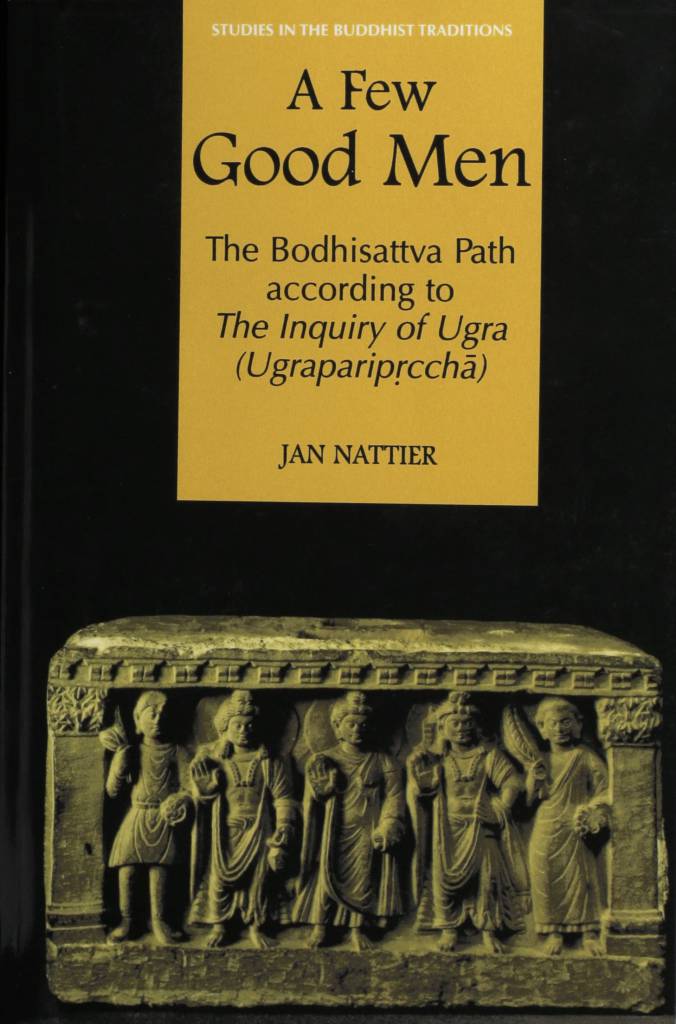
A Few Good Men: The Bodhisattva Path according to The Inquiry of Ugra (Ugraparipṛcchā)
Book
Please note that many items in our library are simply pages that represent a detailed library catalog entry and citation of someone else's work, presentation, or performance. Read our General Disclaimer for more information. You can find more information about this item on the publisher website.

Description
A Few Good Men is a study and translation of The Inquiry of Ugra (Ugraparipṛcchā), one of the most influential Mahāyāna sutras on the bodhisattva path, but also one of the most neglected texts in Western treatments of Buddhism. To achieve a better understanding of the universe of ideas, activities, and institutional structures within which early self-proclaimed bodhisattvas lived, the author first considers the Ugra as a literary document, employing new methodological tools to examine the genre to which it belongs, the age of its extant versions, and their relationships to one another. She goes on to challenge the dominant notions that the Mahāyāna emerged as a "reform" of earlier Buddhism and offered lay people an “easier option.”
A Few Good Men will be compelling reading for scholars and practitioners alike and others interested in the history of Indian Buddhism and the formation of Mahāyāna. (Source: University of Hawai'i Press)
Citation
Nattier, Jan. A Few Good Men: The Bodhisattva Path according to The Inquiry of Ugra (Ugraparipṛcchā). Studies in the Buddhist Traditions. Honolulu: University of Hawai'i Press, 2003.
Publisher Link
Table of contents
- Prefacexi
- Abbreviationsxv
- 1. INTRODUCTION3
- 2. THE FORMATION OF THE INQUIRY OF UGRA10
- The Ugra as a Literary Document11
- Versions of the Sūtra16
- The Name "Ugradatta"21
- The Epithet Grhapati22
- Ugra as Literary Character: Precedents in Earlier Texts25
- The Title of the Sūtra26
- The Ugra as a Ratnakūta Text31
- The Evolution of the Text over Time36
- Structure and Genre38
- Date and Provenance41
- 3. THE UGRA AS A HISTORICAL SOURCE: METHODOLOGICAL CONSIDERATIONS48
- The Problem of Textual Stratification49
- Types of Interpolations in the Ugra51
- Multiplication of epithets53
- Completion of a standard list53
- Recall of a passage from elsewhere54
- Filling in the blanks55
- Reiteration with additional examples56
- Addition of genuinely new material57
- The Possibility of Omissions and Abbreviations59
- Moving Pieces: Alterations in the Sequence of the Text61
- Extracting Historical Data from a Normative Source63
- The principle of embarrassment65
- The principle of irrelevance66
- The principle of counterargument67
- The principle of corroborating evidence68
- Ex Silentio: The Interpretation of Absence69
- A Distant Mirror: Studying Indian Buddhism through Chinese and Tibetan Texts70
- 4. THE INSTITUTIONAL SETTING73
- Defining Categories: Household vs. Renunciant Life74
- Lay Bodhisattvas75
- Monastic Bodhisattvas79
- Bodhisattvas and Śrāvakas in the Buddhist Sangha84
- The Vihāra and the Wilderness89
- Hirakawa's theory of the lay origins of the Mahāyāna89
- Ray's theory of the forest origins of the Mahāyāna93
- Gender Issues96
- Conclusions: Bodhisattvas in Their Nikāya Contexts100
- 5. BODHISATTVA PRACTICES: GUIDELINES FOR THE PATH103
- THE LAY BODHISATTVA106
- Taking Refuge106
- The Eleven Precepts107
- The Practice of Giving111
- The Transformation of Merit114
- Detachment from People and Things115
- The Triskandhaka Ritual117
- The Necessity of Becoming a Monk121
- THE MONASTIC BODHISATTVA127
- The Four Noble Traditions127
- Wilderness-Dwelling130
- Avoiding Contact with Others132
- Maintaining Humility135
- 6. THE STRUCTURE OF THE BODHISATTVA CAREER: IMPLICIT ASSUMPTIONS137
- The Three Vehicles: Separate Paths to Separate Goals138
- The Impossibility of Attaining Buddhahood in This Lifetime142
- Motivations for the Bodhisattva Path144
- Bodhisattva Vows147
- Stages of the Path151
- The Six Pāramitās153
- Tactical Skill154
- The Buddha and the Practitioner156
- Paying homage162
- Making offerings163
- Service166
- Meditative remembrance167
- Conclusions: Imitative vs. Relational Cultivation168
- 7. TELLING ABSENCES: WHAT IS NOT IN THE UGRA171
- The Term "Hīnayāna"172
- Bodhisattva Universalism174
- The Supermundane Buddha176
- The Rhetoric of Emptiness179
- The Cult of the Stūpa182
- The Cult of the Book184
- Devotion to Celestial Buddhas187
- Devotion to Celestial Bodhisattvas188
- Conclusions: The Significance of Absence190
- 8. THE MAHĀYĀNA IN THE MIRROR OF THE UGRA193
- Translation Techniques and Conventions201
- Which Text?202
- Which Reading?204
- Symbols and Conventions205
- PRACTICES OF THE LAY BODHISATTVA
- 0. Opening Salutation207
- 1. The Setting207
- 2. Ugra's Inquiry210
- 3. Going for Refuge216
- 4. The Refuges, Repeated219
- 5. Good Deeds223
- 6. The Bodhisattva's Perspective226
- 7. The Eleven Precepts229
- 8. The Bodhisattva in Society233
- 9. The Faults of the Household Life237
- 10. The Benefits of Giving240
- 11. Thoughts When Encountering Beggars241
- 12. Detachment from People and Things246
- 13. Cultivating Aversion for One's Wife247
- 14. Cultivating Detachment from One's Son255
- 15. How to Interact with Beggars257
- 16. The Triskandhaka Ritual259
- 17. When Monks Violate the Precepts261
- 18. When Visiting a Monastery264
- 19. Contrasts between Household and Renunciant Life266
- 20. When Visiting a Monastery, Cont’d.272
- 21. The Ordination of Ugra and His Friends (version 1)278
- PRACTICES OF THE MONASTIC BODHISATTVA
- 22. The Renunciant Bodhisattva's Practices280
- 23. The Four Noble Traditions282
- 24. The Noble Traditions and Other Ascetic Practices284
- 25. The Virtues of Wilderness-Dwelling291
- 26. Interacting with Other Monks and Teachers307
- 27. The Pure Morality of the Renunciant Bodhisattva310
- 28. The Pure Meditation of the Renunciant Bodhisattva312
- 29. The Pure Insight of the Renunciant Bodhisattva313
- 30. The Ordination of Ugra and His Friends (version 2)314
- 31. How the Householder Can Live as a Renunciant314
- 32. Dialogue with Ānanda316
- 33. The Title of the Text318
- 34. The Final Reaction of the Audience320
- 35. Title and Colophon320
- 1. Synoptic Tables of Versions of the Ugraparipṛcchā325
- Part A: Tibetan Texts326
- Part B: Chinese Texts and Citations in Other Sources333
- 2. Bodhisattva Names in the Ugraparipṛcchā341
- 3. Monastic Specialties Recorded in the Ugraparipṛcchā347
- Bibliography352
- Index369
Interconnections
1 Other editions

A study and translation of the Inquiry of Ugra (Ugraparipṛcchāsūtra), one of the most influential Mahāyāna sūtras, by Jan Nattier.
1 Scholarship on

A group of wealthy householders led by Ugra ask the Buddha for guidance on the proper conduct for married, male, lay practitioners. The Buddha answers by laying out, in great detail, the many challenges presented by remaining in a household as compared to the many advantages of going forth as an ordained monk and renouncing worldly life. Instructions are also given on how laymen should behave when visiting a monastery. Convinced of the superiority of monastic renunciation, Ugra and the other householders request to go forth and receive monastic ordination. The Buddha then lays out the proper conduct for renunciant bodhisattvas while living in retreat in the wilderness. (Source: 84000)