Prajñānāmamūlamadhyamakakārikā/Full text
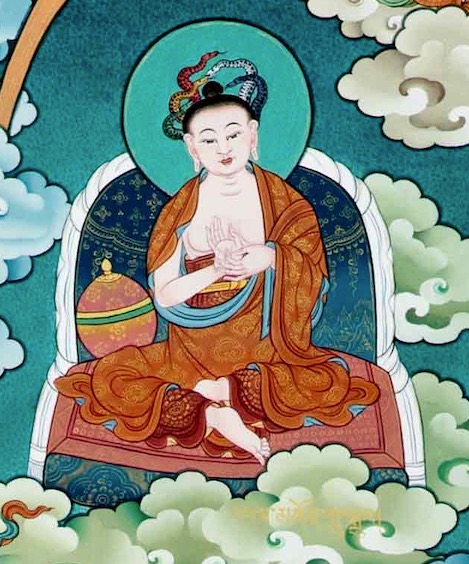
Mūlamadhyamakakārikā. (T. Dbu ma rtsa bai tshig le'u byas pa; C. Zhong lun; J. Chüron; K. Chung non 中論). In Sanskrit, "Root Verses on the Middle Way"; the magnum opus of the second-century Indian master Nāgārjuna ; also known as the Prajñānāmamūlamadhyamakakārikā and the Madhyamakaśāstra. (The Chinese analogue of this text is the Zhong lun, which renders the title as Madhyamakaśāstra. This Chinese version was edited and translated by Kumārajīva . Kumārajīva's edition, however, includes not only Nāgārjuna's verses but also Piṅgala's commentary to the verses.) The most widely cited and commented upon of Nāgārjuna's works in India, the Mūlamadhyamakakārikā, was the subject of detailed commentaries by such figures as Buddhapālita, Bhāvaviveka, and Candrakīrti (with Candrakīrti's critique of Bhāvaviveka's criticism of a passage in Buddhapālita's commentary providing the locus classicus for the later Tibetan division of Madhyamaka into *Svātantrika and *Prāsaṅgika). In East Asia, it was one of the three basic texts of the "Three Treatises" school (C. San lun zong), and was central to Tiantai philosophy. Although lost in the original Sanskrit as an independent work, the entire work is preserved within the Sanskrit text of Candrakīrti's commentary, the Prasannapadā (serving as one reason for the influence of Candrakīrti's commentary in the European reception of the Mūlamadhyamakakārikā). The work is composed of 448 verses in twenty-seven chapters. The topics of the chapters (as provided by Candrakīrti) are the analysis of: (1) conditions (pratyaya), (2) motion, (3) the eye and the other sense faculties (indriya), (4) aggregates (skandha), (5) elements (dhātu), (6) passion and the passionate, (7) the conditioned (in the sense of production, abiding, disintegration), (8) action and agent, (9) prior existence, (10) fire and fuel, (11) the past and future limits of saṃsāra, (12) suffering, (13) the conditioned (saṃskāra), (14) contact (saṃsarga), (15) intrinsic nature (svabhāva), (16) bondage and liberation, (17) action and effect, (18) self, (19) time, (20) assemblage (sāmagrī), (21) arising and dissolving, (22) the tathāgata, (23) error, (24) the four noble truths, (25) nirvāṇa, (26), the twelve links of dependent origination (pratītyasamutpāda), and (27) views. (Source: "Mūlamadhyamakakārikā." In The Princeton Dictionary of Buddhism, 553. Princeton University Press, 2014. http://www.jstor.org/stable/j.ctt46n41q.27.)
| Reference | Nāgārjuna. prajñānāmamūlamadhyamakakārikā [प्रज्ञानाममूलमध्यमककारिका]. dbu ma rtsa ba'i tshig le'ur byas pa shes rab [དབུ་མ་རྩ་བའི་ཚིག་ལེའུར་བྱས་པ་ཤེས་རབ།]. [Fundamental Treatise on the Middle Way called "Wisdom" (84000)]. Tengyur, RKTST 3169 http://www.rkts.org/cat.php?id=3169&typ=2. |
|---|---|
| People | Nāgārjuna, Jñānagarbha, Chokro Lui Gyaltsen |
