Benkenmitsu nikyōron

From Bodhicitta
< TextsTexts/Benkenmitsu nikyōron

🤓 Admin Zone 🛠️ hidden to non-admins
Benkenmitsu nikyōron
Text


Please note that many items in our library are simply pages that represent a detailed library catalog entry and citation of someone else's work, presentation, or performance. Read our General Disclaimer for more information.

Description

Benkenmitsu nikyòron. (辯顯密二教論). In Japanese, literally "Distinguishing the Two Teachings of the Exoteric and Esoteric"; a relatively short treatise composed by the Japanese Shingon monk Kūkai in the early ninth century. The text is commonly known more simply as the Nikyōron. As the title suggests, the central theme of the Benkenmitsu nikyōron is the elaboration of the difference between the exoteric and esoteric teachings of Buddhism and the demonstration of the latter's superiority. The text begins with a brief introduction, followed by a series of questions and answers, and a short conclusion. The Benkenmitsu nikyōron describes the relation between the exoteric teachings preached by the nirmānakāya of the Buddha and the esoteric teachings preached by his dharmakāya as that between provisional words spoken according to the different capacities of sentient beings and ultimate truth. By meticulously citing scriptural references, such as the Laṅkāvatārasūtra, the Benkenmitsu nikyōron shows that the dharmakāya, like the nirmānakāya and sambhogakāya, can indeed preach and that it does so in a special language best articulated in such esoteric scriptures as the Mahāvairocanābhisambodhisūtra. Whereas the nirmānakāya speaks the dharma with reference to the six perfections (pāramitā), the dharmakāya employs the language of the three mysteries: the body, speech, and mind of Mahāvairocana expressed in mudrā, mantra, and maṇḍala. Like many of Kukai's other writings, the arguments presented in his Benkenmitsu nikyōron helped him legitimize the introduction and installment of the new teachings, now known as Mikkyō or esoteric Buddhism, which he had brought back from China. There are several commentaries on the text, including those composed by Seisen (1025-1115), Raiyu (1226-1304), Yūkai (1345-1416), and Kaijō (1750-1805). (Source: "Benkenmitsu nikyōron." In The Princeton Dictionary of Buddhism, 104. Princeton University Press, 2014. http://www.jstor.org/stable/j.ctt46n41q.27.)
Reference
[Distinguishing the Two Teachings of the Exoteric and Esoteric].
Interconnections
1 Full translations
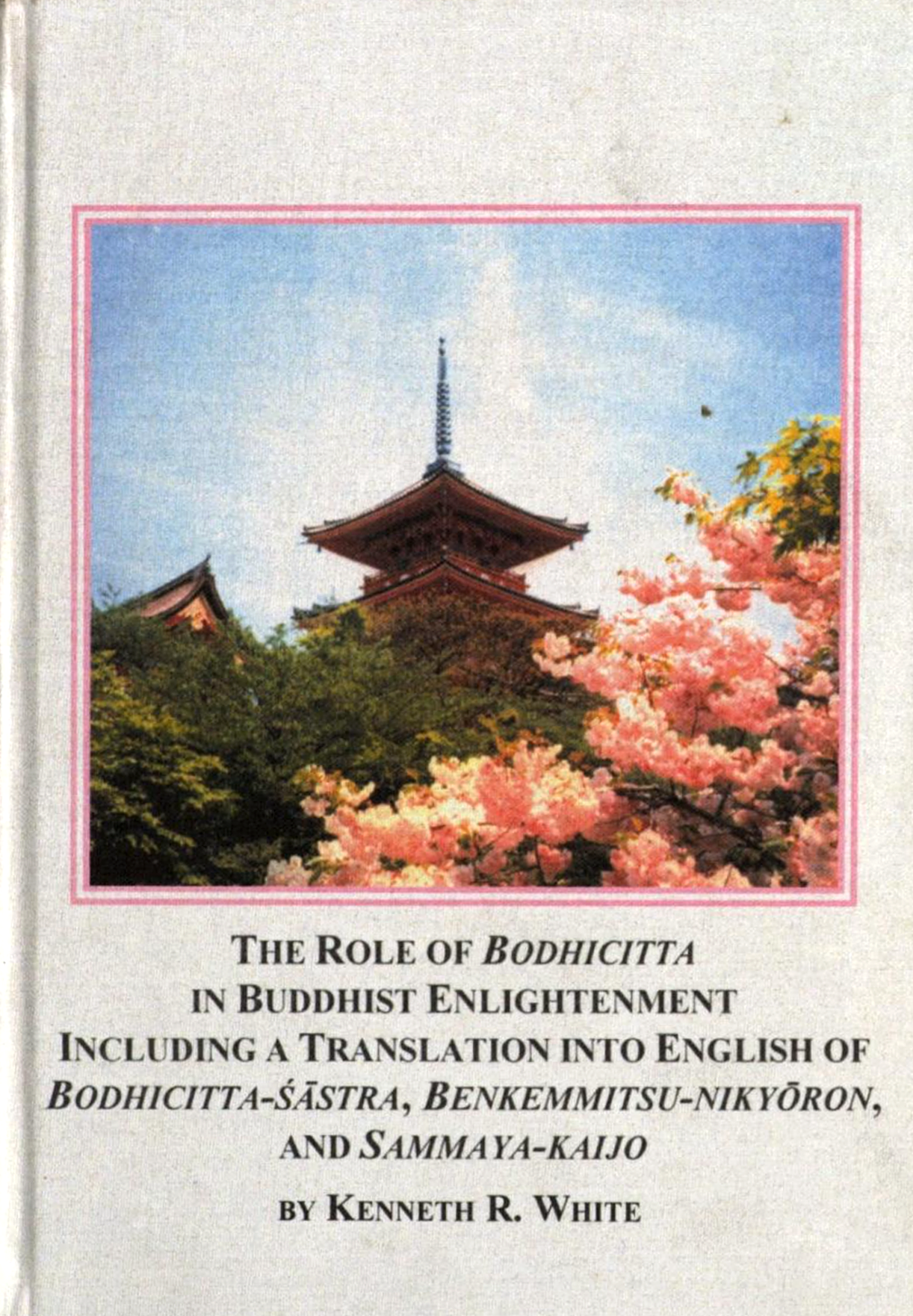
The Role of Bodhicitta in Buddhist Enlightenment-front.png
Books2005About this item
This book contains the first complete translation and interpretation of two of the works of Kūkai (744–845), the founder of the Japanese Shingon School of Buddhism. As an element of Mahāyāna Buddhist thought, bodhicitta ('enlightenment mind') is integral to an accurate understanding of the quest for Buddhist enlightenment. With the development of theories of this process, bodhicitta came to serve as that impetus urging a practitioner to engage himself in practice aiming at not merely individual release from samsara in an effort to attain nirvana, but also in other-oriented compassionate acts, the embodiment of which is the bodhisattva. This important interaction with, and responsibility for, others in the enlightenment process was particularly integral to the formulation of the ethical basis for East Asian Buddhism.

As discussion of the possibilities available to sentient beings engaged in various ritual practices and devotions progressed, the notion arose that they were actual partakers in Buddha-nature, with the potential of attaining Buddhahood. That sentient beings could even think of such a notion was indeed a radical departure from the doctrines of early Buddhism.

It was perhaps Kūkai, in his Shingon Buddhist doctrine, who took this notion to its fullest extent as he forwarded his scheme of actual integration between man and Buddha, facilitated by means of specifically directed practice, including activities of body, speech and mind. Such integration was not merely a philosophical phenomenon, but was viewed as a tangible and very immediate process. This immediacy is typified in the statement adopted by Kūkai indicating that one could even 'be a Buddha in this very body' (sokushin-jōbutsu), eliminating the necessity for countless rebirths.

Kūkai saw his unique Shingon doctrine and practice as not merely an addition to Mahāyāna Buddhist thought and Japanese Buddhist ritual, but rather as the distillation of all that Buddhist doctrine had been hinting at and attempting to explain. He took it to constitute the effective essence of Mahāyāna Buddhism, emphasizing the important notion that Buddhahood is a possibility for all. Two of Kūkai's original works, Benkemmitsu-nikyōron and Sammaya-kaijo, as well as the Bodhicitta-śāstra, a text from which he often quoted, constitute the foundation of his sokushin-jōbutsu thought, and are elucidating in an analysis of the development of his bodhicitta view. (Source: Edwin Mellen Press)

1 A topic of
The Role of Bodhicitta in Buddhist Enlightenment-front.png
Books2005About this item
This book contains the first complete translation and interpretation of two of the works of Kūkai (744–845), the founder of the Japanese Shingon School of Buddhism. As an element of Mahāyāna Buddhist thought, bodhicitta ('enlightenment mind') is integral to an accurate understanding of the quest for Buddhist enlightenment. With the development of theories of this process, bodhicitta came to serve as that impetus urging a practitioner to engage himself in practice aiming at not merely individual release from samsara in an effort to attain nirvana, but also in other-oriented compassionate acts, the embodiment of which is the bodhisattva. This important interaction with, and responsibility for, others in the enlightenment process was particularly integral to the formulation of the ethical basis for East Asian Buddhism.

As discussion of the possibilities available to sentient beings engaged in various ritual practices and devotions progressed, the notion arose that they were actual partakers in Buddha-nature, with the potential of attaining Buddhahood. That sentient beings could even think of such a notion was indeed a radical departure from the doctrines of early Buddhism.

It was perhaps Kūkai, in his Shingon Buddhist doctrine, who took this notion to its fullest extent as he forwarded his scheme of actual integration between man and Buddha, facilitated by means of specifically directed practice, including activities of body, speech and mind. Such integration was not merely a philosophical phenomenon, but was viewed as a tangible and very immediate process. This immediacy is typified in the statement adopted by Kūkai indicating that one could even 'be a Buddha in this very body' (sokushin-jōbutsu), eliminating the necessity for countless rebirths.

Kūkai saw his unique Shingon doctrine and practice as not merely an addition to Mahāyāna Buddhist thought and Japanese Buddhist ritual, but rather as the distillation of all that Buddhist doctrine had been hinting at and attempting to explain. He took it to constitute the effective essence of Mahāyāna Buddhism, emphasizing the important notion that Buddhahood is a possibility for all. Two of Kūkai's original works, Benkemmitsu-nikyōron and Sammaya-kaijo, as well as the Bodhicitta-śāstra, a text from which he often quoted, constitute the foundation of his sokushin-jōbutsu thought, and are elucidating in an analysis of the development of his bodhicitta view. (Source: Edwin Mellen Press)