Words Beyond Words: John Canti on the Prajñāpāramitā Literature
From Bodhicitta
< Media
Media/Words Beyond Words: John Canti on the Prajñāpāramitā Literature| 🤓 Admin Zone 🛠️ hidden to non-admins | |
Words Beyond Words: John Canti on the Prajñāpāramitā Literature
Multimedia
Please note that many items in our library are simply pages that represent a detailed library catalog entry and citation of someone else's work, presentation, or performance. Read our General Disclaimer for more information.
Description
The Prajñāpāramitā—the body of teachings the Buddha gave on Vulture's Peak on the nature of reality—is vast, repetitive, and famously difficult to pin down. It gave rise to the Heart Sutra, the Diamond Sutra, and centuries of philosophical debate across Asia. It also took one of India's greatest scholars nine years of solitary retreat just to begin to understand.
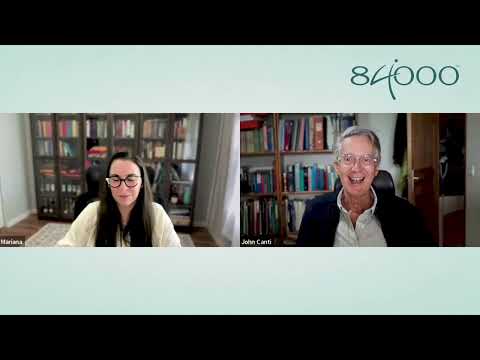
In this conversation, John Canti, senior editor at 84000 and one of the editors of the newly published Prajñāpāramitā in Eight Thousand Lines, speaks with 84000's Public Engagement Strategist Mariana Restrepo, tracing the sweep of this literature: where it came from, why it exists in so many versions, and what those waves of repetition are actually doing to the reader. He also speaks to something more personal, how years of working closely with this text have quietly shifted his own understanding, and what he hopes anyone encountering it for the first time might find there.
The translation is now freely available: https://84000.co/translation/toh12
Citation
Canti, John, and Mariana Restrepo. "Words Beyond Words: John Canti on the Prajñāpāramitā Literature." Produced by 84000: Translating the Words of the Buddha Jun 27, 2026. Video, 1:03:53. https://www.youtube.com/watch?v=z9GTsiKpwwc.
Interconnections
1 Interview about

The Perfection of Wisdom in Eight Thousand Lines, like other sūtras on the Perfection of Wisdom, deals with the topic of emptiness and the understanding of the ultimate truth or the way things are. Modern scholars date the sūtra roughly to the 2nd and 1st century BC and consider it to be the earliest sūtra on which other Perfection of Wisdom sūtras are based. Its adherents claim the sūtra to be a part of the words of the Buddha. It is believed to have been taken to the subterranean world and brought back to the human world by Nāgārjuna. It is sometimes known as the Condensed Mother (ཡུམ་བསྡུས་པ་), the term Mother referring to the Perfection of Wisdom which gives rise to all buddhas and bodhisattvas. It is said to be the condensed version of the long version in one hundred thousand lines and the middle version in twenty-five thousand lines. Having spread across Asia and beyond and having been translated into many languages, it is one of the most common books to be found in the Buddhist Himalayas.
The sūtra takes the form of a series of dialogues between the Buddha Śākyamuni, Subhūti, Śāriputra, and others, such as Indra, the king of gods, and a goddess of the Ganges. In the final chapters, the sūtra contains the inspirational narratives of Sadāprarudita and his quest for the teachings on the Perfection of Wisdom from the Bodhisattva Dharmodgata. The sūtra is also one of the earliest Mahāyāna sources proclaiming the luminous nature of the mind.

