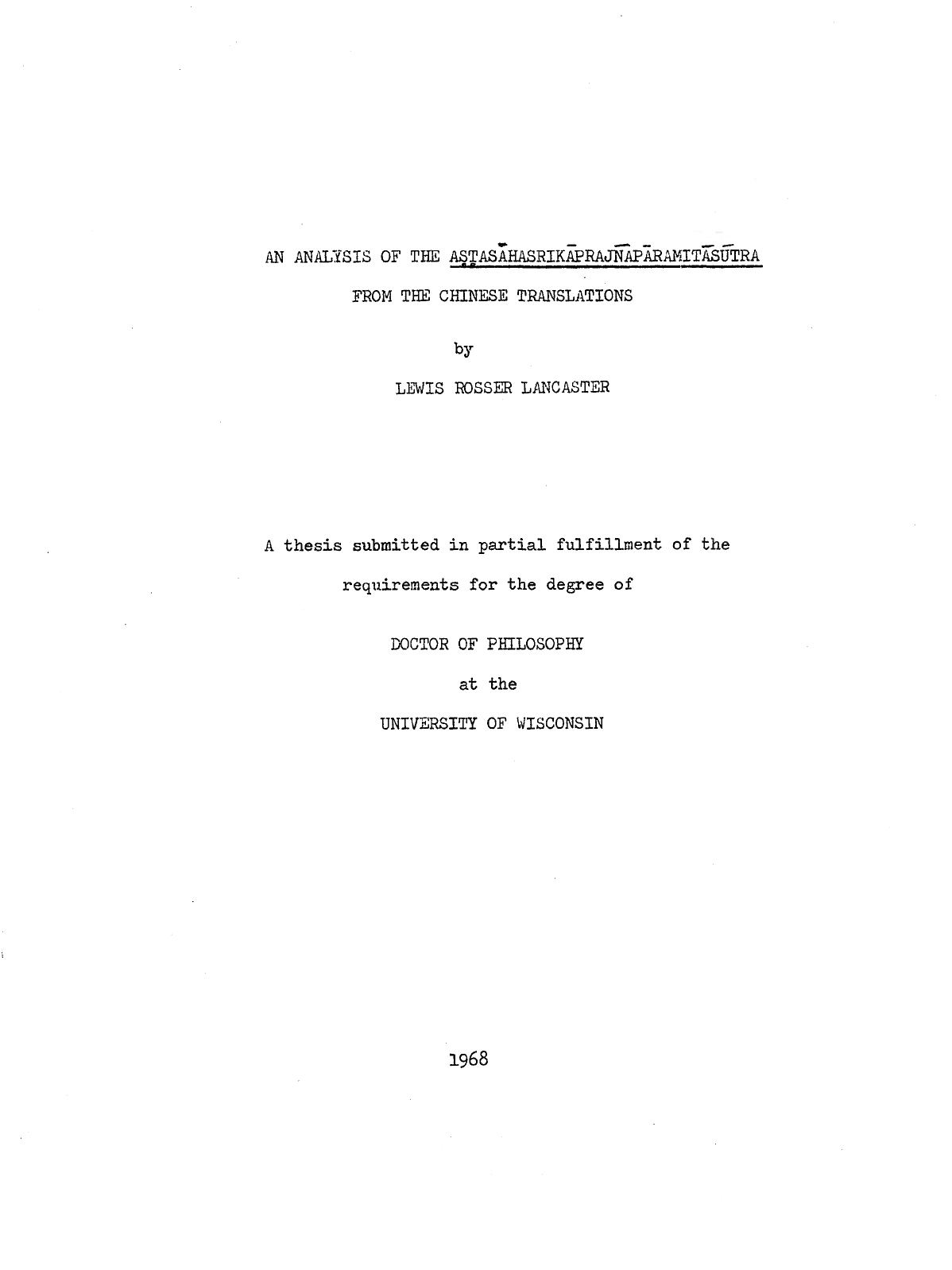
An Analysis of the Aṣṭasāhasrikāprajñāpāramitāsūtra from the Chinese Translations
From Bodhicitta
Dissertations/An Analysis of the Aṣṭasāhasrikāprajñāpāramitāsūtra from the Chinese Translations
| 🤓 Admin Zone 🛠️ hidden to non-admins | |
An Analysis of the Aṣṭasāhasrikāprajñāpāramitāsūtra from the Chinese Translations
Dissertation
Please note that many items in our library are simply pages that represent a detailed library catalog entry and citation of someone else's work, presentation, or performance. Read our General Disclaimer for more information.

Description
An examination of T. 224 in comparison with the Pāla Dynasty Sanskrit text indicates that there was a significant growth of the Aṣṭa from the text of the second century translation by Lokakṣema up to its final redaction. Because of the immense popularity of the Praiñāpāramitā literature in
China, the Aṣṭa was translated seven times, 'providing a record of growth and changes over a period of eight centuries (i.e., 179-985 A.D.). By comparing each of these translations with the Sanskrit and the other Chinese texts, some ideas can be formulated regarding the layers and dates of the textual expansion. (Lancaster, introduction, 1)
Citation
Lancaster, Lewis Rosser. "An Analysis of the Aṣṭasāhasrikāprajñāpāramitāsūtra from the Chinese Translations." PhD diss., University of Wisconsin-Madison, 1968.
Table of contents
- FOREWORDii
- LIST OF ABBREVIATIONSiv
- Chapter
- I. INTRODUCTION1
- II. THE EARLY CHINESE TRANSLATIONS11
- III. DOCTRINAL CHANGES31
- Section A. Mahāyāna Doctrines36
- 1. upāya-kauśalya Passages36
- 2. Kuśala-mūla Passages58
- 3. Bodhisattva Passages77
- 4. Dharma kāya Passages92
- 5. Tathatā Passages101
- 6. Prajñāpāramitā Passages110
- 7. Bhūta-koṭi Passages119
- 8. advaya Passages127
- Summary130
- Section B. Doctrinal Changes Related to Both Hīnayāna and Mahāyāna134
- Summary188
- Section C. Litany Changes190
- 15. Litanies190
- IV. STRUCTURAL CHANGES199
- The Story of Sadaprarudita223
- IV. STRUCTURAL CHANGES199
- V. CONCLUSIONS310
- BIBLIOGRAPHY319
- APPENDIX
- A. A Concordance of the Chinese Translations with the Sanskrit Texts326
- B. Index of Non-standard Translations in the Early Texts374
Interconnections
1 Scholarship on

The Perfection of Wisdom in Eight Thousand Lines, like other sūtras on the Perfection of Wisdom, deals with the topic of emptiness and the understanding of the ultimate truth or the way things are. Modern scholars date the sūtra roughly to the 2nd and 1st century BC and consider it to be the earliest sūtra on which other Perfection of Wisdom sūtras are based. Its adherents claim the sūtra to be a part of the words of the Buddha. It is believed to have been taken to the subterranean world and brought back to the human world by Nāgārjuna. It is sometimes known as the Condensed Mother (ཡུམ་བསྡུས་པ་), the term Mother referring to the Perfection of Wisdom which gives rise to all buddhas and bodhisattvas. It is said to be the condensed version of the long version in one hundred thousand lines and the middle version in twenty-five thousand lines. Having spread across Asia and beyond and having been translated into many languages, it is one of the most common books to be found in the Buddhist Himalayas.
The sūtra takes the form of a series of dialogues between the Buddha Śākyamuni, Subhūti, Śāriputra, and others, such as Indra, the king of gods, and a goddess of the Ganges. In the final chapters, the sūtra contains the inspirational narratives of Sadāprarudita and his quest for the teachings on the Perfection of Wisdom from the Bodhisattva Dharmodgata. The sūtra is also one of the earliest Mahāyāna sources proclaiming the luminous nature of the mind.