Vasubandhu's Treatise on the Bodhisattva Vow (Dharmamitra 2009)
From Bodhicitta
< Books
Books/Vasubandhu's Treatise on the Bodhisattva Vow (Dharmamitra 2009)| 🤓 Admin Zone 🛠️ hidden to non-admins | |
Vasubandhu's Treatise on the Bodhisattva Vow: A Discourse on the Bodhisattva's Vow and the Practices Leading to Buddhahood; Treatise on The Generating the Bodhi Resolve Sutra
Book
Please note that many items in our library are simply pages that represent a detailed library catalog entry and citation of someone else's work, presentation, or performance. Read our General Disclaimer for more information. You can find more information about this item on the publisher website.

Description
"Vasubandhu's Treatise on the Bodhisattva Vow" is Vasubandhu's treatise on the The Sutra on Generating the Resolve to Become a Buddha in which Vasubandhu discourses on the causality behind the origination of the bodhisattva vow (bodhicitta) and on the six perfections through which it reaches fruition. Translation by Bhikshu Dharmamitra. Includes facing-page source text. (Source Accessed Jan 14, 2025)
Citation
Dharmamitra, Bhikshu. Vasubandhu's Treatise on the Bodhisattva Vow: A Discourse on the Bodhisattva's Vow and the Practices Leading to Buddhahood; Treatise on The Generating the Bodhi Resolve Sutra. Kalavinka Buddhist Classics 10. Seattle, WA: Kalavinka Press, 2009.
Publisher Link
Table of contents
- About the Chinese Text6
- Outlining in This Work:6
- Citation and Romanization Protocols6
- Acknowledgments12
- The Translator’s Introduction13
- Exhortation to Generate the Resolve17
- I. Chapter 1: Exhortation to Generate the Resolve17
- A. Declaration of Reverence to the Buddhas17
- B. Introducing Bodhi Exhortation and the Practices Flowing Therefrom17
- C. The Practices Flowing from Exhortation to Resolve on Bodhi17
- D. The Rationale for Explaining These Dharmas19
- E. Praising Buddha’s Qualities to Preserve the Buddhas’ Lineage19
- F. The Immeasurable Practice of Those Resolved on Bodhi19
- G. The Incalculable Benefits Arising from Generating the Bodhi Resolve21
- 1. Analogy: Like When the Great Sea Begins to Form21
- 2. Analogy: Like When the Great Trichiliocosm Forms21
- 3. Bodhi Resolve as Guided by Kindness and Compassion Immeasurables23
- 4. Analogy: Bodhi Resolve Comparable in Inclusiveness to Empty Space23
- 5. Analogy: Bodhi Resolve Equals in Vastness All Realms of Beings23
- 6. Summation on Exhortation to Generate the Bodhi Resolve25
- Generating the Resolve27
- II. Chapter 2: Generating the Resolve27
- A. Ten Factors Conducing to Generation of the Bodhi resolve27
- B. Four Additional Bases for Generation of the Bodhi Resolve27
- 1. Contemplation of All Buddhas29
- 2. Contemplation of the Body’s Faults and Perilous Aspects29
- 3. Generating Resolve Based on Seeking the Path’s Supreme Fruits31
- 4. Generating the Bodhi resolve Based on Kindness and Pity33
- a. Observing that Beings Are Tied up by Ignorance33
- b. Observing that Beings Are Bound up by Manifold Sufferings33
- c. Observing that Beings Are Engaged in Accumulating Bad Karma35
- d. Observing that Beings Are Engaged in Extremely Grave Evils35
- e. Observing that Beings Fail to Cultivate Right Dharma37
- C. Summation on the Causal Bases for Generating the Bodhi resolve37
- The Establishment of Vows39
- III. Chapter 3: The Establishment of Vows39
- A. Introduction to the Bodhisattva’s Establishment of Vows39
- B. The Ten Great Vows39
- C. The Six Pāramitās and Related Practices as Causes of Bodhi43
- D. The Importance of Refraining from Negligence45
- E. Making Definitely-Resolved Vows as Supporting Five Endeavors45
- F. The Buddha’s Own Praise of the Unsurpassed Power of Vows45
- G. Establishing Six Resolutions in Support of the Six Perfections45
- H. The Importance of the Ten Vows and Six Resolutions to Bodhi47
- Dāna Pāramitā51
- IV. Chapter 4: The Perfection of Giving51
- A. Three Kinds of Benefit and Path Adornment Arising from Giving51
- 1. Right Motivation in the Practice of Giving51
- 2. Self-Benefit51
- 3. Benefit of Others51
- 4. Combined Benefit51
- 5. Adorning the Path of Bodhi through Giving53
- B. The Three Types of Giving53
- 1. The Giving of Dharma53
- 2. The Giving of Fearlessness53
- 3. The Definition and Scope of the Giving of Material Wealth53
- 1) Five Subcategories of the Giving of Material Wealth53
- 2) Five Categories of Wrong Giving55
- 3) Summary of Wrong and Right Giving55
- C. Five Additional Benefits of Delighting in Giving55
- D. Universality in Giving, the Defining Characteristic of a Bodhisattva55
- E. Types of Giving as Bases for Corresponding Karmic Fruits57
- F. Summation on the Bodhisattva’s Cultivation of Giving59
- G. The Essence of the Bodhisattva’s Perfection of Giving59
- A. Three Kinds of Benefit and Path Adornment Arising from Giving51
- Śīla Pāramitā61
- V. Chapter 5: The Perfection of Moral Virtue61
- A. Three Kinds of Benefit and Path Adornment from Moral Virtue61
- 1. Right Motivation in the Practice of Moral Virtue61
- 2. Self Benefit61
- 3. Benefit of Others61
- 4. Combined Benefit61
- 5. Adorning the Path of Bodhi through Moral Virtue61
- B. The Three Types of Moral Precepts63
- 1. The Moral precepts Associated with the Body63
- 2. The Moral precepts Associated with the Mouth63
- 3. The Moral Precepts Associated with the Mind65
- 4. Five Benefits Arising from the Precepts of the Ten Good Karmas65
- 5. Summary Discussion of the Precepts of the Ten Good Karmas65
- C. The Five Categories of Moral Precepts67
- D. Rationales for Observing Precepts Linked to Specific Path Practices67
- E. Factors Defining "Purity in Observing Moral Precepts”69
- F. Summation on the Bodhisattva’s Cultivation of Moral Purity71
- G. The Essence of the Bodhisattva’s Perfection of Moral Virtue73
- A. Three Kinds of Benefit and Path Adornment from Moral Virtue61
- Kṣānti Pāramitā75
- VI. Chapter 6: The Perfection of Patience75
- A. Three Kinds of Benefit and Path Adornment from Patience75
- 1. Right Motivation in the Practice of Patience75
- 2. Self Benefit75
- 3. Benefit of Others75
- 4. Combined Benefit75
- 5. Adorning the Path of Bodhi through Patience75
- B. The Three Types of Patience77
- 1. Physical Patience77
- 2. Verbal Patience77
- 3. Mental Patience77
- C. Two Types of Beatings77
- D. Two Types of Scoldings79
- E. The Necessity of Patience When Subjected to Others’ Hatred79
- F. Retributions Corresponding to Presence or Absence of Patience81
- G. Ten Bases for Developing Patience81
- H. Qualifications Prerequisite to Pure and Ultimate Patience81
- I. Summation on the Bodhisattva’s Cultivation of Patience83
- J. The Essence of the Bodhisattva’s Perfection of Patience83
- A. Three Kinds of Benefit and Path Adornment from Patience75
- Vīrya Pāramitā85
- VII.Chapter 7: The Perfection of Vigor85
- A. Three Kinds of Benefit and Path Adornment from Vigor85
- 1. Right Motivation in the Practice of Vigor85
- 2. Self-Benefit85
- 3. Benefit of Others85
- 4. Combined Benefit85
- 5. Adorning the Path of Bodhi through Vigor85
- B. Two Types of Vigor87
- C. Ten Recollections as Bases for Diligent Practice of Vigor87
- D. The Four Right Efforts89
- E. Practice Scenarios Exemplifying Vigor89
- F. The Bodhisattva’s Stately Deportment and Alignment with Dharma91
- G. The Importance of Vigor to the Pāramitās and Buddhahood91
- H. Four Factors in the Bodhisattva’s Initiation of the Great Adornment91
- 1. The Initiation of the Great Adornment93
- 2. The Accumulation of Heroic Strength93
- 3. The Cultivation of Roots of Goodness93
- 4. The Teaching and Transforming of Beings93
- I. Summation on Vigor93
- J. The Essence of the Bodhisattva’s Perfection of Vigor95
- A. Three Kinds of Benefit and Path Adornment from Vigor85
- Dhyāna Pāramitā97
- VIII. Chapter 8: The Perfection of Dhyāna Meditation97
- A. Three Kinds of Benefit and Path Adornment from Dhyāna97
- 1. Right Motivation in the Practice of Dhyāna97
- 2. Self-Benefit97
- 3. Benefit of Others97
- 4. Combined Benefit97
- 5. Adorning the Path of Bodhi through Dhyāna99
- B. The Three Dharmas from which Dhyāna Absorption Arises99
- 1. Learning-Derived Wisdom99
- 2. Deliberation-Derived Wisdom99
- 3. Meditation-Derived Wisdom101
- 4. Summation on the Three Types of Wisdom from Dhyāna103
- C. Ten Meditation Dharmas Not in Common with the Two Vehicles103
- D. Additional Characteristics of Bodhisattva Meditation Practice107
- E. Four Additional Distinctive Factors in Bodhisattva Meditation107
- 1. Spiritual Penetrations107
- 2. Knowing Awareness107
- 3. Skillful Means109
- 4. Wisdom109
- F. Summation on the Bodhisattva’s Distinctive Meditation Practice109
- G. The Essence of the Bodhisattva’s Perfection of Dhyāna Meditation109
- A. Three Kinds of Benefit and Path Adornment from Dhyāna97
- Prajñā Pāramitā111
- IX. Chapter 9: The Perfection of Wisdom111
- A. Three Kinds of Benefit and Path Adornment from Wisdom111
- 1. Right Motivation in the Practice of Wisdom111
- 2. Self-Benefit111
- 3. Benefit of Others111
- 4. Combined Benefit111
- 5. Adorning the Path of Bodhi through Wisdom111
- B. Twenty Types of Mind Key to a Bodhisattva’s Wisdom Realization113
- C. Ten Dharmas of Skillful Contemplation Exclusive to Bodhisattvas115
- D. The Bodhisattva’s Twelve-fold Skillful Entry of Dharma Gateways117
- E. The Bodhisattva’s Contemplation of the Three Periods of Time119
- F. Summation on the Bodhisattva’s Wisdom-Based Contemplation119
- G. The Essence of the Bodhisattva’s Perfection of Wisdom121
- A. Three Kinds of Benefit and Path Adornment from Wisdom111
- The Dharma Gateway of Accordance with Reality123
- X. Chapter 10: The Dharma Gateway of Accordance with Reality123
- A. Seven Dharmas to be Abandoned123
- B. Seven Dharmas to be Cultivated125
- C. Bodhi Resolve’s Incompatibility with "Something to be Gained”127
- D. Generation of Bodhi Resolve and Contemplation of Emptiness127
- E. The Practice of the Bodhisattva Who Understands Emptiness129
- F. The Fruits of this Bodhisattva Practice129
- Emptiness and Signlessness131
- XI. Chapter 11: Emptiness and Signlessness131
- A. An Introductory Passage from Scripture:131
- 1. Explanation of the Concepts of "Emptiness” and "Signlessness”131
- 2. A Comprehensive Analogy133
- B. Faith-Based Patience and its Role in Realizing Fruits of the Path137
- C. Acquiescence-Based Patience from Partial Cognition of Non-Self139
- D. Supreme Patience via Faith-Based and Acquiescence-Based Patience139
- A. An Introductory Passage from Scripture:131
- On the Merit and on Preserving Dharma141
- XII.Chapter 12: On the Merit and on Preserving Dharma141
- A. Characteristics of a Bodhisattva’s Bodhi-Directed Cultivation141
- B. Ten Bodhisattva Dharmas Ensuring Non-Retreat141
- C. Benefits Arising from Scriptures Such as These143
- D. The Meritoriousness of this Sutra and Those Revering It145
- Endnotes149
- Variant Readings from Other Chinese Editions153
- About the Translator157
- Kalavinka Buddhist Classics Title List159
Interconnections
1 Full translation of

Vasubandhu's treatise on the The Sutra on Generating the Resolve to Become a Buddha in which Vasubandhu discourses on the causality behind the origination of the bodhisattva vow (bodhicitta) and on the six perfections through which it reaches fruition.
1 Related

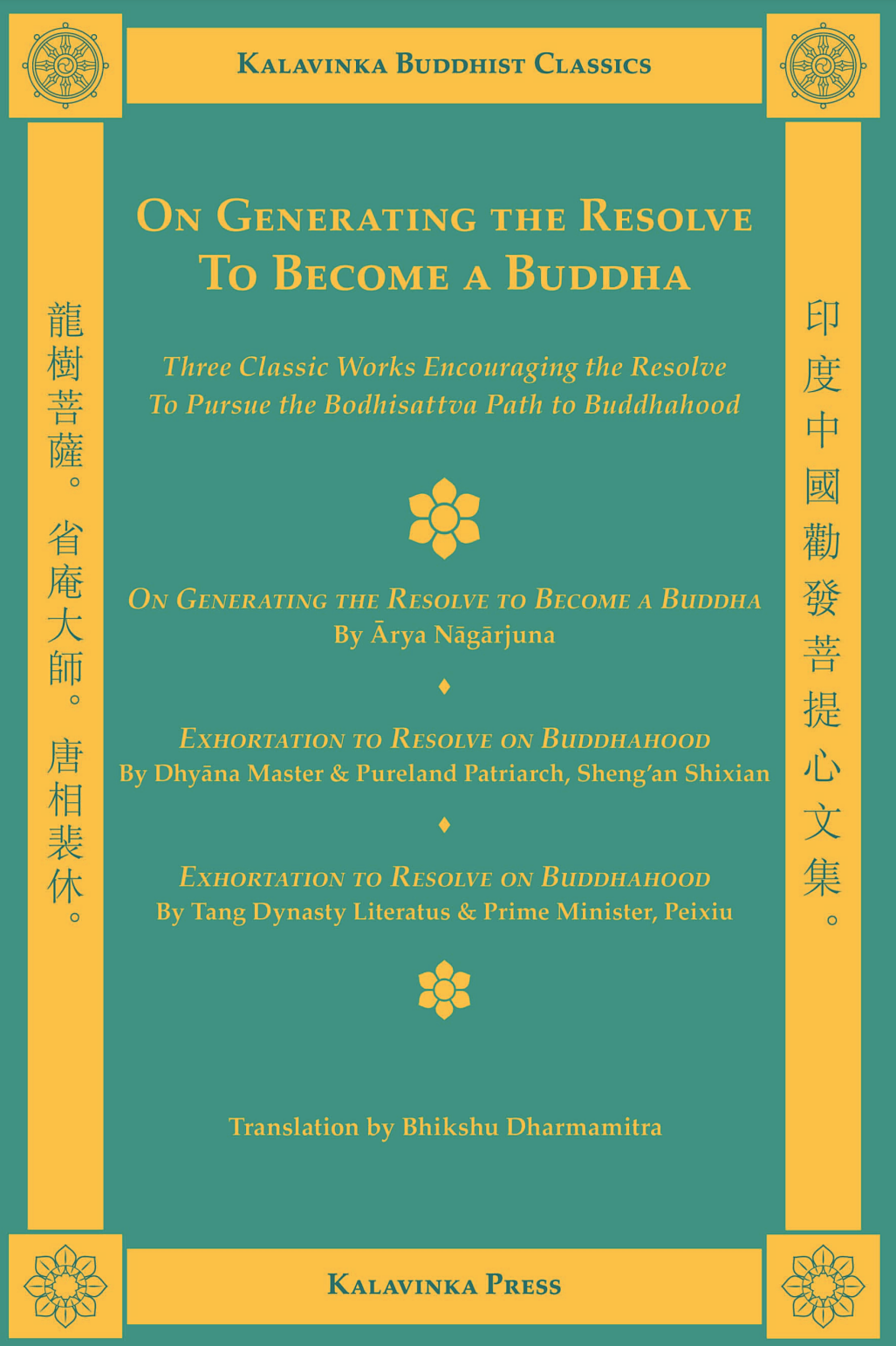
In this volume, Bhikshu Dharmamitra presents translations of three classic works on the bodhisattva vow (bodhicitta) authored by: The early Indian monastic eminence, Arya Nagarjuna (2nd c.); The Dhyana Master and Pureland Patriarch, Sheng'an Shixian (1686-1734); The Tang Dynasty literatus and prime minister, the Honorable Peixiu (797-870). Given that the bodhisattva vow constitutes the very essence of the path to buddhahood, this text can be said to be dedicated to the most important topic in all of Mahayana Buddhism. The translation and notes are by the American monk, Bhikshu Dharmamitra. This volume includes text outlines and facing-page source text in both traditional and simplified scripts. (Source Accessed Jan 15, 2025)
1 Related
In this volume, Bhikshu Dharmamitra presents translations of three classic works on the bodhisattva vow (bodhicitta) authored by: The early Indian monastic eminence, Arya Nagarjuna (2nd c.); The Dhyana Master and Pureland Patriarch, Sheng'an Shixian (1686-1734); The Tang Dynasty literatus and prime minister, the Honorable Peixiu (797-870). Given that the bodhisattva vow constitutes the very essence of the path to buddhahood, this text can be said to be dedicated to the most important topic in all of Mahayana Buddhism. The translation and notes are by the American monk, Bhikshu Dharmamitra. This volume includes text outlines and facing-page source text in both traditional and simplified scripts. (Source Accessed Jan 15, 2025)