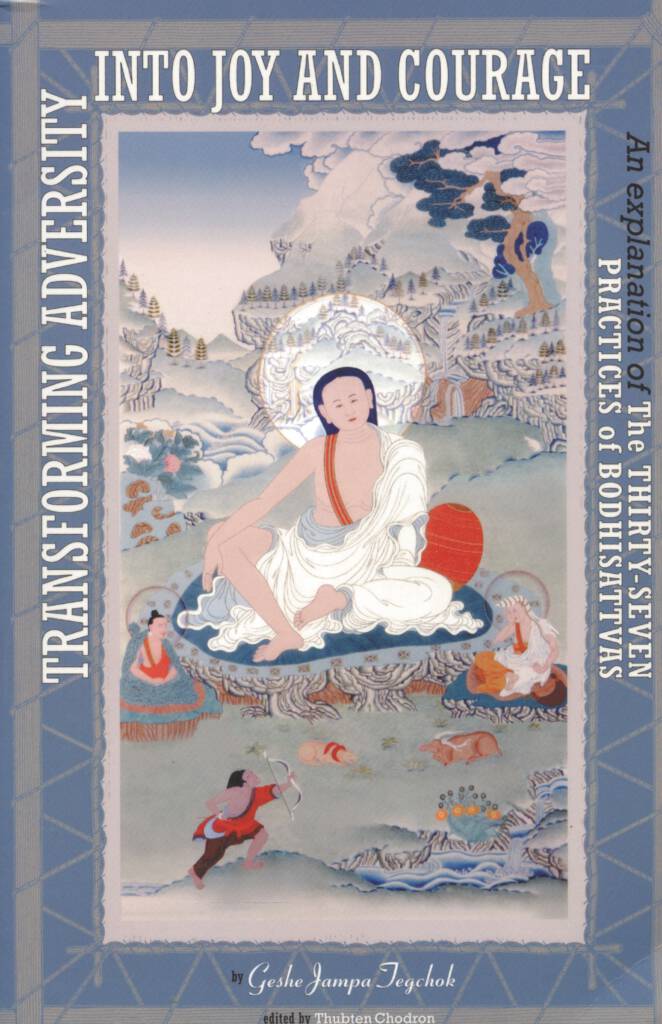
Transforming Adversity Into Joy and Courage: An Explanation of the Thirty-seven Practices of Bodhisattvas

From Bodhicitta
< BooksBooks/Transforming Adversity Into Joy and Courage (Tegchok 2005)

🤓 Admin Zone 🛠️ hidden to non-admins
Transforming Adversity Into Joy and Courage: An Explanation of the Thirty-seven Practices of Bodhisattvas
Book
See Timeline of BCA Commentaries


Please note that many items in our library are simply pages that represent a detailed library catalog entry and citation of someone else's work, presentation, or performance. Read our General Disclaimer for more information.
Transforming Adversity Into Joy and Courage (Tegchok 2005)-front.jpg

Description

A practical and inspiring guide for developing our ability to be happy and benefit others this commentary on The Thirty-Seven Practices of Bodhisattvas by Gyalsay Togme Sangpo is studied by followers of all schools of Tibetan Buddhism.

The root text gives in thirty-seven short verses the essential practices leading to enlightenment. Gyalsay Togme Sangpo (1295-1369) was renowned as a bodhisattva in Tibet and revered for living according to the bodhisattva ideals and practices that he taught. He inspired not only his direct disciples but also generations of practitioners up to the present day.

This extraordinary commentary by Geshe Jampa Tegchok clearly explains the popular practice of exchanging oneself with others for developing love and compassion for all living beings. It lays open the methods for doing glance stabilizing and analytical meditations and offers an in-depth discussion of the nature of emptiness. All the essentials are here for transforming our attitudes and developing courage and joy. (Source: Shambhala Publications)

Citation
Tegchok, Jampa. Transforming Adversity Into Joy and Courage: An Explanation of the Thirty-seven Practices of Bodhisattvas. Edited by Thubten Chodron. Boulder: Snow Lion Publications, 2005.
Table of contents
  • Preface 7
  • Introduction: The Buddhist World View by Thubten Chodron11
  • 1. Setting the Stage 23
  • 2. Freedom and Fortune 33
  • 3. Listening, Thinking, and Meditation 47
  • 4. Creating a Conductive Environment 63
  • 5. Being Mindful of Impermanence 67
  • 6. Spiritual Friends 85
  • 7. Refuge: A Safe Direction 101
  • 8. Creating Causes, Experiencing Results 113
  • 9. The Four Noble Truths 121
  • 10. Generating the Altruistic Intention 155
  • 11. Courageous Compassion 165
  • 12. Transforming Unfavorable Circumstances into the Path 205
  • 13. Meditation on Emptiness 221
  • 14. The Bodhisattvas' Training 277
  • The Root Text 293
  • Outline of The Thirty-seven Practices of Bodhisattvas 299
  • Glossary 303
  • Suggested Reading 311
Interconnections
1 Full translation of
Gyalse Thokme.jpg
Classical WorksAbout this item
Gyalse Tokme Zangpo's (1295–1369) highly influential work on Mind Training (blo sbyong) that outlines the training of a bodhisattva in a series of thirty-seven verses is still very popular today with Buddhist practitioners around the world. The colophon states: "This was composed at the Jewel Cave of Ngulchu by the monk Tokme [Zangpo], expounder of scripture and reasoning, for the benefit of myself and others." Since he gathered together all the paths of the bodhisattvas and composed them in the form of thirty-seven verses, the title is clearly fitting.
1 Teaching on
Gyalse Thokme.jpg
Classical WorksAbout this item
Gyalse Tokme Zangpo's (1295–1369) highly influential work on Mind Training (blo sbyong) that outlines the training of a bodhisattva in a series of thirty-seven verses is still very popular today with Buddhist practitioners around the world. The colophon states: "This was composed at the Jewel Cave of Ngulchu by the monk Tokme [Zangpo], expounder of scripture and reasoning, for the benefit of myself and others." Since he gathered together all the paths of the bodhisattvas and composed them in the form of thirty-seven verses, the title is clearly fitting.