The Sutra of Bodhisattva Ksitigarbha's Fundamental Vows
From Bodhicitta
< Books
Books/The Sutra of Bodhisattva Ksitigarbha's Fundamental Vows| 🤓 Admin Zone 🛠️ hidden to non-admins | |
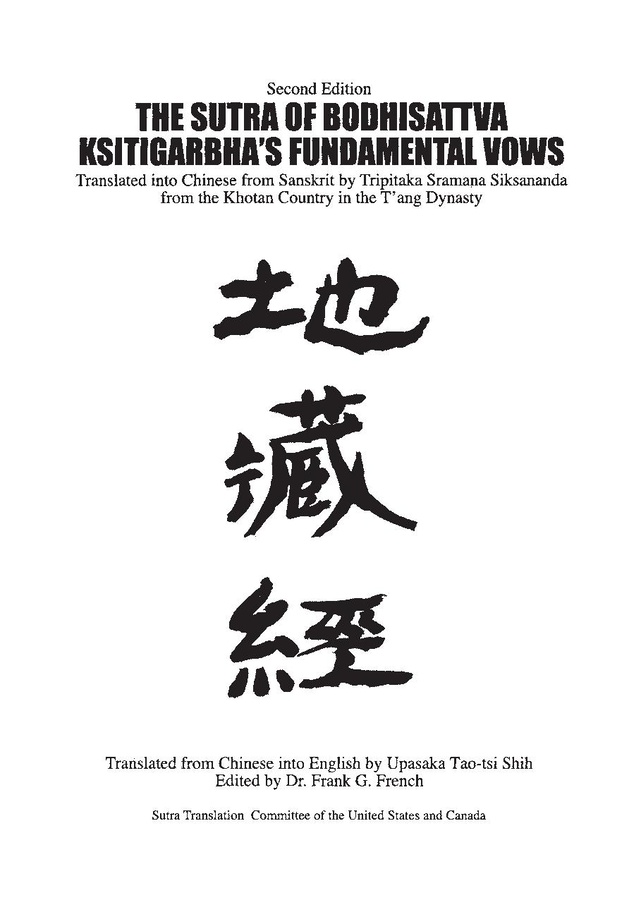
The Sutra of Bodhisattva Ksitigarbha's Fundamental Vows: Translated into Chinese from Sanskrit by Tripitaka Sramana Siksananda from the Khotan Country in the T'ang Dynasty
Book
Please note that many items in our library are simply pages that represent a detailed library catalog entry and citation of someone else's work, presentation, or performance. Read our General Disclaimer for more information.

Description
Kṣitigarbhasūtra. (C. Dizang pusa benyuan jing; J. Jizō bosatsu hongangyō; K. Chijang posal ponwǒn kyǒng 地藏菩薩本願經. In Sanskrit, "The Scripture on Kṣitigarbha," now extant only in a Chinese translation (which may be rendered as "Scripture on the Original Vows of Kṣitigarbha Bodhisattva") made by the Khotanese monk Śikṣānanda between 695 and 700 CE. The Chinese recension is in a total of thirteen chapters, which are divided into three sections. The sūtra is presented as a dialogue between Śākyamuni Buddha and Kṣitigarbha before a congregation of buddhas, bodhisattvas, divinities, and ghosts. The sūtra describes Kṣitigarbha's vow to save all beings from saṃsāra before becoming a buddha himself and offers various accounts of his prior births, during which he exhibited the uncanny ability to save beings from rebirth in the Avīci hell. For example, in one prior-birth story, the bodhisattva is portrayed as a young girl mourning the death of her non-Buddhist mother; through the girl’s filial devotion, her mother was rescued from avīci hell and reborn in one of the heavens. Another chapter outlines the far-reaching effects of Kṣitigarbha's vows, by demonstrating that even beings suffering in different hells (the attributes of which are described in vivid detail in the sūtra) were rescued by various other transformations of Kṣitigarbha. Some chapters also detail proper religious behavior: for example, in one chapter, Śākyamuni Buddha outlines in detail the ways one should pray to Kṣitigarbha, while in another is delineated the appropriate actions for honoring and benefiting the dead and the dying. (Source: "Kṣitigarbhasūtra." In The Princeton Dictionary of Buddhism, 448–49. Princeton University Press, 2014. http://www.jstor.org/stable/j.ctt46n41q.27.)
Citation
Shih, Tao-tsi, trans. The Sutra of Bodhisattva Ksitigarbha's Fundamental Vows: Translated into Chinese from Sanskrit by Tripitaka Sramana Siksananda from the Khotan Country in the T'ang Dynasty. 2nd ed. Edited by Frank G. French. Dharma Series 2. New York: Sutra Translation Committee of the United States and Canada, 2000. http://ftp.budaedu.org/ebooks/pdf/EN123.pdf.
Table of contents
- Prefacei
- Preface to the Second Editionvii
- Acknowledgmentsix
- Chapter 1: Miracles in the Palace of the Trayastrimsas Heaven1
- Chapter 2: The Assembly of Innumerable Transformational Ksitigarbhas12
- Chapter 3: Contemplation on the Karmic Connection Between Sentient Beings16
- Chapter 4: The Karmic Retribution of Sentient Beings in Jambudvipa22
- Chapter 5: The Names of the Various Hells33
- Chapter 6: Tathagata's Praises37
- Chapter 7: Benefitting the Living and the Dead47
- Chapter 8: The Praises of Yamaraja and Others53
- Chapter 9: The Recitation of the Buddhas' Names61
- Chapter 10: Appraisal of the Meritorious Virtue Gained from Almsgiving65
- Chapter 11: Protection of the Dharma by the Deities in Charge of the Land70
- Chapter 12: The Benefits of Seeing and Hearing73
- Chapter 13: The Commendation of Human Beings and Devas87
- Transfer-of-Merit Vow (Parinamana) for All Donors94
Interconnections
1 Full translation of

Kṣitigarbhasūtra. (C. Dizang pusa benyuan jing; J. Jizō bosatsu hongangyō; K. Chijang posal ponwǒn kyǒng 地藏菩薩本願經. In Sanskrit, "The Scripture on Kṣitigarbha," now extant only in a Chinese translation (which may be rendered as "Scripture on the Original Vows of Kṣitigarbha Bodhisattva") made by the Khotanese monk Śikṣānanda between 695 and 700 CE. The Chinese recension is in a total of thirteen chapters, which are divided into three sections. The sūtra is presented as a dialogue between Śākyamuni Buddha and Kṣitigarbha before a congregation of buddhas, bodhisattvas, divinities, and ghosts. The sūtra describes Kṣitigarbha's vow to save all beings from saṃsāra before becoming a buddha himself and offers various accounts of his prior births, during which he exhibited the uncanny ability to save beings from rebirth in the Avīci hell. For example, in one prior-birth story, the bodhisattva is portrayed as a young girl mourning the death of her non-Buddhist mother; through the girl’s filial devotion, her mother was rescued from avīci hell and reborn in one of the heavens. Another chapter outlines the far-reaching effects of Kṣitigarbha's vows, by demonstrating that even beings suffering in different hells (the attributes of which are described in vivid detail in the sūtra) were rescued by various other transformations of Kṣitigarbha. Some chapters also detail proper religious behavior: for example, in one chapter, Śākyamuni Buddha outlines in detail the ways one should pray to Kṣitigarbha, while in another is delineated the appropriate actions for honoring and benefiting the dead and the dying. (Source: "Kṣitigarbhasūtra." In The Princeton Dictionary of Buddhism, 448–49. Princeton University Press, 2014. http://www.jstor.org/stable/j.ctt46n41q.27.)