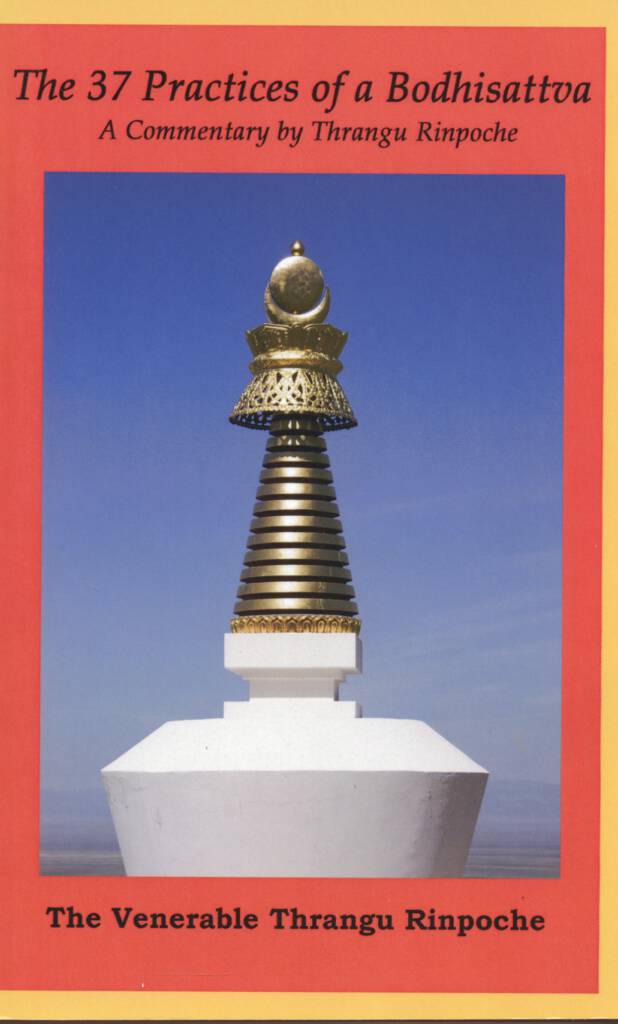
The 37 Practices of a Bodhisattva (Thrangu Rinpoche 2020)
From Bodhicitta
< BooksBooks/The 37 Practices of a Bodhisattva (Thrangu Rinpoche 2020)
| 🤓 Admin Zone 🛠️ hidden to non-admins | |
The 37 Practices of a Bodhisattva of Ngülchu Thogme: A Commentary by Thrangu Rinpoche
Book
Please note that many items in our library are simply pages that represent a detailed library catalog entry and citation of someone else's work, presentation, or performance. Read our General Disclaimer for more information. You can find more information about this item on the publisher website.
-front.jpg)
Description
In this book the great practitioner, Tokme Zangpo, condensed these teachings on the Bodhisattva's way into 37 profound verses. Each verse is short and many monks have memorized these verses to remind them when they have strayed from the path of compassion and Bodhichitta. This teaching covers relative and ultimate Bodhichitta, meditation and practice, abandoning the disturbing emotions, and the practice of the six paramitas. (Source: Namo Buddha Publications)
Citation
Thrangu Rinpoche. The 37 Practices of a Bodhisattva of Ngülchu Thogme: A Commentary by Thrangu Rinpoche. Translated by Yeshe Gyamtso and Michele Martin. n.p.: Namo Buddha Publications, 2020.
Publisher Link
Table of contents
- Foreword 1
- The Root Text 5
- 1. Introduction to the Text 13
- A. The Homage 13
- B. The Expression of Veneration 15
- C. The Reason for Composing This Text 18
- 2. The Preliminaries 21
- 3. The Main Practice 41
- A. The Path for the Lesser Individual 41
- B. The Path for the Average Individual 43
- C. The Path for the Superior Individual 44
- 4. Cultivating Relative Bodhichitta 49
- A. Exchanging Oneself for Others 49
- B. Post-Meditation of Relative Bodhichitta 50
- 5. Cultivating Absolute Bodhichitta 69
- A. The Meditation of Absolute Bodhichitta 69
- B. The Post-Meditation of Absolute Bodhichitta 74
- 6. Cultivating Relative and Absolute Bodhichitta 77
- A. The Six Paramitas 77
- B. The Four Things to be Trained In 87
- 7. How to Abandon Disturbing Emotions 95
- A. Benefits of Mindfulness and Attentiveness 98
- 8. The Conclusion 103
- A. The Dedication 111
- B. The Colophon 112
- Glossary 117
- Glossary of Tibetan Terms 125
- Bibliography 127
- Index 129
Interconnections
1 Full translation of

Gyalse Tokme Zangpo's (1295–1369) highly influential work on Mind Training (blo sbyong) that outlines the training of a bodhisattva in a series of thirty-seven verses is still very popular today with Buddhist practitioners around the world. The colophon states: "This was composed at the Jewel Cave of Ngulchu by the monk Tokme [Zangpo], expounder of scripture and reasoning, for the benefit of myself and others." Since he gathered together all the paths of the bodhisattvas and composed them in the form of thirty-seven verses, the title is clearly fitting.
1 Modern commentary of
Gyalse Tokme Zangpo's (1295–1369) highly influential work on Mind Training (blo sbyong) that outlines the training of a bodhisattva in a series of thirty-seven verses is still very popular today with Buddhist practitioners around the world. The colophon states: "This was composed at the Jewel Cave of Ngulchu by the monk Tokme [Zangpo], expounder of scripture and reasoning, for the benefit of myself and others." Since he gathered together all the paths of the bodhisattvas and composed them in the form of thirty-seven verses, the title is clearly fitting.