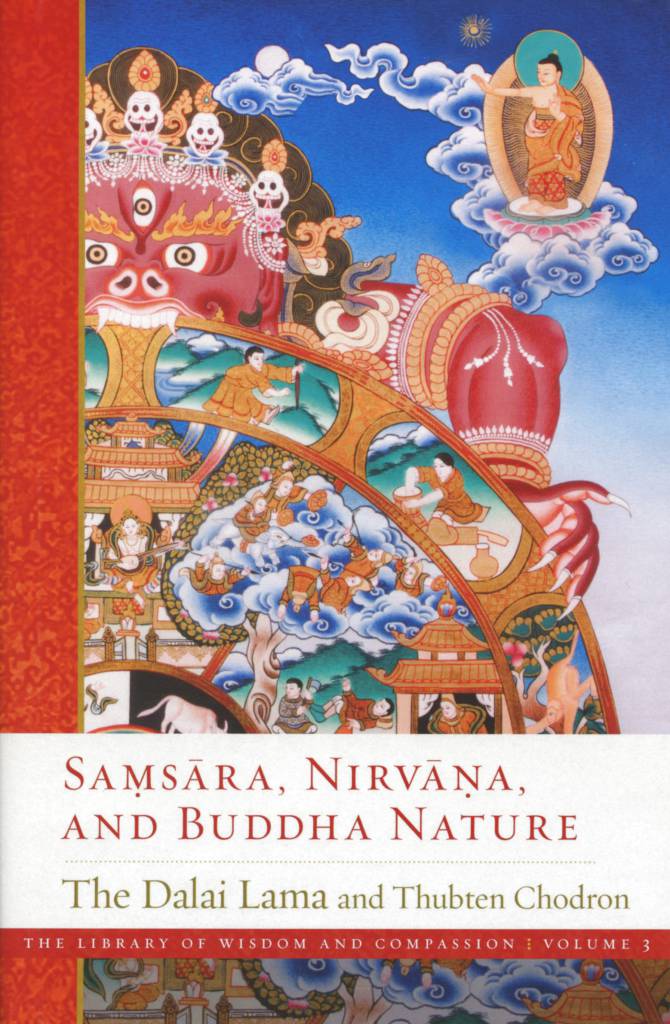
Saṃsāra, Nirvāṇa, and Buddha Nature
From Bodhicitta
< Books
Books/Saṃsāra, Nirvāṇa, and Buddha Nature| 🤓 Admin Zone 🛠️ hidden to non-admins | |
Saṃsāra, Nirvāṇa, and Buddha Nature
Book
Please note that many items in our library are simply pages that represent a detailed library catalog entry and citation of someone else's work, presentation, or performance. Read our General Disclaimer for more information. You can find more information about this item on the publisher website.

Description
Knowledge of buddha nature reveals and reconciles the paradox of how the mind can be the basis for both the duhkha of samsara (the unpurified mind) and the bliss and fulfillment of nirvana (the purified mind). To illustrate this, Saṃsāra, Nirvāṇa, and Buddha Nature first takes readers through Buddhist thought on the self, the four truths, and their sixteen attributes. It then explains afflictions—including how they arise and their antidotes—followed by an examination of karma and cyclic existence, and, finally, a deep and thorough elucidation of buddha nature. Saṃsāra, Nirvāṇa, and Buddha Nature shows us how to purify our minds and cultivate awakened qualities.
This is the third volume in the Dalai Lama’s definitive and comprehensive series on the stages of the Buddhist path, The Library of Wisdom and Compassion. Volume 1, Approaching the Buddhist Path,contains introductory material that sets the context for Buddhist practice. Volume 2, The Foundation of Buddhist Practice, describes the important teachings that help us establish a flourishing Dharma practice. Saṃsāra, Nirvāṇa, and Buddha Nature can be read as the logical next step in this series or enjoyed on its own. (Source: Wisdom Publications)
Citation
Dalai Lama, 14th, and Thubten Chodron. Saṃsāra, Nirvāṇa, and Buddha Nature. Library of Wisdom and Compassion 3. Somerville, MA: Wisdom Publications, 2018.
Publisher Link
Table of contents
- Preface by Bhikṣuṇī Thubten Chodronxiii
- Abbreviationsxxi
- Introduction by His Holiness the Dalai Lamai
- 1. The Self, the Four Truths, and Their Sixteen Attributes5
- Three Questions about the Self5
- The Four Truths10
- The Coarse and Subtle Four Truths18
- The Sixteen Attributes of the Four Truths of Āryas19
- 2. Revolving in Cyclic Existence: The Truth of Duḥkha39
- Knowing Duḥkha for What It Is39
- Realms of Existence41
- Three Types of Duḥkha47
- Feelings, Afflictions, and Duḥkha50
- Six Disadvantages of Cyclic Existence51
- Eight Unsatisfactory Conditions53
- Examining True Duḥkha via Ten Points54
- Our Human Value57
- 3. True Origins of Duḥkha63
- The Six Root Afflictions64
- More Types ofDefilements87
- Afflictions88
- Underlying Tendencies88
- Auxiliary Afflictions92
- Fetters97
- Pollutants98
- Hindrances99
- 4. Afflictions, Their Arising, and Their Antidotes101
- Eighty-Four Thousand Afflictions101
- The Order in Which Afflictions Arise104
- Factors Causing Afflictions to Arise106
- Feelings That Accompany Afflictions109
- The Ethical Dimension of Afflictions110
- Counterforces to the Afflictions112
- Afflictions, Our Real Enemy119
- 5. Afflictions and Karma, Their Seeds and Latencies123
- Acquired and Innate Afflictions124
- Coarse and Subtle Afflictions126
- Seeds, Latencies, and Having-Ceased126
- Latencies and Ideas in Other Religions and in Psychology135
- Virtue, Nonvirtue, Merit, and Roots of Virtue137
- 6. Karma, the Universe, and Evolution141
- The Origin of the Universe141
- Mind and the External World144
- The Laws of Nature and the Law of Karma and Its Effects148
- Karma and Our Present Environment150
- Karma, Instinctual Behavior, and Our Bodies152
- 7. Revolving in Cyclic Existence: The Twelve Links of Dependent Origination155
- Dependent Arising156
- How Cyclic Existence Occurs158
- 1. Ignorance (avidyā)159
- 2. Formative Action (saṃskāra karman)165
- 3. Consciousness (vijñāna)168
- 4. Name and Form (nāma-rūpa)170
- 3. Six Sources (ṣaḍāyatana)172
- 6. Contact (sparśa)176
- 7. Feeling (vedanā)176
- 8. Craving (tṛṣṇā)179
- 9. Clinging (upādanā)182
- 10. Renewed Existence (bhava)183
- 11. Birth (jāti)188
- 12. Aging or Death (jarāmaraṇa)190
- 8. Dependent Origination: Cycling in Saṃsāra193
- How the Twelve Links Produce a Life193
- An Example197
- Flexibility200
- Pali Tradition: How We Cycle200
- An Example from a Pāli Sūtra202
- Who Revolves in Cyclic Existence?204
- The Ultimate Nature of the Twelve Links211
- 9. The Determination to Be Free217
- The Benefits of Meditating on the Twelve Links217
- Invigorating a Dry Dharma Practice219
- Can a Leper Find Happiness?222
- Compassion for Ourselves and Others223
- The Demarcation of Generating the Determination to Be Free227
- 10. Seeking Genuine Peace231
- The "Ye Dharmā" Dhāraṇī232
- Forward and Reverse Orders of the Afflictive and Purified Sides of the Twelve Links234
- Transcendental Dependent Origination (Pāli Tradition)238
- Karma in Samsara and Beyond249
- 11. Freedom from Cyclic Existence233
- Stages Leading to Liberation and Full Awakening254
- The Two Obscurations259
- Nirvāṇa262
- Pāli Tradition: Nirvāṇa266
- Bodhi274
- 12. The Mind and Its Potential277
- The Mind's Potential277
- Is Liberation Possible?279
- Excellent Qualities Can Be Cultivated Limitlessly281
- Afflictive Mental States and the Nature of the Mind283
- The Equality of Saṃsāra and Nirvāṇa284
- Levels of Mind286
- 13. Buddha Nature291
- The Mind's Potential according to the Pāli Tradition291
- Ārya Disposition according to the Vaibhāṣikas and Sautrāntikas292
- Buddha Nature according to the Cittamātra School293
- Buddha Nature according to the Madhyamaka School296
- Buddha Nature according to Tantra301
- Nine Similes for Tathāgatagarbha302
- Three Aspects of the Tathāgatagarbha310
- Three Aspects ofBuddha Disposition314
- A Puzzle315
- 14. Going Deeper into Buddha Nature319
- The Three Turnings of the Dharma Wheel and Buddha Nature319
- A Link between Sūtra and Tantra322
- Nothing Is to Be Removed325
- The Capacity Giving Rise to the Three Kāyas327
- A Buddha's Nature Dharmakāya328
- Pristine Wisdom Abiding in the Afflictions330
- Causal Clear Light Mind332
- What Continues to Awakening?332
- Dzogchen and Mahāmudrā334
- Are We Already Buddhas?337
- Awareness of Our Buddha Nature Eliminates Hindrances341
- 1. The Self, the Four Truths, and Their Sixteen Attributes5
- Notes343
- Glossary353
- Further Reading367
- Index371
- About the Authors409
Interconnections