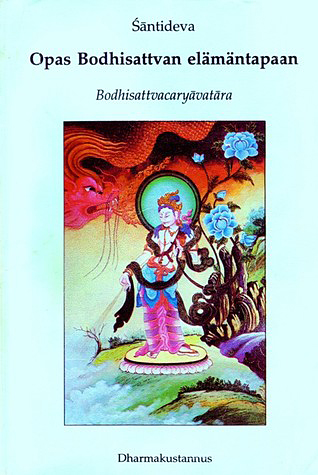
Opas Bodhisattvan Elämäntapaan (Bodhisattvacaryāvatāra)
From Bodhicitta
< Books
Books/Opas Bodhisattvan Elämäntapaan (Bodhisattvacaryāvatāra)| 🤓 Admin Zone 🛠️ hidden to non-admins | |
Opas Bodhisattvan Elämäntapaan (Bodhisattvacaryāvatāra)
Book
Please note that many items in our library are simply pages that represent a detailed library catalog entry and citation of someone else's work, presentation, or performance. Read our General Disclaimer for more information. You can find more information about this item on the publisher website.
-front.jpg)
Description
A classic work that has been the masterpiece of both Mahāyāna and Vajrayāna Buddhist practitioners for centuries. Its author was an Indian learned monk from the University of Nālanda, Śāntideva. The work is poetic and provides practical instructions for the journey towards enlightenment and a happier, more balanced life. (Source Accessed Mar 19, 2021)
Citation
Halso, Jukka, trans. Opas Bodhisattvan Elämäntapaan (Bodhisattvacaryāvatāra). By Śāntideva. (In Finnish.) Edited by Pekka Airaksinen and Jukka Halso. Alastaro, Finland: Dharmakustannus, 1993. http://www.dharmakeskus.fi/bodhi/sisalto.htm.
Publisher Link
Table of contents
Luku 1. Valaistumismielen tuoma hyöty
Luku 2. Taitamattomuuden paljastaminen
Luku 3. Valaistumismielen täysi omaksuminen
Luku 4. Tunnollisuus
Luku 5. Valppauden vartioiminen
Luku 6. Kärsivällisyys
Luku 7. Tarmokkuus
Luku 8. Meditaatio
Luku 9. Viisaus
Luku 10. Omistus
Jälkisana
Interconnections
1 Full translation of

An "Introduction to Bodhisattva Practice," the Bodhisattvacaryāvatāra is a poem about the path of a bodhisattva, in ten chapters, written by the Indian Buddhist Śāntideva (fl. c. 685–763). One of the masterpieces of world literature, it is a core text of Mahāyāna Buddhism and continues to be taught, studied, and commented upon in many languages and by many traditions around the world. The main subject of the text is bodhicitta, the altruistic aspiration for enlightenment, and the path and practices of the bodhisattva, the six perfections (pāramitās). The text forms the basis of many contemporary discussions of Buddhist ethics and philosophy.