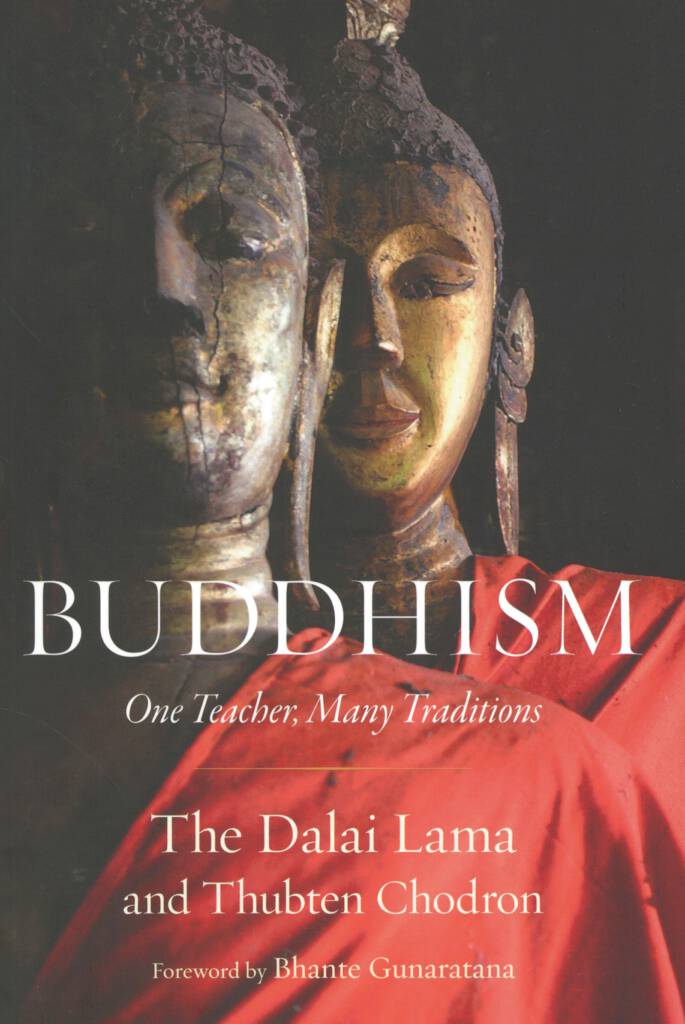
Buddhism: One Teacher, Many Traditions (14th Dalai Lama and Chodron 2014)
From Bodhicitta
< BooksBooks/Buddhism: One Teacher, Many Traditions (14th Dalai Lama and Chodron 2014)
| 🤓 Admin Zone 🛠️ hidden to non-admins | |
Buddhism: One Teacher, Many Traditions
Book
Please note that many items in our library are simply pages that represent a detailed library catalog entry and citation of someone else's work, presentation, or performance. Read our General Disclaimer for more information.
-front.jpg)
Description
Buddhism is practiced by hundreds of millions of people worldwide, from Tibetan caves to Tokyo temples to redwood retreats. To an outside viewer, it might be hard to see what they all have in common. In Buddhism, His Holiness the Dalai Lama and American Buddhist nun Thubten Chodron map out with clarity the convergences and the divergences between the two major strains of Buddhism—the Sanskrit traditions of Tibet and East Asia and the Pali traditions of Sri Lanka and Southeast Asia. Especially deep consideration is given to the foundational Indian traditions and their respective treatment of such central tenets as:
The four noble truths
The practice of meditation
The meaning of nirvana
Enlightenment
The authors seek harmony and greater understanding among Buddhist traditions worldwide, illuminating the rich benefits of respectful dialogue and the many ways that Buddhists of all stripes share a common heritage and common goals. (Source: Wisdom Publications)
Citation
Dalai Lama, 14th, and Thubten Chodron. Buddhism: One Teacher, Many Traditions. Somerville, MA: Wisdom Publications, 2014.
Table of contents
- Foreword by Bhante Gunaratanaxiii
- Prologue by His Holiness the Dalaixvii
- Lama Preface by Venerable Thubtenxix
- Chodron Abbreviationsxxiii
- 1. Origin and Spread of the Buddha's Doctrine1
- The Buddha's Life1
- Buddhist Canons and the Spread of the Dharma2
- Pāli Tradition4
- Buddhism in China7
- Buddhism in Tibet11
- Our Commonalities and Diversity13
- 1. Origin and Spread of the Buddha's Doctrine1
- 2. Refuge in the Three Jewels17
- Existence of the Three Jewels18
- The Tathāgata’s Qualities19
- Three Jewels: Pāli Tradition24
- Three Jewels: Sanskrit Tradition28
- Buddha’s Awakening, Parinirvāṇa, and Omniscience31
- Taking Refuge and Maintaining Proper Refuge35
- 2. Refuge in the Three Jewels17
- 3. Sixteen Attributes of the Four Truths39
- Sanskrit Tradition39
- Pāli Tradition49
- 3. Sixteen Attributes of the Four Truths39
- 4. The Higher Training in Ethical Conduct61
- The Importance of Ethical Conduct61
- Prātimokṣa Ethical Restraints62
- Why Celibacy?65
- The Vinaya Schools66
- The Value of the Monastic Community70
- Fulfilling the Purpose of Monastic Life72
- Monastics, Priests, and Lay Teachers74
- Tibetan Monastics and Monastic Institutions75
- Challenges for Western Monastics76
- Full Ordination for Women77
- Advice for Monastics79
- The Joy of Monastic Discipline80
- Bodhisattva and Tantric Ethical Restraints81
- 4. The Higher Training in Ethical Conduct61
- 5. The Higher Training in Concentration83
- The Importance of Concentration83
- Realms of Existence and Spheres of Consciousness84
- Pāli Tradition85
- Five Hindrances and Five Absorption Factors88
- Four Jhānas91
- Four Immaterial Absorptions95
- Eight Meditative Liberations97
- Superknowledges97
- Sanskrit Tradition101
- Meditation Position and Meditation Objects103
- Five Faults and Eight Antidotes106
- Nine Stages of Sustained Attention108
- Serenity and Further Meditative Absorptions110
- Chinese Buddhism113
- 5. The Higher Training in Concentration83
- 6. The Higher Training in Wisdom: Thirty-Seven Aids to Awakening115
- Four Establishments of Mindfulness116
- Mindfulness of the Body118
- Mindfulness of Feelings121
- Mindfulness of the Mind122
- Mindfulness of Phenomena125
- Four Establishments of Mindfulness for Bodhisattvas127
- Four Supreme Strivings128
- Four Bases of Supernormal Power128
- Five Faculties and Five Powers129
- Seven Awakening Factors130
- The Noble Eightfold Path131
- Conventional and Ultimate Natures of the Thirty-Seven Aids132
- 6. The Higher Training in Wisdom: Thirty-Seven Aids to Awakening115
- 7. Selflessness and Emptiness135
- Pāli Tradition: The Self and the Aggregates136
- Madhyamaka: The Object of Negation139
- Seven-Point Refutation141
- Six Elements Are Not the Self144
- Refutation of Four Extremes of Arising148
- Selfless and Deceptive156
- Emptiness158
- What Carries the Karma?160
- 7. Selflessness and Emptiness135
- 8. Dependent Arising163
- Twelve Links of Dependent Arising163
- Flow of the Links170
- Who Circles in Saṃsāra?173
- Benefits of Meditating on the Twelve Links of Dependent Arising175
- Sanskrit Tradition: Levels of Dependence176
- Causal Dependence177
- Mutual Dependence177
- Mere Dependent Designation179
- Emptiness and Dependent Arising Are Compatible180
- Pāli Tradition: Terms, Concepts, and Conventions182
- 8. Dependent Arising163
- 9. Uniting Serenity and Insight185
- Pāli Tradition185
- Sanskrit Tradition188
- Chinese Buddhism190
- 9. Uniting Serenity and Insight185
- 10. Progressing on the Path193
- Pāli Tradition: Purification and Knowledge193
- Sanskrit Tradition: Five Paths and Ten Bodhisattva Grounds198
- Differences among the Three Vehicles201
- Sanskrit Tradition: Nirvāṇa201
- Pāli Tradition: Nibbāna204
- 10. Progressing on the Path193
- 11. The Four Immeasurables207
- Pāli Tradition207
- Love209
- Compassion213
- Joy215
- Equanimity215
- Four Immeasurables and Insight216
- Near and Far Enemies217
- Sanskrit Tradition218
- 11. The Four Immeasurables207
- 12. Bodhicitta221
- Tibetan Buddhism221
- Equanimity222
- Sevenfold Cause-and-Effect Instruction223
- Equalizing and Exchanging Self and Others224
- Self-Interest, Self-Confidence, Self-Centered Attitude, and Self-Grasping Ignorance228
- Integrating the View with Bodhicitta229
- Chinese Buddhism230
- Four Great Vows233
- Aspiring and Engaging Bodhicitta235
- Pāli Tradition: Bodhicitta and Bodhisattas237
- 12. Bodhicitta221
- 13. Bodhisattva Training in the Perfections243
- Sanskrit Tradition243
- Pāli Tradition: Ten Pāramīs246
- Perfection of Generosity249
- Perfection of Ethical Conduct251
- Perfection of Fortitude253
- Perfection of Joyous Effort256
- Perfections of Meditative Stability and of Renunciation259
- Perfection of Wisdom259
- Perfections of Unshakable Resolve and of Determination262
- Perfections of Skillful Means, Power, and Exalted Wisdom263
- Pāramīs of Truthfulness, Love, and Equanimity264
- The Four Ways of Gathering Disciples265
- 13. Bodhisattva Training in the Perfections243
- 14. The Possibility of Awakening and Buddha Nature269
- Is Liberation Possible?269
- Pāli Tradition: Luminous Mind271
- Yogācāra School: Buddha Nature272
- Madhyamaka School: Buddha Nature273
- Tantrayāna: Buddha Nature275
- Chan: Buddha Nature, Bodhicitta, and True Suchness276
- Understanding Tathāgatagarbha278
- 14. The Possibility of Awakening and Buddha Nature269
- 16. Conclusion287
- Notes291
- Index293
- About the Authors321
Interconnections
1 Teachings

Thubten Chodron guides viewers through her book, Buddhism: One Teacher, Many Traditions in this video series produced by Sravasti Abbey. This talk addressing Chapter 14 discusses buddha-nature by way of emptiness. Venerable Thubten Chodron presents that emptiness is the reason that the mind's afflictions and obscurations can be purified and that purification process reveals buddha-nature inherent in the minds of all beings.
1 Related
Thubten Chodron guides viewers through her book, Buddhism: One Teacher, Many Traditions in this video series produced by Sravasti Abbey. This talk addressing Chapter 14 discusses buddha-nature by way of emptiness. Venerable Thubten Chodron presents that emptiness is the reason that the mind's afflictions and obscurations can be purified and that purification process reveals buddha-nature inherent in the minds of all beings.