| 🤓 Admin Zone 🛠️ hidden to non-admins | |
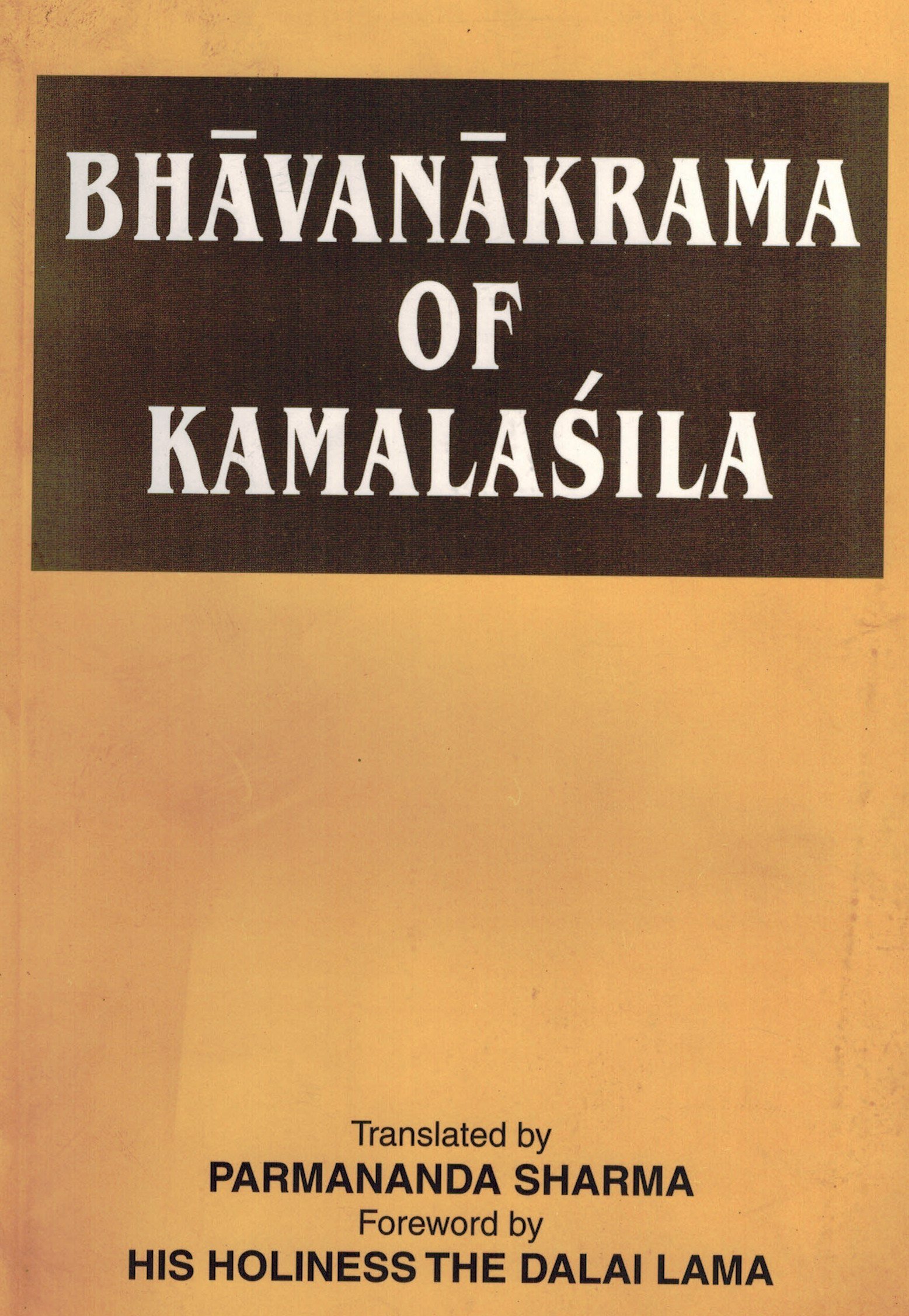
Bhāvanākrama of Kamalaśila
Book
Please note that many items in our library are simply pages that represent a detailed library catalog entry and citation of someone else's work, presentation, or performance. Read our General Disclaimer for more information.

Description
Kamalaśīla is one of those distinguished acharyas who went to Tibet from India, stayed there and wrote scholarly treatises on Buddha dharma. The present work is the first-ever English rendering from original Sanskrit, suggested by the Dalai Lama. Amazon.com
Citation
Sharma, Parmananda, trans. Bhāvanākrama of Kamalaśila. New Delhi: Aditya Prakashan, 2004. First published 1997 by Aditya Prakashan (New Delhi).
Table of contents
- 1. Introduction9
- 2. Bhāvanākrama-I13
- 3. Bhāvanākrama-II51
- 4. Bhāvanākrama-III77
- 5. Glossary-II101
- 6. Glossary-II117
- 7. Glossary-III123
Interconnections
3 Full translation of

[I]n the first Bhāvanākrama, Kamalaśīla sets forth the three forms of wisdom (prajñā): the wisdom derived from learning (śrutamayīprajñā), the wisdom derived from reflection (cintāmayīprajñā), and the wisdom derived from cultivation (bhāvanāmayīprajñā), explaining that the last of these gradually destroys the afflictive obstructions (kleśāvaraṇa) and the obstructions to omniscience (jñeyāvaraṇa). (Source: "Bhāvanākrama." In The Princeton Dictionary of Buddhism, 113. Princeton University Press, 2014. http://www.jstor.org/stable/j.ctt46n41q.27.)
The second Bhāvanākrama considers many of [the] same topics [as the first], stressing that the achievement of the fruition of buddhahood requires the necessary causes, in the form of the collection of merit (puṇyasaṃbhāra) and the collection of wisdom (jñānasaṃbhāra). Both the first and second works espouse the doctrine of mind only (cittamātra); it is on the basis of these and other statements that Tibetan doxographers classified Kamalaśīla as a Yogācāra-Svātantrika-Madhyamaka. (Source: "Bhāvanākrama." In The Princeton Dictionary of Buddhism, 112–13. Princeton University Press, 2014. http://www.jstor.org/stable/j.ctt46n41q.27.)
The third and briefest of the Bhāvanākrama is devoted especially to the topics of śamatha and vipaśyanā, how each is cultivated, and how they are ultimately unified. Kamalaśīla argues that analysis (vicāra) into the lack of self (ātman) in both persons (pudgala) and phenomena (dharma) is required to arrive at a nonconceptual state of awareness. The three texts are widely cited in later Tibetan Buddhist literature, especially on the process for developing śamatha and vipaśyanā. (Source: "Bhāvanākrama." In The Princeton Dictionary of Buddhism, 112–13. Princeton University Press, 2014. http://www.jstor.org/stable/j.ctt46n41q.27.)