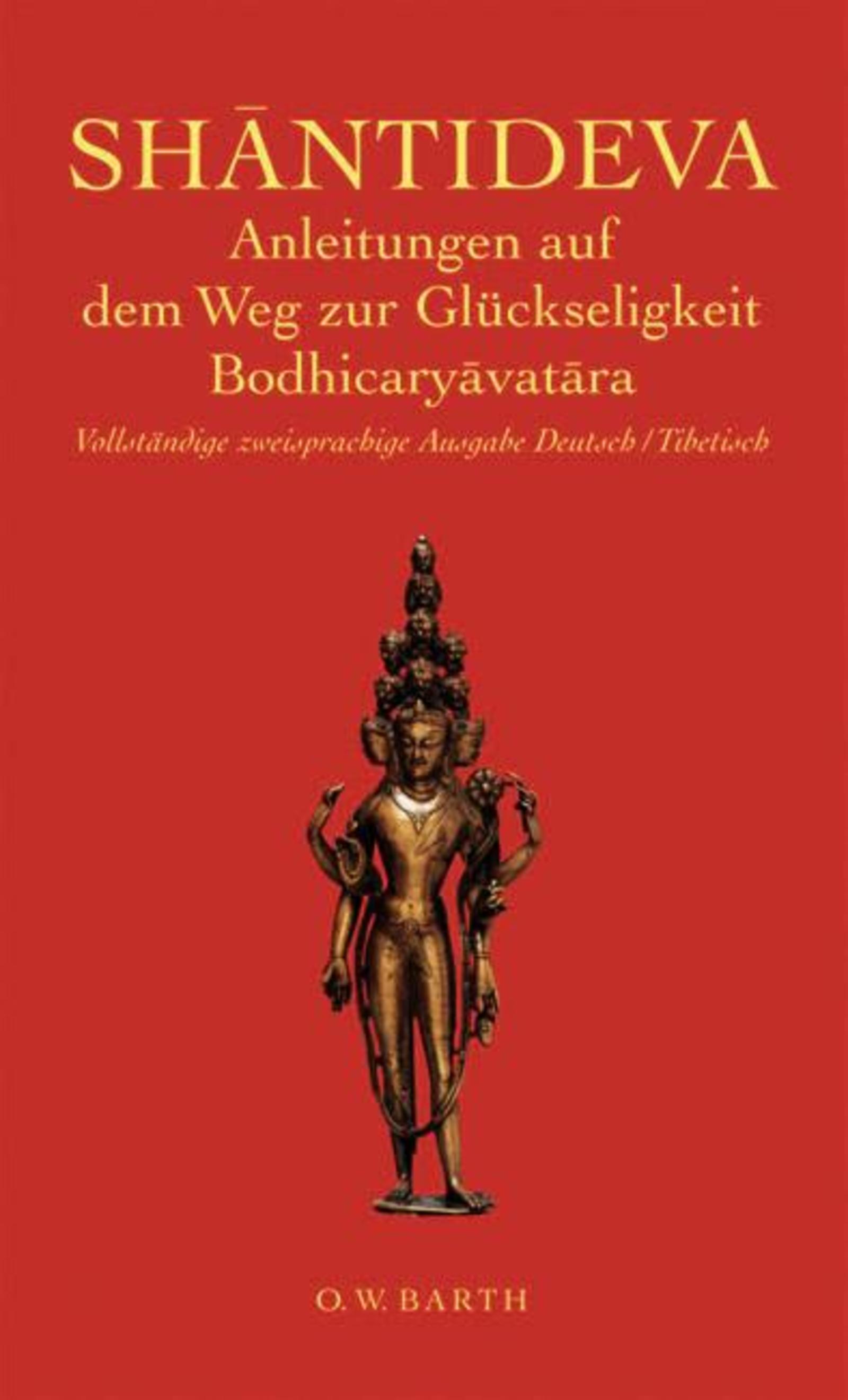
Anleitungen auf dem Weg zur Glückseligkeit: Bodhicaryāvatāra
From Bodhicitta
< Books
Books/Anleitungen auf dem Weg zur Glückseligkeit: Bodhicaryāvatāra| 🤓 Admin Zone 🛠️ hidden to non-admins | |
Anleitungen auf dem Weg zur Glückseligkeit: Bodhicaryāvatāra
Book
See Timeline of BCA Translations
- Anleitungen auf dem Weg zur Glückseligkeit: Bodhicaryāvatāra
- Der Eintritt in den Wandel in Erleuchtung
- Die Lebensführung im Geiste der Erleuchtung: Das Bodhisattvacharyavatara
- Nichtselbst, Leerheit und Altruistische Ethik im Bodhicaryāvatāra (Lecture Transcript)
- Nichtselbst, Leerheit und Altruistische Ethik im Bodhicaryāvatāra (Official Publication)
Please note that many items in our library are simply pages that represent a detailed library catalog entry and citation of someone else's work, presentation, or performance. Read our General Disclaimer for more information.

Description
This original translation of one of the most important texts of Buddhism, authorized by the Dalai Lama, reveals the work of the king's son and monk Shantideva from the 8th century in all its linguistic power and philosophical depth. It describes in an exemplary way the career and work of a Bodhisattva, a person who devotes all his strength to the welfare of all living beings. (Source: Droemer Knaur Publishing Group)
Citation
Hangartner, Diego, trans. Anleitungen auf dem Weg zur Glückseligkeit: Bodhicaryāvatāra. By Shāntideva. Frankfurt am Main, Germany: O.W. Barth, 2005.
Interconnections
1 Full translation of

An "Introduction to Bodhisattva Practice," the Bodhisattvacaryāvatāra is a poem about the path of a bodhisattva, in ten chapters, written by the Indian Buddhist Śāntideva (fl. c. 685–763). One of the masterpieces of world literature, it is a core text of Mahāyāna Buddhism and continues to be taught, studied, and commented upon in many languages and by many traditions around the world. The main subject of the text is bodhicitta, the altruistic aspiration for enlightenment, and the path and practices of the bodhisattva, the six perfections (pāramitās). The text forms the basis of many contemporary discussions of Buddhist ethics and philosophy.